
TL;DR:
- Milan offers more predictable rental yields due to steady corporate demand and fewer regulatory hurdles. Rome provides prestige and long-term appreciation, especially in historic areas with tourism-driven returns. Local expertise and buyer-side representation are crucial when investing remotely in either city.
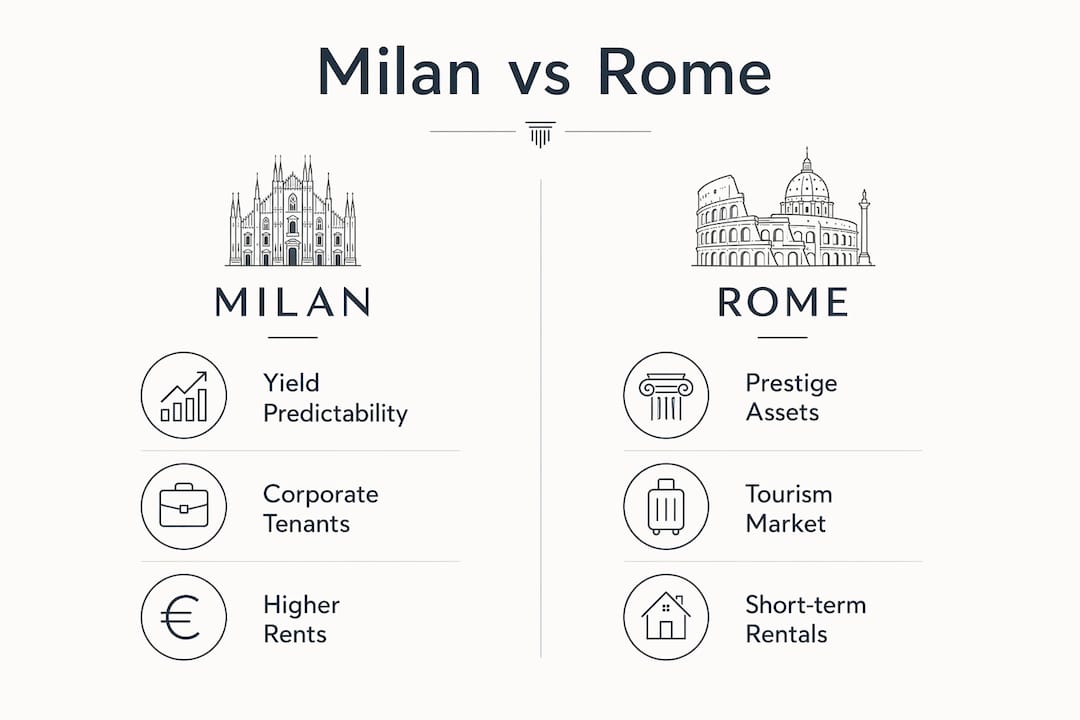
For US buyers who want predictable rental income and simpler remote management, Milan is usually the stronger choice. Rome wins for cultural prestige, tourism-driven returns, and long-term capital appreciation on carefully selected historic addresses. The right answer depends almost entirely on what you need the property to do.
Choose Milan if you want corporate and expatriate tenants, steadier occupancy, and fewer regulatory headaches. Milan operates as Italy’s primary hub for business and international finance, which produces more consistent professional-class demand year-round.

Choose Rome if you’re targeting tourism-linked short-term rentals, prestige positioning, or a trophy asset in one of the world’s most recognized cities. Rome draws more than 35 million visitors annually, and the right address in the historic core can appreciate significantly over time.
Consider both if you’re building a portfolio and want to diversify across demand profiles. The Frecciarossa connects the two cities in roughly three hours, making a dual-city strategy logistically viable.
On price, Numbeo’s comparative data shows Milan’s rent prices run noticeably higher than Rome’s across comparable categories, so entry costs and holding costs differ meaningfully between the two markets.
One practical note: whichever city you choose, buyer-side representation from a firm like Livingitaly reduces the execution risk that catches most US buyers off guard.
Table of Contents
How Livingitaly Helps You Execute in Either Market
Deciding between Milan and Rome is step one. Getting the transaction right from 5,000 miles away is the harder part, and that’s exactly where Livingitaly’s buyer-side advisory earns its place.
Livingitaly handles the full acquisition chain: property sourcing, legal due diligence, tax and SPV structuring, restoration project management, and ongoing property management once you close. For Rome specifically, the team brings local expertise on conservation mandates and Soprintendenza requirements that routinely add a significant increase to renovation budgets when buyers go in unprepared. The Luxury Apartment in Rome Flaminio listing illustrates exactly the kind of premium, conservation-sensitive asset Livingitaly handles in the capital. For Milan, the focus shifts to transit-proximate units with modern energy certificates (APE) in corporate-demand neighborhoods like Porta Nuova and CityLife.
Three steps to get started:
- Schedule a needs assessment (typically one call): define your objective, budget, and timeline so the team can map the right city and neighborhood shortlist.
- Shortlist neighborhoods and listings: Livingitaly sources and vets options, handles viewings, and flags red flags before you commit to travel.
- Sign a buyer-side mandate: the formal engagement that puts Livingitaly legally on your side, not the seller’s.
- Fees are structured as a retainer plus a success component tied to closing, so incentives stay aligned throughout.
- Buyer-side representation matters especially in Rome, where local bureaucracy and conservation oversight create friction that remote buyers rarely anticipate.
Pro Tip: When vetting any buyer’s advocate or property manager in Italy, ask specifically how they handle Soprintendenza filings in Rome or APE certification in Milan. A vague answer is a red flag.
Explore Livingitaly’s investment advisory or Rome-specific services to see how the process maps to your situation, then book a discovery call to get a city-specific shortlist within two weeks.
Key Takeaways
Milan wins on yield predictability; Rome wins on prestige and tourism upside, but both cities require local expertise to execute safely from abroad.
| Point | Details |
|---|---|
| Milan for steady yield | Corporate and expatriate demand produces more predictable occupancy than Rome’s tourism-driven seasonality. |
| Rome for prestige and appreciation | Historic-core addresses offer strong long-term capital growth, but conservation rules routinely add a significant increase to renovation budgets—local expertise is essential to anticipate these costs. |
| Price gap is real | Milan rent prices run roughly 31% higher than Rome’s, affecting both entry cost and yield math. |
| Remote ownership needs support | Rome’s bureaucracy and conservation oversight make buyer-side representation especially critical for US buyers. |
| Livingitaly as your advocate | Livingitaly provides end-to-end buyer-side advisory for both Milan and Rome, from sourcing through closing and management. |