
TL;DR:
- The Italy investor visa allows non-EU nationals to obtain a renewable residence permit by investing at least €250,000 in qualifying Italian projects.
- The process requires careful structuring of investments, thorough documentation, and coordination with legal and banking experts to meet strict deadlines.
The Italy investor visa grants a renewable residence permit to non-EU nationals who direct qualifying capital into Italian government bonds, corporate equity, innovative startups, or philanthropic projects. For a U.S. investor, the fastest self-assessment is simple: do you have access to at least €250,000 and a clearly identified single investment target? If yes, you are in the right program. Once your application is complete, the IV4I Committee typically issues a decision within 30 days.
The qualifying investment categories are:
- Government bonds: a minimum investment
- Corporate shares or bonds: a minimum investment
- Innovative startups: a reduced minimum investment
- Philanthropic donations: a minimum charitable commitment
Your immediate next step: create your account on the IV4I portal and begin assembling source-of-funds documentation.
Table of Contents
- Who qualifies and what rights the visa actually grants
- What investment routes qualify and at what thresholds
- How the application process works, step by step
- Costs, U.S. tax obligations, and compliance you need to plan for
- Risks and due diligence for property and company investments
- How a buyer-side advisor like Livingitaly reduces your risk
- Your 30–90 day action checklist
- Key Takeaways
- What most investor-visa guides get wrong
- Livingitaly guides U.S. investors through every step
- Useful sources
- FAQ
Who qualifies and what rights the visa actually grants
The program targets natural persons over 18 with non-EU nationality who can demonstrate lawful origin of funds and direct capital into a single qualifying target. That last point matters more than most guides acknowledge.
The visa itself is a 2-year entry visa, converted on arrival into a 2-year residence permit. You can work or be self-employed in Italy, and you can bring qualifying family members under Italian family reunification rules. After maintaining lawful residence, you become eligible for a long-term EU residence permit and, eventually, Italian citizenship, though citizenship typically requires 10 years of continuous legal residence and language proficiency. The Italy investor visa is not a citizenship shortcut.
One genuine advantage for internationally mobile Americans: Italy imposes no minimum physical presence requirement to maintain the residence permit. You do not need to count days the way you would under many other programs.
Pro Tip: Start the source-of-funds paper trail at least six months before you plan to apply. Italian authorities and U.S. banks both require layered documentation, and gaps in the chain are the most common reason applications stall.
What investment routes qualify and at what thresholds
Direct property purchase alone does not qualify. The official thresholds are set by route, and each route has specific structural requirements.

| Investment Route | Minimum Threshold | Key Structural Requirement |
|---|---|---|
| Italian government bonds | €2 million | Held at an Italian-domiciled financial institution |
| Corporate shares or bonds | €500,000 | Single Italian company; cannot split across multiple |
| Innovative startup equity | €250,000 | Company must hold official “innovative startup” status |
| Philanthropic donation | €1 million | Approved cultural, scientific, or social project |
For property-focused investors, the path runs through corporate equity. If you invest in an Italian company that develops, acquires, or manages real estate, that equity stake can qualify under the €500,000 corporate route. An SPV (special purpose vehicle) structure is the most common mechanism. The policy guidance is explicit that certain collective investment funds do not qualify, and deposits must be held at an Italian-domiciled institution.
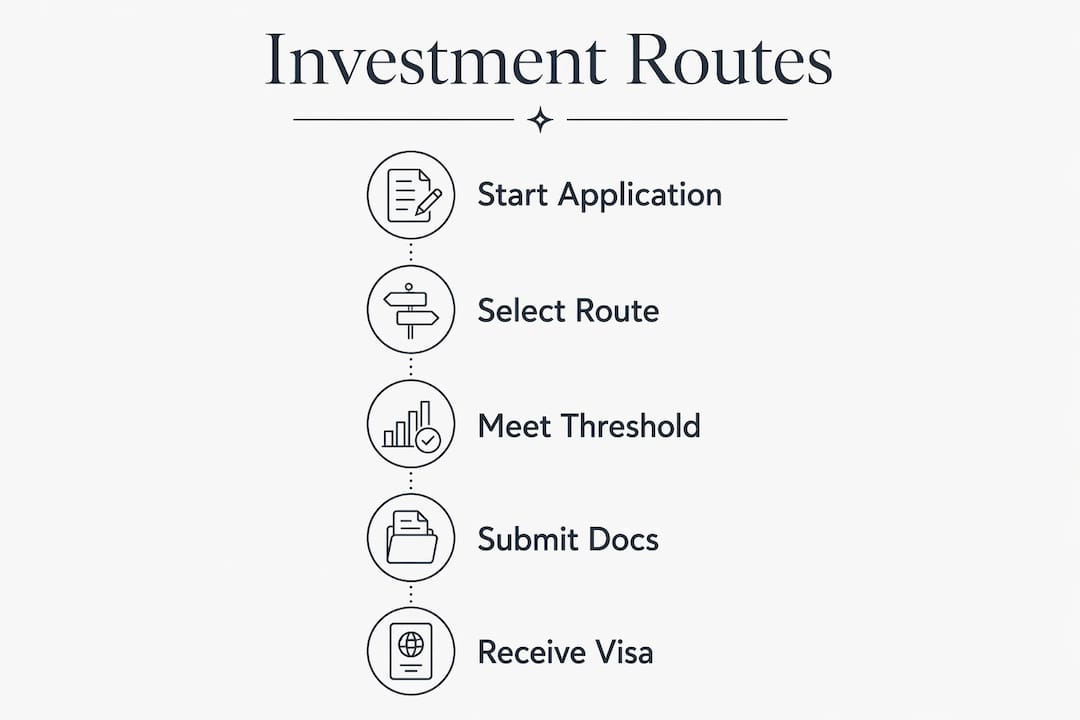
Per the IV4I FAQ, you must identify the target company at the time of submission. Applications without a named target are rejected outright.
How the application process works, step by step
- Create your IV4I portal account and upload your passport, CV, criminal record certificate, proof of financial resources, and investment documentation.
- Submit your declaration with an electronic signature. The Committee reviews completeness first; if documents are missing, you get 30 days to supply them.
- Receive the Nulla Osta (certificate of no impediment). The Committee’s decision is typically issued within 30 days for a complete application.
- Apply at the Italian consulate in your country of residence within 6 months of Nulla Osta issuance. Personal appearance is required; bring the printed Nulla Osta and all supporting documents.
- Enter Italy within 2 years of visa issuance.
- Apply for the residence permit at the local Questura within 8 working days of arrival. Notify the IV4I Secretariat in advance to coordinate the appointment.
- Execute the investment within 3 months of arrival and upload proof to the portal.
- Renew at least 60 days before expiry. A maintained investment converts the 2-year permit into a 3-year renewal.
The 8-day Questura window is the step most investors underestimate. Poor coordination of that appointment is one of the most common causes of delay in the entire process.
Costs, U.S. tax obligations, and compliance you need to plan for
Beyond the qualifying capital, budget for several layers of professional fees and tax obligations.
Typical outlays include consular application fees, notary fees for any property or corporate transaction, immigration attorney fees, Italian tax advisor fees, and advisory fees if you engage a buyer-side firm like Livingitaly. None of these are trivial, and they compound quickly on a complex SPV structure.
For U.S. investors, the tax picture has two sides. Italy will tax Italian-source income and, depending on your residency status, potentially worldwide income. The U.S.–Italy tax treaty reduces double taxation on most income categories, but it does not eliminate U.S. reporting obligations. FATCA and FBAR rules require you to disclose foreign financial accounts and assets above applicable thresholds. Engage a U.S. cross-border tax specialist before you move any funds, not after. For a full picture of ongoing property tax obligations in Italy, review the applicable IMU and income-tax rules for your ownership structure.
Pro Tip: Wire investment funds in a single documented transfer with a clear reference to the investment purpose. Italian banks and the IV4I portal both require traceable proof of execution, and multiple smaller transfers create documentation headaches.
Risks and due diligence for property and company investments
| Risk Area | What to Check | Mitigation |
|---|---|---|
| Property title | Cadastral records, mortgage liens, tax arrears | Notary title search + anti-mafia clearance |
| Zoning and permits | Building permits, use restrictions, restoration orders | Local municipality records review |
| Company governance | Financial statements, shareholder agreements, litigation | Independent accountant review |
| Investment lock-up | Cannot use investment as loan collateral during maintenance period | Confirm in shareholder agreement |
| Exit liquidity | Resale timelines for Italian real estate or private equity | Model realistic 3–7 year exit horizon |
The single-company rule creates concentration risk. If the target company underperforms or faces legal issues, your visa maintenance is tied to that same investment. Certified translations of all corporate documents are required, and escrow or SPV structuring can protect your capital during the execution window.
How a buyer-side advisor like Livingitaly reduces your risk
Coordinating an investor visa tied to a property investment means managing legal, tax, immigration, and banking tasks simultaneously, often across time zones. Livingitaly’s buyer-side advisory covers:
- Property sourcing and market analysis aligned to your investment thesis
- Full due diligence: title search, notary coordination, anti-mafia checks
- SPV and corporate structuring for the equity investment route
- Immigration document coordination and IV4I portal support
- Local banking introductions to open accounts at Italian-domiciled institutions
- Questura appointment coordination to meet the 8-day arrival window
- Post-acquisition property management and rental oversight
Pro Tip: Engage your advisory team before you submit the IV4I application, not after. The target company or SPV must be identified at submission, so sourcing and structuring work needs to happen upstream of the portal.
The buyer-agent role Livingitaly fills is distinct from a traditional real estate agent. The firm works exclusively for the buyer, which means its incentives are aligned with getting the deal structured correctly for visa compliance, not just getting a transaction closed.
Your 30–90 day action checklist
- Assemble identity documents: valid passport, criminal record certificates from every country of residence in the past 10 years, and certified translations.
- Build your source-of-funds file: bank statements (typically 6–12 months), asset documentation, and a clear funds-flow narrative.
- Choose your investment route and identify the specific target (company name, startup registration, or philanthropic project). This cannot be left undefined at submission.
- Decide on SPV vs. direct equity for property-linked strategies and engage a notary or corporate lawyer to begin structuring.
- Engage an immigration attorney to review your application before portal submission.
- Contact Livingitaly for property sourcing, SPV setup, and Questura coordination.
- Retain a U.S. cross-border tax advisor to map FATCA/FBAR obligations and treaty benefits before funds move.
- Open or identify an Italian-domiciled bank account for the investment deposit.
Key Takeaways
The Italy investor visa is a viable residency pathway for U.S. investors who can direct at least €250,000 into a single qualifying Italian investment and execute within three months of arrival.
| Point | Details |
|---|---|
| Minimum threshold | €250,000 for innovative startups; €500,000 for corporate equity; €2M for government bonds |
| Critical timing | Committee decides within ~30 days; invest within 3 months of arrival; Questura within 8 working days |
| No stay requirement | Italy imposes no minimum physical presence to maintain the residence permit |
| Property route | Direct purchase does not qualify; use an SPV or corporate equity structure tied to real estate |
| Livingitaly’s role | Buyer-side advisory covering SPV setup, due diligence, banking, and Questura coordination for investor-visa clients |
What most investor-visa guides get wrong
The framing around Italy’s investor visa tends to oversell the citizenship angle and undersell the operational complexity. Citizenship after 10 years of lawful residence is real, but it requires language proficiency, continuous tax compliance, and sustained physical presence in later years. That is a very different proposition from simply parking capital and collecting a permit.
What actually trips up U.S. investors is not the investment threshold. It is the 8-day Questura window, the 3-month execution deadline, and the single-company rule arriving simultaneously. Most people discover these constraints after they have already committed to a target. The investors who move through the process cleanly are the ones who structured the SPV, identified the target company, and coordinated the banking before they ever submitted the portal application.
The no-minimum-presence rule is genuinely valuable for Americans with active business lives. But it is not a reason to treat the process casually. The documentation chain, the FATCA reporting, and the Italian tax obligations all require active management from day one.
Livingitaly guides U.S. investors through every step
For U.S. investors linking an investor visa to a property acquisition, the gap between knowing the rules and executing them cleanly is where deals fall apart. Livingitaly fills that gap as a dedicated buyer-side advisor: sourcing the right property or SPV target, structuring the corporate vehicle, coordinating Italian banking, and managing the Questura appointment so the 8-day window does not become a crisis.
The process starts with a scoping consultation to validate your investment target before you submit the IV4I application. From there, Livingitaly coordinates legal, tax, and immigration specialists around your timeline, not theirs. Explore the full advisory services or go directly to the property buying guide to see how the process works from first search to residence permit.
Useful sources
- IV4I portal: how it works — official process overview and portal access
- Phase 1: getting your investor visa — step-by-step Nulla Osta and consular guidance
- IV4I policy guidance (July 2021) — definitive rules on thresholds, routes, and process
- IV4I FAQ (inter-ministerial) — single-company rule and common procedural questions
- What is Investor Visa for Italy? — official threshold summary
- Livingitaly: how to buy property in Italy — buyer-side advisory and acquisition process
- Livingitaly: legal, immigration, and visa residency — residency pathways for Americans
FAQ
What is the minimum investment for the Italy investor visa?
The lowest threshold is €250,000 for equity in a certified innovative startup. Corporate equity or bonds require €500,000, philanthropic donations €1 million, and government bonds €2 million.
Does buying property in Italy qualify for the investor visa?
Direct property purchase is not a listed qualifying route. Investors can qualify through the corporate equity route by investing in an Italian company, including an SPV structured around a real estate project.
How long does the Italy investor visa application take?
The IV4I Committee typically issues a decision within 30 days for a complete application. After receiving the Nulla Osta, you have 6 months to apply at the Italian consulate.
Do U.S. investors need to live in Italy to keep the residence permit?
No. Italy does not impose a minimum physical presence requirement to maintain the investor residence permit, which makes it practical for Americans with active business commitments elsewhere.
Can Livingitaly help with the visa process as well as the property purchase?
Yes. Livingitaly coordinates buyer-side advisory, SPV structuring, banking introductions, and Questura appointment management alongside the property acquisition, aligning all tasks to the visa’s timing requirements.