
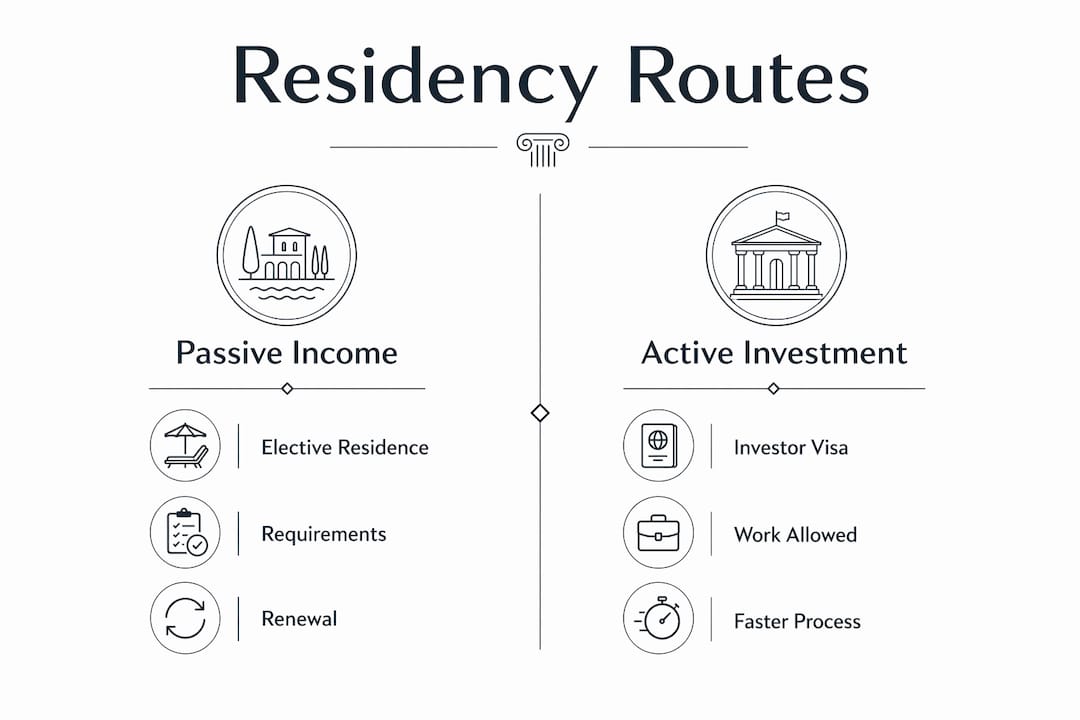
For most U.S. citizens planning a long-term move to Italy, the two routes that matter most are the Elective Residence Visa and the Investor (Golden) Visa. The Elective Residence Visa suits retirees and anyone living on passive income; the Investor Visa suits those making a qualifying capital investment. Work visas, family reunification, study visas, and the Digital Nomad Visa cover the remaining cases. Your immediate next step depends on which route fits: either pull together certified proof of recurring passive income (for Elective Residence) or confirm your investment vehicle and consult the relevant Italian Consulate (for the Investor Visa).
- Elective Residence Visa: passive income required, no work permitted, baseline income expectations set by consulates for a single applicant
- Investor (Golden) Visa: qualifying capital investment required, work permitted, faster path in some cases
- Work Visa: employer sponsorship required, subject to annual quota system
- Family Reunification: valid permit holder sponsors eligible family members
- Study Visa: enrollment at a recognized Italian institution required
- Digital Nomad Visa: minimum €28,000 annual income, remote work for foreign employers permitted
Pro Tip: Always verify current fees and processing times directly with the Italian Consulate that has jurisdiction over your U.S. state of residence before submitting any application. Rules and fee schedules change, and the consulate’s own published guidance is the only authoritative source.
Table of Contents
- Which residency route fits your situation?
- Elective Residence Visa: full requirements and what consulates actually want
- Investor (Golden) Visa: qualifying investments and the application path
- Other routes: work, study, family reunification, and the Digital Nomad Visa
- What to do after you arrive in Italy
- How to apply from the United States: a step-by-step guide
- Common mistakes applicants make and how consulates evaluate financial proof
- Typical costs, consular fees, and processing times
- From temporary permit to EU long-term residence and citizenship
- Key Takeaways
- What U.S. clients consistently get wrong
- Livingitaly’s advisory services for U.S. applicants
- Official sources and recommended reading
Which residency route fits your situation?
The fastest way to pick the right path is to answer one question: where does your income come from, and do you plan to work in Italy?
Elective Residence is the default choice for retirees, those with dividend income, rental income from U.S. properties, annuities, or pensions. You cannot work in Italy under this visa, and that prohibition extends to remote work for a foreign employer. If your income is passive and recurring, this is your route.

Investor Visa suits those who can deploy capital into Italy. Work is permitted. The path to permanent residency follows the same five-year rule as other permits, but the visa itself signals a higher level of financial commitment upfront.
Digital Nomad Visa (launched April 2024) is specifically for remote workers employed by or contracting with companies outside Italy. It requires a minimum annual income of €28,000, a university degree or three to five years of relevant professional experience, and health insurance with at least €30,000 in coverage.
Work Visa requires an Italian employer to sponsor you through the nulla osta (work authorization) process, which is subject to annual quotas set by the Italian government.
Family Reunification allows a non-EU national already holding a valid Italian residence permit to sponsor a spouse, minor children, or dependent parents. Financial thresholds scale with the number of dependents.
Study Visa requires documented enrollment at a recognized Italian university or institution. It does not lead directly to permanent residency without converting to another permit category after graduation.
Elective Residence Visa: full requirements and what consulates actually want
The Elective Residence Visa is designed for people who can live comfortably in Italy without touching the Italian labor market. That means no employment of any kind while resident, including remote work for a U.S. employer. Consulates are strict on this point.
Document checklist
| Document | Submitted to consulate | After arrival (questura) | Translation/legalization notes |
|---|---|---|---|
| Valid U.S. passport (6+ months validity) | Yes | Copy required | None |
| Completed visa application form | Yes | No | None |
| Two recent passport photos | Yes | No | None |
| Proof of recurring passive income | Yes | Referenced in permesso | Certified translation + Apostille |
| Bank statements (12 months minimum) | Yes | May be requested | Certified translation |
| Housing proof (registered lease or deed) | Yes | Yes | Certified translation + Apostille |
| International health insurance policy | Yes | Yes, until SSN enrollment | English policy acceptable if comprehensive |
| Civil-status documents (birth, marriage) | Yes | Copies | Certified translation + Apostille |
| Criminal record certificate (FBI + state) | Yes | No | Certified translation + Apostille |
| Certified translations of all foreign documents | Yes | Yes | Sworn translator or ATA-certified |
Income: the official baseline and the real expectation
The baseline passive income for a single applicant is approximately €32,000 per year, with higher amounts required for spouses or dependents. In practice, consulates across Italy routinely expect applicants to document recurring passive income of 2.5 to 3 times the official minimum. Presenting only the baseline may raise questions about long-term self-sufficiency—consulates look for genuinely recurring income, not a one-time transfer or large savings balance.
Qualifying income sources include pensions (Social Security, private pensions), dividends, rental income from properties outside Italy, annuities, and trust distributions. Savings alone, even substantial ones, typically do not satisfy the recurring-income requirement.
Housing: what “registered” actually means
Your lease or property deed must be formally registered with the Agenzia delle Entrate. A short-term vacation rental or an Airbnb booking does not qualify. If you are renting, the landlord must have registered the lease with the tax authority, and you will need a copy of that registration receipt. If you are purchasing property, the notarial deed (rogito) serves as proof. Livingitaly’s property-finding advisory can help you structure a purchase or lease that meets this requirement before you apply.
Visa validity and renewal
The Elective Residence Visa is typically issued for a limited initial period with renewals required thereafter. After arrival, you convert it to a permesso di soggiorno (residence permit) at the questura, which is then renewable annually or biannually depending on your situation. The permit does not grant work rights at any renewal stage.
Pro Tip: Present your income documentation as a single organized packet: cover letter summarizing sources, then each source’s evidence in its own labeled section (pension award letter, dividend statements, rental income records). Consular officers process hundreds of files. A clear, sequenced packet reduces the chance of a request for additional documents, which can add weeks to your timeline.
Investor (Golden) Visa: qualifying investments and the application path
The Investor Visa gives you a faster entry point to Italian residency without the passive-income restriction. You can work in Italy while holding it. The trade-off is a significant upfront capital commitment and a more complex due-diligence process.

Qualifying investment tracks
The Italian Investor Visa program recognizes several investment categories, each with distinct minimum amounts and documentation requirements:
- Philanthropic donation to an Italian public-interest initiative: minimum €1,000,000
- Equity investment in an Italian company (innovative startup): minimum €250,000
- Equity investment in an Italian company (non-startup): minimum €500,000
- Italian government bonds: minimum €2,000,000
Each track requires a formal investment commitment letter, source-of-funds documentation, and background checks before the consulate issues the visa. The Italian government’s Investor Visa Committee (Comitato Investor Visa for Italy) reviews applications and issues a clearance certificate, which the consulate then uses to issue the visa.
Eligibility and due diligence
The process is more structured than Elective Residence. Expect to provide:
- Detailed source-of-funds documentation (tax returns, corporate ownership records, asset statements)
- Background checks and criminal-record certificates
- Investment agreement or term sheet from the receiving entity
- Proof of funds held in a verifiable account
How it compares to Elective Residence
The Investor Visa permits work; Elective Residence does not. Both lead to the EU Long-Term Residence Permit after five years of continuous legal residence. The Investor Visa’s tax consequences can differ significantly: Italy’s flat-tax regime for new residents (a fixed annual substitute tax on foreign-source income) may be available to Investor Visa holders, but the interaction with U.S. tax obligations under FATCA and the U.S.-Italy tax treaty requires careful pre-arrival planning. Engaging an immigration attorney and a cross-border tax advisor before committing to an investment track is not optional for most U.S. applicants. Livingitaly’s investment advisory services can help structure property-based components of an investment strategy.
Other routes: work, study, family reunification, and the Digital Nomad Visa
| Route | Who it’s for | Work permitted? | Typical validity | Path to permanent residency |
|---|---|---|---|---|
| Work Visa | Sponsored by Italian employer; subject to annual quota | Yes (employer-specific) | 1–2 years, renewable | Yes, after 5 years |
| Study Visa | Enrolled at recognized Italian institution | Limited (part-time) | Duration of program | Requires permit conversion |
| Family Reunification | Dependent of valid permit holder | Yes (after permit issued) | Tied to sponsor’s permit | Yes, after 5 years |
| Digital Nomad Visa | Remote workers for non-Italian employers | Yes (remote only) | 1 year, renewable | Yes, after 5 years |
The Digital Nomad Visa deserves a closer look for U.S. applicants who work remotely. Unlike Elective Residence, it explicitly permits you to continue working for your U.S. employer or clients while living in Italy. The income floor is €28,000 annually, which is lower than the practical Elective Residence threshold. You must also carry health insurance with at least €30,000 in coverage.
Family members and dependents can generally accompany the primary applicant on most permit types, but the financial thresholds for the main applicant increase with each dependent added. For Elective Residence, each additional family member raises the required income documentation. For family reunification specifically, the sponsor must demonstrate housing of adequate size and income above the social assistance threshold for the household size.
What to do after you arrive in Italy
The first 8 days after arrival are the most time-sensitive. Here is the sequence:
- Apply for your permesso di soggiorno within 8 days of arrival. Go to a post office (Sportello Amico) to pick up the yellow kit (kit giallo), fill out the application, and submit it with your documents and the required fees. You will receive a receipt and an appointment date at the questura.
- Attend your questura appointment. Bring originals and certified copies of everything. Fingerprints are taken at this stage. The questura issues the physical permesso di soggiorno card, which can take weeks to months to arrive.
- Register with the Anagrafe (civil registry) at your comune. This is the municipal registration step. An officer will visit your registered address to verify you actually live there. Registration establishes your civil residence in Italy.
- Understand AIRE. AIRE (Anagrafe degli Italiani Residenti all’Estero) is the registry for Italian citizens living abroad. As a U.S. citizen, you will not register with AIRE. However, if you hold dual citizenship, your Italian consulate in the U.S. manages your AIRE registration, and deregistering from AIRE when you move to Italy is part of the process.
- Arrange health coverage. Your international health insurance policy satisfies the visa requirement initially. Once you are registered as a resident, you may be eligible to enroll in Italy’s Servizio Sanitario Nazionale (SSN). Enrollment rules vary by permit type and region.
Anagrafe registration alone can trigger Italian tax residency, regardless of how many days you have physically spent in Italy. Under Agenzia delle Entrate rules, you are considered tax resident if you are enrolled in the resident population register for most of the tax year, even if you have not yet reached 183 days of physical presence. Time your registration carefully, and consult a cross-border tax advisor before you register.
Tax residency: the 183-day rule and its limits
Italian tax residency is triggered by any one of three conditions: spending 183 or more days in Italy in a calendar year (184 in a leap year), registering with the Anagrafe, or having your center of vital interests (family, business, primary home) in Italy. The Agenzia delle Entrate’s updated guidance under Legislative Decree No. 209 of 2023 added physical presence as a standalone criterion, meaning even fractional days count toward the 183-day threshold.
Timeline guide:
- Days 1–8: Submit permesso di soggiorno application at the post office
- Days 8–30: Attend questura appointment; begin Anagrafe registration process
- Days 30–60: Confirm health insurance coverage; open Italian bank account
- Days 60–120: Receive permesso di soggiorno card; confirm Anagrafe registration is complete
Pro Tip: If you are arriving mid-year, consider whether registering with the Anagrafe in the current calendar year makes sense from a tax perspective. Registering in December versus January can determine whether you owe Italian tax on your worldwide income for that entire year. A tax advisor who works with U.S.-Italy cross-border cases should review your timing before you book your one-way flight.
How to apply from the United States: a step-by-step guide
The consulate application is the stage where most U.S. applicants run into delays. The Italian Consulate that has jurisdiction over your U.S. state of residence handles your visa application. There are ten Italian Consulates General across the U.S., and you must apply to the one covering your state.
Step-by-step process
- Identify your consular jurisdiction. The Ministero degli Affari Esteri (Farnesina) website lists which consulate covers each U.S. state. The Consulate General of Italy in New York, for example, covers New York, New Jersey, and several other states.
- Book your consulate appointment. Appointments fill quickly. Book as early as possible, often months in advance. Most consulates use an online booking system.
- Obtain your FBI background check. Request an Identity History Summary from the FBI. This takes several weeks. You will also need a state-level criminal record certificate from each state where you have lived in the past five years.
- Get your documents Apostilled. The U.S. Department of State issues federal Apostilles for FBI background checks. State-level documents (birth certificates, marriage certificates, state criminal records) are Apostilled by the relevant state’s Secretary of State office.
- Commission certified translations. All Italian consulates require certified translations of foreign-language documents. Use an ATA-certified translator or a sworn translator recognized by the consulate. Do not use machine translation.
- Secure international health insurance. The policy must cover the full duration of your intended stay and meet minimum coverage thresholds. Get a policy letter in English; most consulates accept it without translation.
- Confirm your housing documentation. Your lease or property deed must be registered with the Agenzia delle Entrate. If you are buying property to support your application, the purchase must be completed and registered before you apply. Livingitaly’s guide on how to buy property in Italy walks through the registration steps.
- Assemble and submit your packet. Bring originals and copies of everything to your appointment. The consulate keeps copies and returns originals in most cases.
U.S.-specific checklist
- FBI Identity History Summary (Apostilled by U.S. Department of State)
- State criminal record certificates (Apostilled by relevant Secretary of State)
- IRS tax transcripts or Social Security award letters if used as income proof (certified translation required)
- Certified translations of all documents not in Italian
- International health insurance policy letter
- Registered lease or property deed with Agenzia delle Entrate registration receipt
Practical timing: Allow at least three months for FBI checks, Apostilles, and translations before your consulate appointment. Consulate backlogs in major cities can push appointment availability out by two to four months. Start the process earlier than you think you need to.
Common mistakes applicants make and how consulates evaluate financial proof
The most common reasons for refusal or delay are predictable, and most are avoidable.
- Relying on savings rather than recurring income. A large bank balance does not substitute for documented recurring income. Consulates want to see that money flows in regularly, not that you have a lump sum sitting in an account.
- Using short-term rental evidence for housing. An Airbnb confirmation or a hotel booking does not satisfy the housing requirement. The lease must be formally registered.
- Missing or incomplete Apostilles. A document that is translated but not Apostilled, or Apostilled but not translated, will be rejected. Both steps are required for most foreign documents.
- Inconsistent dates across documents. If your bank statements cover January through October but your application is submitted in December, the gap raises questions. Keep all documents current and consistent.
- Incomplete criminal-record coverage. You need records from every state where you have lived, not just your current state. The FBI check covers federal records; state records are separate.
- Underestimating the income threshold. The published baseline is approximately €32,000 per year for a single applicant, but consulates in practice often expect recurring passive income of €80,000 or more to feel confident in long-term self-sufficiency.
How consulates read your income file
Consular officers are not accountants, but they are experienced at spotting income that does not look genuinely recurring. A pension award letter from the Social Security Administration is strong evidence. A single large wire transfer from a brokerage account is not. Dividend income should be documented with brokerage statements showing consistent quarterly or annual distributions over multiple years, not just a single year’s 1099-DIV.
Pro Tip: If your passive income comes from multiple sources (a pension, rental income, and dividends), present each source in its own clearly labeled section with a one-paragraph cover note explaining what it is and how it recurs. A consular officer who can follow your income narrative in three minutes is far less likely to request additional documentation than one who has to piece it together.
Typical costs, consular fees, and processing times
Fees and processing windows change. Always confirm current amounts with your specific Italian Consulate before submitting payment.
| Item | Typical range | Notes |
|---|---|---|
| Elective Residence Visa fee | — | Verify with your consulate; subject to change |
| Permesso di soggiorno kit (post office) | Approximately €30 | Includes postal fee and kit cost |
| Permesso di soggiorno electronic card fee | — | Revenue stamp (marca da bollo) also required |
| Questura appointment (fingerprints/card) | No separate fee | Included in permesso process |
| Investor Visa application fee | — | Same consular fee; Investor Visa Committee review is separate |
| Certified translation (per page) | Varies by translator | Budget varies for ATA-certified work |
| FBI Apostille (U.S. Department of State) | — | Processing time: several weeks |
Processing times vary significantly. Consulate decisions on Elective Residence applications typically take four to twelve weeks after a complete file is submitted, though some consulates run longer during peak periods. The Investor Visa adds the Investor Visa Committee review stage, which can take up to 30 days for the clearance certificate before the consulate issues the visa. After arrival, the physical permesso di soggiorno card from the questura can take two to six months to arrive, though the receipt serves as proof of legal status in the meantime.
Delays almost always trace back to incomplete files, missing Apostilles, or background-check processing times. Submitting a complete, well-organized packet at your first appointment is the single most effective way to avoid a second trip.
From temporary permit to EU long-term residence and citizenship
The path from a first-year visa to permanent residency follows a clear sequence, but the details matter.
- Five years of continuous legal residence qualifies you for the EU Long-Term Residence Permit (permesso di soggiorno per soggiornanti di lungo periodo). This is what most people mean when they say “permanent residency” in Italy.
- Continuity rules are strict. Absences of more than six consecutive months, or more than ten months total across the five-year period, can interrupt continuity and reset your clock. Keep records of every trip in and out of Italy.
- Language requirement: A2-level Italian proficiency is required for the EU Long-Term Residence Permit. You will need to pass a recognized language test or provide equivalent documentation.
- Income requirement: You must meet minimum income thresholds at the time of application, tied to the annual social security benefit amount. The specific figure is updated periodically; confirm the current threshold with the Ministero dell’Interno or a qualified practitioner.
- The EU Long-Term Residence Permit card is renewed every ten years, but the underlying status is permanent as long as you maintain the requirements. The status can be revoked after 12 consecutive months outside the EU, or if you acquire a long-term permit in another EU country, or for serious criminal convictions.
- Citizenship requires ten years of legal residence for most non-EU nationals. Naturalization is a separate process from permanent residency and does not follow automatically from holding the EU Long-Term Residence Permit. The ten-year clock runs from your first legal entry, but gaps in legal status can affect the count.
One common misunderstanding: permanent residency does not shorten the citizenship timeline for non-EU nationals. You still need ten years of legal residence to naturalize, regardless of when you obtained the EU Long-Term Residence Permit. For citizenship, B1-level Italian language proficiency is required, a step up from the A2 needed for permanent residency.
Family members who have been resident alongside the main applicant can apply for their own EU Long-Term Residence Permit independently once they meet the five-year continuous residence requirement.
Key Takeaways
The most direct path to Italian residency for U.S. citizens runs through the Elective Residence Visa for passive-income earners or the Investor Visa for those deploying qualifying capital, with both routes converging at the EU Long-Term Residence Permit after five years of continuous legal stay.
| Point | Details |
|---|---|
| Pick your route early | Elective Residence requires recurring passive income (approximately €32,000/year baseline, with consulates in practice often expecting 2.5–3 times that amount); Investor Visa requires qualifying capital investment. |
| Consular income bar is higher than published | Consulates typically expect 2.5–3x the official minimum (baseline ~€32,000/year for a single applicant), meaning most successful applicants document significantly higher recurring income. |
| Continuity rules are strict | More than six consecutive months or ten months total outside Italy in five years can reset your permanent residency clock. |
| Anagrafe registration triggers tax residency | Registering with the municipal civil registry can make you Italian tax resident immediately, regardless of days physically present. |
| Livingitaly advisory | Livingitaly provides buyer-side property advisory, visa/residency assistance, and tax planning for U.S. clients navigating Elective Residence and Investor Visa applications. |
What U.S. clients consistently get wrong
The pattern Livingitaly sees most often among U.S. clients is not a lack of resources. It is a mismatch between how Americans think about financial documentation and what Italian consulates actually want to see.
U.S. applicants tend to think in terms of net worth. They have a brokerage account with a substantial balance, and they assume that demonstrates financial stability. Italian consulates think in terms of income flow. A €2 million brokerage account that generates €18,000 in annual dividends is not a strong Elective Residence application. The €18,000 is the number that matters, and it falls short of the baseline, let alone the practical threshold.
The second recurring issue is Anagrafe timing. Clients arrive in Italy in October, register with the Anagrafe in November because they want to get settled, and then discover in the following spring that they have been treated as Italian tax residents for the entire prior year, triggering worldwide income reporting obligations they were not prepared for. The fix is simple: understand the tax calendar before you register, and get a cross-border tax advisor involved before you book your flight, not after you land.
For Investor Visa applicants, the source-of-funds narrative is where files fall apart. The Italian Investor Visa Committee expects a clear, documented chain from the origin of the funds to the investment account. Funds that have moved through multiple accounts, been converted between currencies, or originated from a business sale without clean documentation create questions that slow the process considerably.
Livingitaly recommends pre-arrival tax planning, staged income presentation for Elective Residence files, and early engagement with local Italian counsel for both visa types. For property-based components of an Investor Visa, structuring the purchase correctly from the start matters more than most clients expect.
Livingitaly’s advisory services for U.S. applicants
Navigating Italy’s residency process from the U.S. means coordinating consular appointments, certified translations, Apostilles, registered housing, and cross-border tax planning simultaneously. Most clients underestimate how much these pieces depend on each other.
Livingitaly works exclusively on the buyer’s side, which means the firm’s interests are aligned with yours, not with a seller, a landlord, or a government office. For Elective Residence applicants, Livingitaly helps structure and present income documentation, sources and registers qualifying housing, and coordinates with local counsel at the questura stage. For Investor Visa applicants, the firm provides investment property advisory, source-of-funds preparation support, and ongoing property management once the investment is in place. Tax planning and legal due diligence are handled through Livingitaly’s network of cross-border specialists.
If you are at the stage of choosing a route, confirming your income documentation, or identifying a qualifying property, the right next step is a direct advisory conversation. Book an initial call through Livingitaly’s advisory services page to discuss your specific situation and get a clear picture of what your application will require.
Official sources and recommended reading
Confirm all fees, forms, and procedural requirements with the official sources below before submitting any application. Rules change, and the consulate’s published guidance supersedes anything in a third-party guide.
- Ministero degli Affari Esteri (Farnesina): The Italian Ministry of Foreign Affairs publishes visa categories, eligibility criteria, and consulate contact information. Start here for the official visa framework.
- Ministero dell’Interno: The Italian Ministry of the Interior governs the permesso di soggiorno process, questura procedures, and long-term residence permit rules. Their published guidance on the permesso di soggiorno is the authoritative source for post-arrival formalities.
- Consulate General of Italy in New York (and your jurisdictional consulate): The consulate’s own visa pages list current document requirements, fee schedules, and appointment booking links. The Consulate General of Italy in New York publishes specific Elective Residence guidance that is more detailed than the general Farnesina pages.
- Agenzia delle Entrate: Italy’s tax authority publishes guidance on tax residency rules in English, including the updated criteria introduced by Legislative Decree No. 209 of 2023. Essential reading before you register with the Anagrafe.
- Investor Visa for Italy (official program): The Italian government’s Investor Visa Committee publishes investment track details, minimum amounts, and the clearance certificate process. Confirm current investment minimums here before committing capital.
When reviewing official pages, look specifically for: the current visa application form (modulo), the nulla osta process for work-related permits, and the questura’s local instructions for your comune. Requirements can vary slightly by region and by consulate, so always cross-reference the national guidance with your specific consulate’s published instructions.