
VAT applies to a property purchase in Italy when the seller is a construction or renovation company selling within five years of completing the work, or when that same seller expressly opts for IVA on a later sale. Outside those cases, you pay the imposta di registro instead. When IVA does apply, the rate depends on the property:
- a reduced rate for eligible prima casa purchases
- a standard rate for ordinary residential properties
- a higher rate for luxury homes classified A/1, A/8, or A/9
Whenever IVA applies to the sale, registration, mortgage, and cadastral taxes drop to a fixed €200 each rather than being calculated as a percentage of the price. That single fact changes the math on a lot of purchases, and it’s the first thing to check before you get attached to a number your agent quoted you.
Key Takeaways
Getting the tax regime right before signing the preliminary contract, not after, is what determines whether a property purchase in Italy costs thousands more or less than the sticker price suggests.
| Point | Details |
|---|---|
| Confirm seller status first | Ask whether the seller is a private individual or a construction/renovation company before negotiating price. |
| Check the five-year clock | IVA is mandatory within five years of completion for constructor sales, optional after. |
| Run both tax scenarios | Compare IVA rates against registro with prezzo-valore using actual cadastral values, not estimates. |
| Get declarations in writing | Any IVA option must appear in the preliminary contract or rogito, not a verbal assurance. |
| Separate renovation invoices | Require contractors to split labor (10%) from significant goods (potentially 22%) on every invoice. |
Table of Contents
- Understanding IVA Acquisto Immobile: Seller Status and the Five-Year Rule
- What Are the VAT Rates on Property in Italy?
- IVA vs Imposta di Registro: Which Costs Less?
- How Corporate Sellers and Commercial Property Change the Rules
- Your Pre-Signing Checklist for VAT and Property Tax
- Two Quick Examples: New Build vs Private Resale
- Why Living Italy Runs Both Tax Scenarios for Every Client
- Claiming VAT Deductions When You’re Buying as a Business
- Exemptions and Special Cases Worth Knowing
- How VAT Affects Your Mortgage and Financing
- Deadlines: When and How VAT Gets Paid and Declared
- An Editorial Take on Buying Smart, Not Fast
- Sources
- FAQ
Understanding IVA Acquisto Immobile: Seller Status and the Five-Year Rule
Whether IVA acquisto immobile applies almost always comes down to one question: who is selling, and how long ago did they finish building or renovating? A private seller, someone selling their own home with no business tax registration, never charges VAT. A construction or renovation company (impresa costruttrice or impresa di ristrutturazione) is a different story entirely.
Here’s how the timeline works:
- If the seller is a construction or renovation company and the sale happens within five years of completing the work, IVA is mandatory. No opting out.
- After five years have passed, that same company can choose whether to apply IVA or fall back to registration tax. This is the “seller’s option.”
- If the seller opts in, that choice must appear in writing, either in the preliminary contract or the final deed (rogito).
This matters because the tax regime is entirely dependent on the seller’s declared status, and buyers rarely think to verify it until the notaio raises it days before signing.
Pro Tip: Ask for the seller’s VAT number and the building’s original habitability certificate (certificato di abitabilità) date before you sign anything preliminary. That date is what starts the five-year clock, and if the seller can’t produce it, treat that as a red flag, not an oversight.
What Are the VAT Rates on Property in Italy?
Once you’ve confirmed IVA acquisto immobile applies to your purchase, the rate depends on what kind of property you’re buying and whether you qualify for prima casa benefits.
The standard IVA rates depend on the property’s classification and the buyer’s eligibility for prima casa benefits: a reduced rate applies to prima casa properties, a standard rate for ordinary residential properties, and a higher rate applies to luxury properties classified as A/1, A/8, or A/9.
Even the prima casa discount survives inside an IVA transaction: the benefit simply converts from a reduced registration tax into a reduced 4% VAT rate. To claim it, you declare your intent to establish residency in the property’s municipality within 18 months, and that declaration goes directly into the deed.
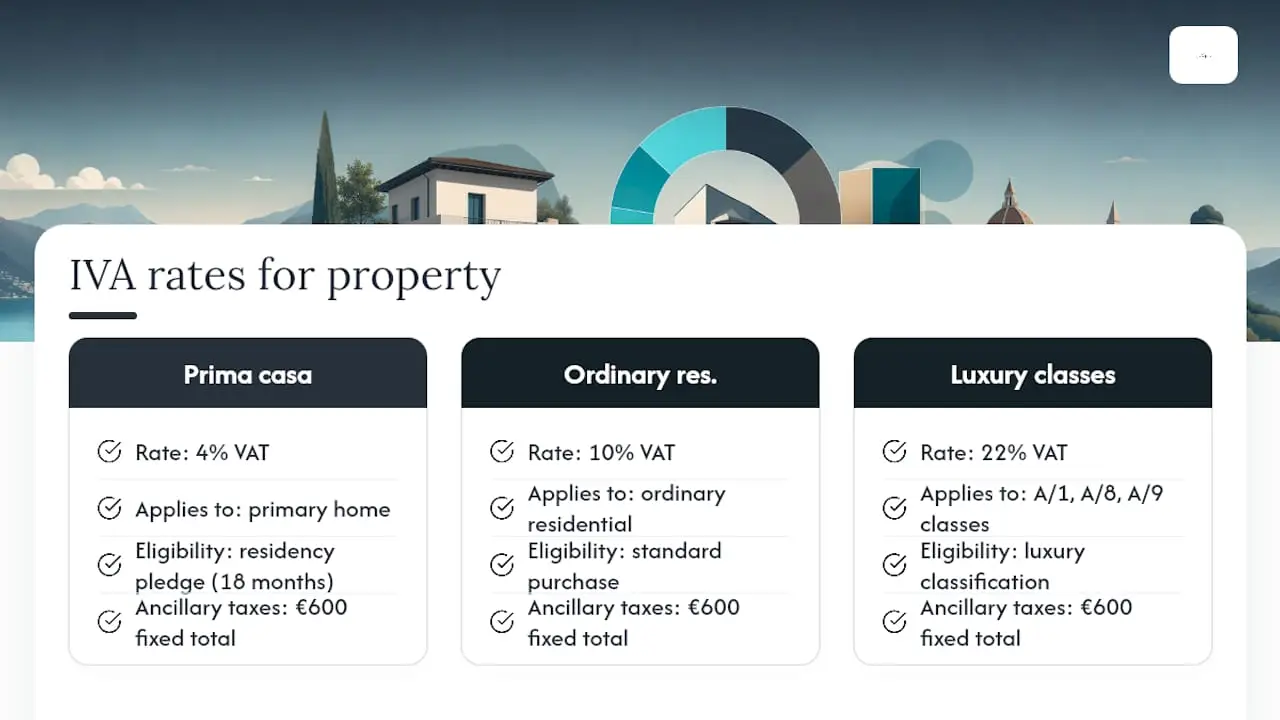
The other detail that surprises international buyers: fixed taxes of €200 each replace the usual proportional registration, mortgage, and cadastral charges whenever IVA applies, no matter which of the three rates you pay. That’s a fixed cost of €600 total on top of the VAT itself.
IVA vs Imposta di Registro: Which Costs Less?
Italian tax law treats IVA and imposta di registro as mutually exclusive; a transaction pays one or the other, never both. This principle, called alternatività, means that whenever a sale is subject to IVA, the proportional registration tax disappears and gets replaced by the fixed €200 charge described above.
When a sale isn’t subject to IVA, most private buyers can request the prezzo-valore system instead of paying registration tax on the contract price. Under prezzo-valore, the tax base becomes the property’s cadastral value (rendita catastale multiplied by 1.05, then by 110 for residential property), which is almost always lower than the market price.
| Regime | Tax base | Typical rate |
|---|---|---|
| IVA (mandatory or opted) | Contract price | 4%, 10%, or 22%, plus €200 x 3 fixed taxes |
| Registro, standard | Contract price | 9% (2% for prima casa) |
| Registro, prezzo-valore | Cadastral value | 9% (2% for prima casa) on a lower base |
To request prezzo-valore, you declare the cadastral value option to the notaio at signing, and the price still gets stated in full in the deed for legal purposes. Buyers purchasing from private sellers, where prezzo-valore is available, almost always come out ahead of an equivalent IVA transaction on the same nominal price. Our guide to calculating the prezzo-valore base walks through the formula with real cadastral figures.
How Corporate Sellers and Commercial Property Change the Rules
Buying from an SRL doesn’t automatically mean you’ll pay IVA. The same five-year logic applies to corporate sellers: if the SRL is a construction company selling within five years of completion, IVA is mandatory. Beyond five years, or if the SRL never built or renovated the property (it simply held it as an investment), the sale is usually exempt from IVA and falls under registration tax instead, unless the company opts back in.
Commercial and instrumental property (immobili strumentali, meaning offices, warehouses, retail units) follows different logic entirely. These almost always attract IVA regardless of timing, and the ancillary tax percentages applied on top can differ from residential rates.
A few things worth checking before you commit:
- Confirm whether the property is classified residential or strumentale in the cadastral records; this changes which rules apply.
- Ask why the seller opted for IVA if they weren’t required to; sometimes it’s to recover input VAT they paid during construction.
- For strumentale purchases, get a commercialista to confirm the exact ancillary tax percentages before you budget the deal.
Your Pre-Signing Checklist for VAT and Property Tax
Before you sign a preliminary contract, get these items nailed down in writing:
- Request the seller’s VAT status and, if they’re a company, the original construction or renovation completion date.
- If IVA applies, insist on an invoice (fattura) showing the VAT amount separately from the price, not a generic receipt.
- If the seller is applying IVA by choice rather than obligation, require a written option declaration and confirm the notaio will record it in the rogito.
- For any renovation work included in the deal, require invoices that separate labor costs from “significant goods” supplied under the contract.
Pro Tip: *That last point trips up more buyers than anything else on this list.
Two Quick Examples: New Build vs Private Resale
Numbers make this concrete faster than rules do. Take two identical prima casa purchases at €300,000.
| Scenario | Tax base | Rate | Tax owed |
|---|---|---|---|
| A: New build from builder, IVA mandatory | €300,000 contract price | 4% IVA + €200 x 3 fixed | €12,600 |
| B: Private resale, prezzo-valore | Cadastral value (example: ) | 2% registro (prima casa) | €2,550 |
Scenario A produces roughly €12,600 in total tax. Scenario B, using a cadastral value far below market price, produces closer to €2,550. The difference in taxation between IVA and prezzo-valore regimes varies depending on the relationship between cadastral value and contract price, which can differ widely by region and property age. Running the actual cadastral figures before assuming either scenario is cheaper is worth the hour it takes.
Why Living Italy Runs Both Tax Scenarios for Every Client
We run the IVA and registro comparison for every purchase before a client signs, because the nominal price rarely tells the whole story.
The biggest costly surprise we see with international buyers isn’t the tax rate itself. It’s discovering the seller’s VAT status three days before the rogito, when there’s no time left to renegotiate the price around it.
Engage a commercialista, or a buyer-side advisor who works with one, as soon as you have a preliminary contract on the table, not after. Living Italy folds this check into every property purchase workflow from the first property visit onward.
Pro Tip: If two properties are priced identically, don’t assume the older private resale is automatically cheaper. Run the actual cadastral value before deciding.
Claiming VAT Deductions When You’re Buying as a Business
If you’re purchasing through a business entity (an SRL, a partnership, or as a VAT-registered sole proprietor) rather than as a private individual, the IVA you pay on the purchase can potentially be deducted or credited against VAT you charge on your own activities. This only works if the property is genuinely used for business purposes, not as a personal residence dressed up as a corporate asset.
Documentation is everything here. You need a proper fattura from the seller showing the VAT amount as a distinct line item, issued to your business’s VAT number, not to you personally. Keep the invoice alongside the deed and any preliminary contract that references the IVA option, since the Agenzia delle Entrate can ask to see the paper trail years later during an audit.
The deduction gets claimed through your regular VAT return (dichiarazione IVA), where the property purchase appears as an input credit against your output VAT. If your business generates more input credit than output VAT owed in a given period, you can request a refund or carry the credit forward. The mechanics get complicated fast when the property serves mixed use (partly business, partly personal, or partly rented to third parties), since the deductible percentage shrinks proportionally.
This is not a do-it-yourself exercise. A commercialista familiar with real estate transactions should structure the purchase and file the return, because getting the pro-rata calculation wrong on a mixed-use property can trigger a reassessment with penalties attached. Buyers structuring a purchase through an SPV or corporate vehicle should get this reviewed before the deed is signed, not after.
Exemptions and Special Cases Worth Knowing
Not every property purchase fits neatly into the 4%, 10%, or 22% framework. Social housing (edilizia residenziale pubblica) and properties sold under specific public housing agreements sometimes carry reduced rates or exemptions tied to the buyer’s income bracket or the property’s designated use, administered at the municipal or regional level rather than nationally. These programs vary significantly by region, so a reduced rate available in Lombardy might not exist in the same form in Puglia.
Non-residential and agricultural land purchases follow entirely separate rules. Agricultural land sold to a coltivatore diretto (a registered farmer) can qualify for reduced registration tax rather than IVA, regardless of the seller’s status, because the exemption targets the buyer’s professional classification rather than the transaction type.
Properties transferred as part of an inheritance or donation fall outside the IVA framework entirely; those transactions are governed by inheritance and gift tax rules, not VAT or registration tax on a sale.
For international buyers specifically, one exemption rarely applies: there’s no special VAT reduction tied to foreign buyer status alone.
How VAT Affects Your Mortgage and Financing
VAT changes the numbers your lender works with, and it changes them at the exact moment you’re trying to lock in financing. Italian banks calculate loan-to-value ratios against the property’s declared price, and when IVA applies, that price is the full contract price, not a discounted cadastral figure the way prezzo-valore transactions sometimes get treated informally in registro deals.

Lenders in Italy typically finance a percentage of the property value, not the tax on top of it, so buyers need to budget the IVA and the fixed €200 taxes as cash due at signing, separate from whatever the bank advances.
International buyers financing through an Italian bank should also confirm early whether the lender requires proof of the seller’s VAT status before releasing funds, since some banks build this verification into their own due diligence and delays here can push back your closing date. If you’re financing through a foreign lender instead, factor in that Italian notai still expect the IVA and fixed taxes settled in euros at the rogito, regardless of where your mortgage originates.
Deadlines: When and How VAT Gets Paid and Declared
The seller, not the buyer, is legally responsible for collecting and remitting IVA to the Agenzia delle Entrate, since VAT is charged through the seller’s invoice and paid by the seller through their periodic VAT return. As the buyer, your obligation is to pay the invoiced amount, VAT included, at the time specified in the contract, which for most transactions means at the rogito itself, when the notaio finalizes the deed.
The notaio handles the registration of the deed and the payment of the fixed ancillary taxes (registration, mortgage, cadastral) within the standard window required by law, generally at the moment of signing or within a few days after. There’s no separate VAT filing the buyer needs to submit personally for a residential purchase; your role ends with paying the invoiced total and confirming the seller’s option declaration is recorded correctly.
If you’re buying through a business entity and plan to claim the VAT as a deductible input credit, your own periodic VAT return deadline applies, following the same quarterly or annual filing schedule as any other VAT-registered business in Italy. Missing that filing window doesn’t cancel the deduction outright, but it does complicate the credit’s timing and can delay any refund you’re owed.
An Editorial Take on Buying Smart, Not Fast
Most guidance on this topic treats IVA and registration tax as a formula to plug numbers into. That’s backward. The real decision point isn’t which rate applies; it’s whether you verified the seller’s status early enough to negotiate around it.
Buyers who wait until the rogito to discover a construction company is charging mandatory IVA lose all their leverage. That’s not a tax problem; it’s a timing problem dressed up as a tax problem.
The conventional advice, “consult a commercialista,” is correct but incomplete. Consult one before the preliminary contract, not before the rogito. By the time most buyers bring in a tax advisor, the only remaining question is how to pay, not whether there was a cheaper structure available. Verify seller status and run the registro comparison in the first week of negotiations, not the last.
This article is general information, not a substitute for advice from a qualified financial advisor. Consult a qualified financial professional about your own circumstances before acting on anything here.
FAQ
When is a property purchase subject to IVA in Italy?
IVA applies when the seller is a construction or renovation company selling within five years of completing the work, or when that seller opts to apply IVA on a later sale, with the choice declared in the contract or deed.
When do you pay IVA on a property purchase?
You pay IVA at the time specified in the sale contract, typically at the rogito, when the notaio finalizes the deed and the seller issues an invoice showing the VAT amount.
Who qualifies for the 4% IVA rate on a first home?
When does the 4% VAT rate on housing apply?
Recommended
- Investment Property in Italy | Living Italy
- How to Buy Property in Italy Smartly – Living Italy
- Buying Property in Italy | Buyer Advisory – Living Italy
- Buying Property in Italy | Buyer Advisory – Living Italy
The information provided here is general in nature and does not replace professional assistance. Reading this content does not create a professional-client relationship.