
TL;DR:
- The prezzo-valore method allows private buyers to calculate Italy’s registration tax based on cadastral value, often reducing costs significantly. It applies when the buyer explicitly requests it in the deed for residential properties not subject to VAT, using a specific formula and fixed fees. Proper early verification and documentation ensure tax savings and legal certainty in property transactions.
The prezzo-valore method lets eligible buyers calculate Italy’s registration tax (imposta di registro) on the cadastral value rather than the sale price, and the savings are often substantial. The formula is straightforward: rendita catastale × 1.05 × 110 for a first home, or × 120 for any other residential property. Apply the relevant registration tax rate for qualifying first-home purchases or ordinary ones, and you have your tax base. On a property selling at market prices with a rendita of €800, using prezzo-valore means paying tax on a significantly reduced base derived from the cadastral value instead of the full sale price.
Here is what you need to know right away:
- Who qualifies: Private individuals buying residential property where the sale is subject to registration tax, not VAT. This includes purchases from companies, provided the transaction is not VAT-liable.
- The formula: Rendita catastale × 1.05 × 110 (first home) or × 120 (other residential) = taxable base. Then apply 2% or 9%.
- Minimum tax: For first-home purchases, a minimum registration tax of €1,000 applies even when the formula produces a lower figure.
- How to activate it: The buyer must request prezzo-valore explicitly in the deed. The notary must include the wording.
- Bonus: The notary’s professional fees are automatically reduced by 30% when prezzo-valore applies.
Quick comparison: on that same €350,000 purchase with a rendita of €800, registration tax on the sale price at 9% can be substantially higher than the tax calculated using prezzo-valore’s cadastral base, resulting in significant savings before considering the notary fee reduction.
Table of Contents
- What prezzo-valore is and when you actually qualify
- How to calculate the registration tax base step by step
- Worked numeric examples: first home, second home, and pertinenze
- How to request prezzo-valore at the deed: the buyer’s checklist
- Advantages, limits, and the tax shield effect
- What to budget and when payments happen
- Key Takeaways
- Why checking prezzo-valore before the compromesso matters
- Livingitaly’s buyer-advisory services cover this from day one
- Authoritative sources and further reading
- FAQ
What prezzo-valore is and when you actually qualify
The prezzo-valore system was introduced through L. 266/2005 and operates within the framework of D.P.R. 131/1986, Italy’s consolidated registration tax law. The core idea: instead of taxing the declared sale price, the tax base is anchored to the property’s cadastral value, a figure derived from the official land registry (Catasto) and generally well below market prices.
Core eligibility conditions:
- The buyer is a natural person (a private individual, not a company or partnership acting in a business capacity).
- The property is residential (not commercial, industrial, or classified as luxury under categories A/1, A/8, and A/9 for first-home benefits).
- The sale is subject to registration tax, not VAT. This is the single most important filter.
- The buyer requests prezzo-valore in the deed. Without that explicit request, the option is forfeited.
- Pertinenze (garage, cellar, storage) can be included when they are properly declared as accessories to the main residential unit.
Transactions excluded from prezzo-valore:
Sales subject to VAT fall entirely outside this system. When a developer sells a newly built property and the transaction is VAT-liable, registration tax follows different fixed rules and prezzo-valore cannot be invoked. The practical flag: if the seller is a construction company and the property is less than five years old, check whether the sale is VAT-liable before assuming prezzo-valore applies.
Luxury properties (A/1 villas, A/8 historic mansions, A/9 castles) are excluded from first-home benefits, though prezzo-valore can still apply to the base calculation at the ordinary 9% rate.
Documents needed to confirm eligibility:
- Visura catastale showing the current rendita catastale and property category.
- Buyer’s identity document and Italian fiscal code (codice fiscale).
- Seller’s tax status confirmation (VAT-registered business or private individual).
- Proof that the property is classified as residential in the Catasto.
One compliance point that trips up buyers: the real agreed sale price must still appear in the deed. Prezzo-valore changes the tax base, not the obligation to disclose the actual transaction price.
How to calculate the registration tax base step by step
The calculation is reproducible in five steps. Before you start, you need the rendita catastale, which you can retrieve from the Agenzia delle Entrate’s Catasto service or from a visura catastale requested at any Agenzia delle Entrate office or through their online portal.
Step 1: Obtain and verify the rendita catastale.
Pull the visura catastale for the specific property unit. Confirm the cadastral category (A/2, A/3, etc.) and the current rendita. If the property has been recently renovated or reclassified, the rendita may have changed — always use the figure on the most recent visura, not what the seller quotes verbally.
Step 2: Apply the 5% revaluation.
Multiply the rendita by 1.05. This statutory revaluation has been in place for decades and applies uniformly.
Step 3: Apply the cadastral multiplier.
Multiply the result by 110 if the purchase qualifies for first-home benefits, or by 120 for all other residential purchases.
Step 4: Apply the registration tax rate.
Multiply the taxable base by 2% (first home) or 9% (ordinary purchase). Check the minimum: for first-home purchases, the minimum registration tax is €1,000.
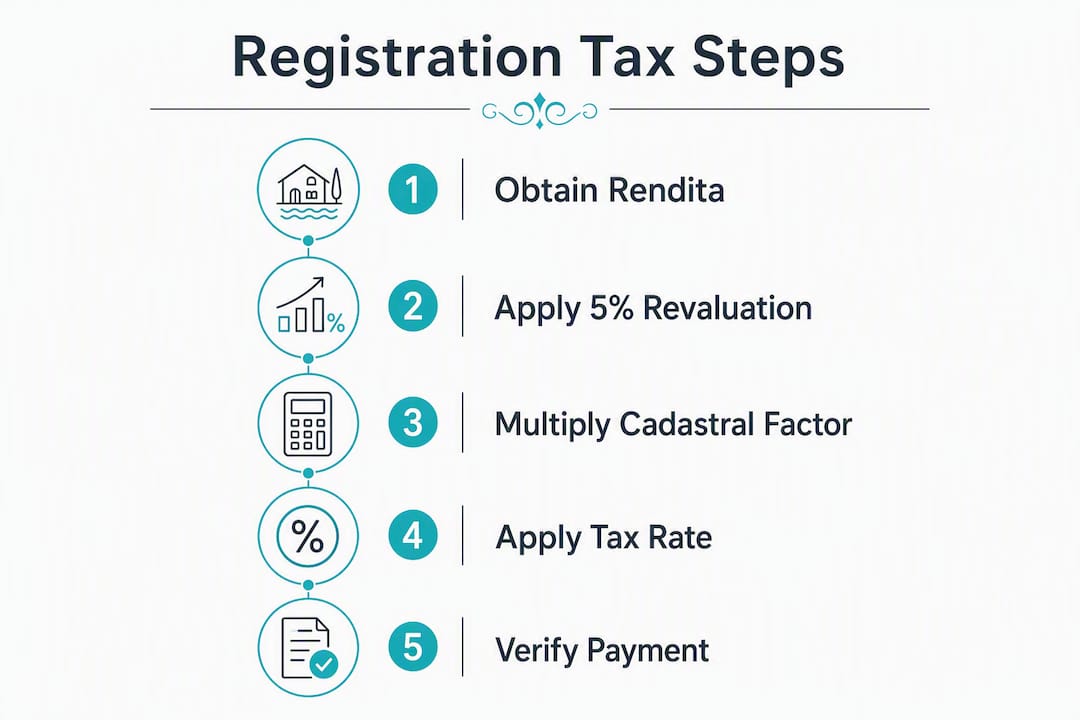
Step 5: Add fixed cadastral and mortgage taxes.
For private-party transfers, the imposta ipotecaria and imposta catastale are each fixed at €50. These do not change with the prezzo-valore calculation.
| Formula Component | Value / Rule |
|---|---|
| Rendita catastale | From the official visura catastale (Catasto) |
| Revaluation factor | × 1.05 (statutory, applies to all cases) |
| Multiplier — first home | × 110 |
| Multiplier — other residential | × 120 |
| Registration tax rate — first home | 2% (minimum €1,000) |
| Registration tax rate — ordinary | 9% |
| Fixed imposta ipotecaria (private sale) | €50 |
| Fixed imposta catastale (private sale) | €50 |
Worked example: Rendita = €600. First-home purchase.
Step 1: €600
Step 2: €600 × 1.05 = €630
Step 3: €630 × 110 = €69,300 (taxable base)
Step 4: €69,300 × 2% = €1,386 registration tax
Step 5: Add €50 + €50 = €100 in fixed fees
Total tax outlay: €1,486
Compare to 2% on a €280,000 sale price: €5,600. Saving: €4,114.
Pro Tip: Use the iltuonetto registration tax calculator to cross-check your manual calculation before the deed. Enter the rendita, select the property type and buyer status, and the tool reconstructs the prezzo-valore base automatically. It takes two minutes and catches input errors.
Worked numeric examples: first home, second home, and pertinenze
Three scenarios illustrate how the numbers play out in practice, including the minimum-tax trap and how accessories are handled.
Example 1: First-home purchase, rendita €500, sale price €220,000
- Taxable base: €500 × 1.05 × 110 = €57,750
- Registration tax: €57,750 × 2% = €1,155
- Minimum check: €1,155 > €1,000, so the minimum does not apply
- Fixed fees: €50 + €50 = €100
- Total taxes: €1,255
- Tax on sale price (2% × €220,000): €4,400
- Saving: €3,145
Example 2: Second-home purchase, rendita €900, sale price €400,000
- Taxable base: €900 × 1.05 × 120 = €113,400
- Registration tax: €113,400 × 9% = €10,206
- Fixed fees: €50 + €50 = €100
- Total taxes: €10,306
- Tax on sale price (9% × €400,000): €36,000
- Saving: €25,694
This is where the prezzo-valore system delivers its most dramatic results: second-home buyers at the 9% rate, purchasing at market prices well above cadastral values, routinely see savings in the tens of thousands.
Example 3: First-home with garage (pertinenza), rendita of house €480, rendita of garage €60
When the garage is declared as a pertinenza in the deed, both rendite are combined for the calculation:
- Combined rendita: €480 + €60 = €540
- Taxable base: €540 × 1.05 × 110 = €62,370
- Registration tax: €62,370 × 2% = €1,247
- Fixed fees: €50 + €50 = €100
- Total taxes: €1,347
The pertinenza must be explicitly listed in the deed as an accessory to the main unit. If it is treated as a separate purchase, it may attract different rates or lose the first-home multiplier.
When prezzo-valore produces minimal benefit: If the property has an unusually high rendita relative to its market price (common with recently reclassified properties or certain urban apartments), the cadastral base may approach the sale price. In those cases, the tax saving shrinks, and the main remaining benefit is the notary fee reduction and the tax shield against future reassessment.

How to request prezzo-valore at the deed: the buyer’s checklist
Activating prezzo-valore is procedurally simple, but missing any step can void the benefit entirely.
Before the deed:
- Pull the visura catastale and verify the rendita, property category, and any recent reclassifications.
- Confirm the seller’s VAT status in writing. If the seller is a company, ask whether the sale is VAT-exempt or VAT-liable.
- Notify the notary at the earliest stage, ideally before the compromesso (preliminary agreement), so the rendita check is built into due diligence.
- Prepare documentation of all payment methods: bank transfer records, deposit receipts, escrow instructions.
At the deed:
- Explicitly request prezzo-valore verbally and confirm it is included in the act.
- Verify that the deed contains an analytic declaration of payment methods, listing every payment made (deposits, bank transfers, any prior payments). Omitting this declaration can trigger administrative fines of €500 to €10,000 and may nullify the prezzo-valore benefit.
- Confirm the real agreed sale price is stated in the deed. Prezzo-valore does not permit concealment of the actual price.
- Check that the notary has applied the 30% fee reduction automatically. Under Italian law, this reduction is mandatory, not discretionary, when prezzo-valore is validly invoked.
The notary’s role: The notary is legally required to include the buyer’s prezzo-valore request in the deed and to apply the reduced fees. They also handle the registration with the Agenzia delle Entrate and the payment of registration tax, cadastral tax, and mortgage tax at closing.
Pro Tip: Document every payment with a bank transfer, never cash. The analytic payment declaration in the deed must match your actual payment trail exactly. A mismatch, even an innocent one, gives the tax authority grounds to challenge the prezzo-valore election and reassess on the full sale price.
Advantages, limits, and the tax shield effect
The immediate cash saving is obvious from the examples above. What buyers often underestimate is the second benefit: legal certainty. When prezzo-valore is validly applied, the Agenzia delle Entrate loses the power to reassess the registration tax base through accertamento di valore. The agency cannot come back years later and argue the property was worth more than declared. That protection has real financial value, particularly for investors holding property long-term or planning future sales.
Advantages in summary:
- Immediate registration tax savings, often significant at the 9% rate.
- Notary fees reduced by 30% automatically.
- Eliminates future registration tax reassessment risk.
- Simplifies tax planning: the liability is fixed at closing.
Limits and risks:
VAT sales are completely outside the system. Buyers purchasing from developers on new builds must budget on the actual sale price for VAT purposes. The VAT exclusion is non-negotiable and catches international buyers who assume prezzo-valore always applies.
Concealing the true price is a serious mistake. If the declared price differs from the actual transaction, sanctions include administrative fines of 50–100% of the tax difference, recalculation of registration tax on the real price, and in serious cases, criminal charges. The prezzo-valore system was designed to encourage transparency, not to enable underreporting.
When the rendita is high relative to market value, the benefit narrows. In those cases, weigh the notary fee reduction and the tax shield against the cost of additional due diligence, and factor the price-to-rendita ratio into your offer strategy.
Pro Tip: Professional advisors treat prezzo-valore as a routine part of pre-purchase structuring. Verify the rendita early, before you make an offer, so you can include realistic tax lines in your budget and financing plan. A property with a low rendita and high market value is structurally more tax-efficient to acquire.
What to budget and when payments happen
Understanding the full cost picture before signing anything is the difference between a smooth closing and a last-minute scramble for cash.
| Cost Line | Typical Amount | Notes |
|---|---|---|
| Registration tax (first home) | 2% of prezzo-valore base (min. €1,000) | Paid at deed via notary |
| Registration tax (ordinary) | 9% of prezzo-valore base | Paid at deed via notary |
| Imposta ipotecaria (private sale) | €50 fixed | Paid at deed |
| Imposta catastale (private sale) | €50 fixed | Paid at deed |
| Notary fees | Varies; reduced 30% with prezzo-valore | Paid at deed or shortly after |
| Visura catastale | Small administrative fee | Before deed, during due diligence |
Timing: Registration tax, cadastral tax, and mortgage tax are all paid at the deed through the notary, who collects and remits them to the Agenzia delle Entrate. There is no separate filing or deferred payment for these items. The notary issues a formal liquidazione (tax calculation) at closing, which is the authoritative figure.
For broader context on property taxes in Italy, including recurring annual taxes like IMU, buyers should factor those into their long-term ownership budget separately from the one-time acquisition taxes covered here.
Documents to have ready at closing:
- Valid identity document and Italian fiscal code for all buyers.
- Visura catastale (current, not older than a few months).
- Proof of all prior payments (deposits, wire transfer confirmations).
- Seller’s tax status documentation (VAT registration or confirmation of non-VAT status).
- Any preliminary agreement (compromesso) showing the agreed price and payment schedule.
Key Takeaways
The prezzo-valore method bases Italy’s registration tax on the cadastral value (rendita × 1.05 × 110 or 120) rather than the sale price, cutting tax costs significantly for eligible private buyers of residential property not subject to VAT.
| Point | Details |
|---|---|
| Core formula | Rendita catastale × 1.05 × 110 (first home) or × 120 (other residential) = taxable base. |
| Tax rates and minimum | Apply 2% (first home, minimum €1,000) or 9% (ordinary) to the cadastral base. |
| Notary fee reduction | Notary fees are automatically reduced by 30% when prezzo-valore is validly invoked. |
| Tax shield benefit | The Agenzia delle Entrate cannot reassess the registration tax base once prezzo-valore is applied. |
| Livingitaly advisory | Livingitaly integrates rendita checks and prezzo-valore eligibility into its buyer-advisory workflow before the compromesso, so clients enter the deed with accurate tax budgets. |
Why checking prezzo-valore before the compromesso matters
Most buyers think about registration tax at the deed. By then, the opportunity to use the rendita as a negotiating input has already passed.
The rendita catastale is not just a tax input. It is a signal about the property’s fiscal history, its classification, and the gap between official value and market price. A property with a very low rendita relative to its asking price offers structural tax efficiency that a buyer who runs the numbers early can factor into their offer. One who discovers it at the notary’s office cannot.
For international buyers, this gap is especially consequential. Financing plans, currency conversions, and liquidity requirements are all built around expected closing costs. A late-stage discovery that the registration tax is €8,000 rather than the €2,000 estimated from a rough market-price calculation creates real problems. Running the prezzo-valore check during initial screening, not at the compromesso stage, eliminates that risk entirely.
Livingitaly builds this check into its buyer advisory process from the first property shortlist. Prezzo-valore eligibility, the seller’s VAT status, and the rendita-to-price ratio are all confirmed before a client signs anything preliminary. That sequencing matters: it means the tax budget is accurate from day one, and the offer price reflects the real total acquisition cost.
For investors, the prezzo-valore calculation feeds directly into ROI modeling. Lower upfront tax costs improve net yield, and the tax shield eliminates a category of post-purchase fiscal risk that can otherwise cloud the investment case for years.
Livingitaly’s buyer-advisory services cover this from day one

Calculating prezzo-valore correctly requires the right rendita, the right multiplier, and confirmation that the sale is not VAT-liable. Get any of those wrong and the tax estimate is wrong, sometimes by tens of thousands of euros. Livingitaly’s buyer-advocacy service covers all of it: property finding, due diligence (including visura and rendita verification), notary coordination, and full transactional tax planning so you know your exact closing costs before you commit.
For international buyers navigating Italian bureaucracy from abroad, having a dedicated buyer’s advocate who confirms prezzo-valore eligibility, checks the seller’s VAT status, and coordinates with the notary removes the single biggest source of budget surprises in Italian property transactions. Book a buyer-advisory consultation with Livingitaly to get a pre-purchase rendita check and a clear tax estimate for any property you are considering.
Authoritative sources and further reading
The following official and professional sources are the most reliable references for prezzo-valore rules, formulas, and procedural requirements. Verify all figures with your notary at the time of the deed, since the notary issues the formal tax liquidation.
- Agenzia delle Entrate — Acquisto di una casa: le imposte: The tax authority’s official guide to registration tax, cadastral tax, and mortgage tax rates for residential purchases. Covers both ordinary and first-home rates.
- Agenzia delle Entrate — Acquisto con i benefici prima casa: Detailed rules for first-home tax benefits, including the 2% rate, fixed fees, and eligibility conditions.
- Agenzia delle Entrate — Risposte ai quesiti più frequenti: Official Q&A confirming that prezzo-valore limits the agency’s power to reassess the registration tax base.
- Notariato FAQ — Prezzo valore: The Italian Notarial Council’s authoritative FAQ on prezzo-valore: scope, formula, notary obligations, payment declaration requirements, and sanctions for non-compliance.
- LeggeInChiaro — Sistema del prezzo-valore: Clear explanation of the formula, applicable rates, and VAT exclusion, with the legal basis in D.P.R. 131/1986.
- iltuonetto — Calcolo imposta di registro: Online calculator that reconstructs the prezzo-valore base from the rendita and estimates total registration tax and fixed fees.
“The notary is required to include the buyer’s prezzo-valore request in the deed and to apply the mandatory 30% reduction in professional fees. This reduction is automatic, not discretionary, once the conditions are met.” — Notariato FAQ, Prezzo valore
FAQ
What value is Italy’s registration tax calculated on?
When prezzo-valore applies, registration tax is calculated on the cadastral base (rendita catastale × 1.05 × 110 or 120), not the sale price. Without prezzo-valore, the tax base is the declared sale price.
When does prezzo-valore apply to a property purchase?
Prezzo-valore applies when the buyer is a private individual, the property is residential, the sale is subject to registration tax (not VAT), and the buyer explicitly requests it in the deed.
How much does the deed cost for a property with a cadastral value of €250,000?
If the prezzo-valore base is calculated as rendita × 1.05 × 110 for a first home with a 2% rate, plus fixed fees of €50 + €50, registration tax will be substantially less than taxing the full sale price at 9%. Notary fees are reduced by 30% in both cases when prezzo-valore is validly invoked.
What is the registration tax rate in Italy?
The standard registration tax rate for residential purchases is 9% on the taxable base. For qualifying first-home purchases, the rate is 2%, with a minimum tax of €1,000. These rates are confirmed by the Agenzia delle Entrate.
What happens if the true sale price is not declared in the deed?
Omitting or understating the real price triggers administrative fines of 50–100% of the tax difference, recalculation of registration tax on the actual price, and potentially criminal charges in serious cases. The prezzo-valore election does not protect against price concealment.