
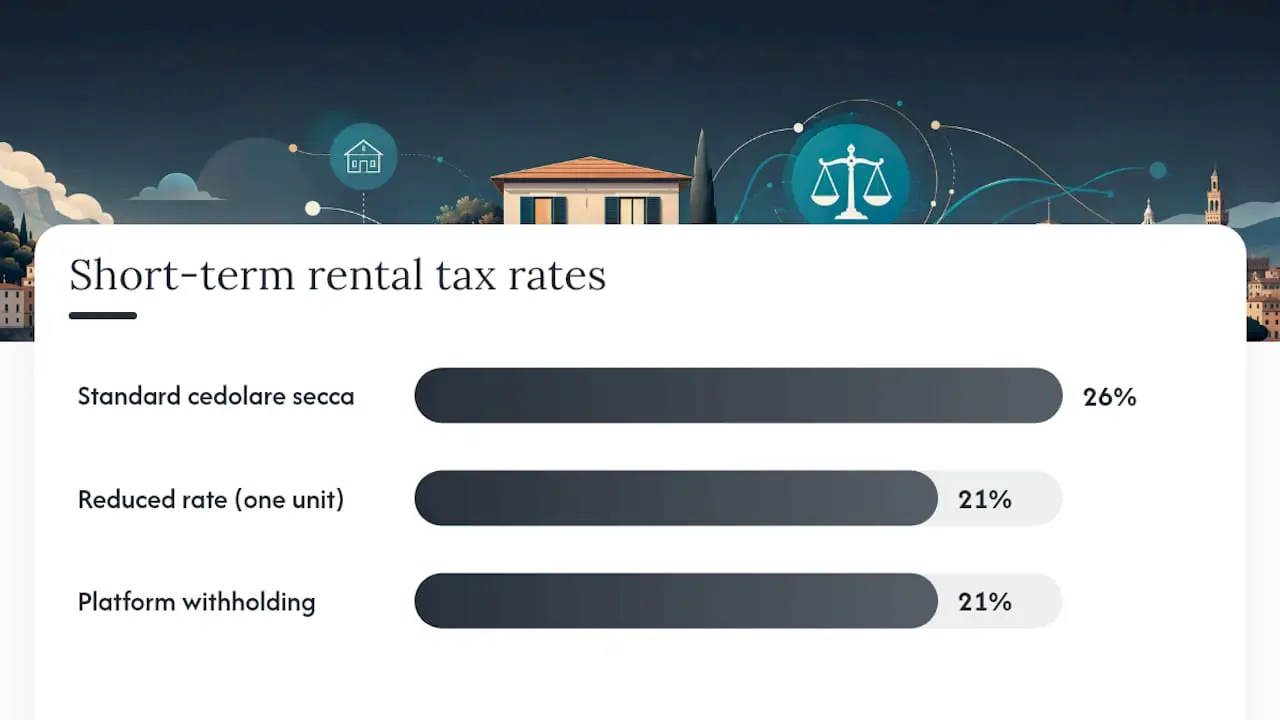
If you rent out one or two apartments short-term in Italy, cedolare secca is almost certainly your best option, and it comes down to two numbers: two units and two rates. Stay at two apartments or fewer and you can elect the flat 26% cedolare secca on short-term rental income, or drop to 21% on one unit you name in your tax return. Cross into a third apartment and the Agenzia delle Entrate presumes you’re running a business, which pulls you out of cedolare secca entirely.
- Unit limit: cedolare secca for locazioni brevi is capped at two apartments per owner per tax year.
- Rates: 26% standard; 21% on exactly one unit you designate.
- Platform withholding: booking platforms must withhold 21% as an advance payment when they collect or forward rent.
It’s an acconto, an advance credited against what you actually owe. If you picked the wrong unit for the reduced rate, you could still owe more at filing.*
Key Takeaways
| Point | Details |
|---|---|
| Two-unit ceiling | Cedolare secca for locazioni brevi applies only up to two apartments per owner per year. |
| Rate structure | 26% standard rate, or 21% on one unit you name in your annual tax return. |
| Platform withholding | Intermediaries withhold 21% as an advance, paid via F24 with tax code 1919. |
| Third unit consequences | A third short-term unit typically triggers partita IVA affitti brevi and possible INPS obligations. |
| Co-ownership rule | Only the owner named on a withholding certificate can offset that specific withheld amount. |
| Living Italy support | Livingitaly’s tax planning and property management services handle regime selection, CIN registration, and platform documentation for international owners. |
This article is general information, not a substitute for advice from a qualified financial advisor. Consult a qualified financial professional about your own circumstances before acting on anything here.
Table of Contents
- How Cedolare Secca Works for Tassazione Affitti Brevi
- When Are F24 Payments and Tax Returns Due?
- What Happens if You Get Tassazione Affitti Brevi Wrong?
- Do You Need a Partita IVA for Short-Term Rentals?
- How to Register for Cedolare Secca and Get Your CIN
- Do Short-Term Rentals Trigger INPS Contributions?
- Key Rates, Limits, and Deadlines at a Glance
- What Can You Deduct Under Ordinary IRPEF Instead of Cedolare Secca?
- A Practical Checklist Before You File
- How Living Italy Handles Tax Planning and Rental Compliance
- Sources
- FAQ
How Cedolare Secca Works for Tassazione Affitti Brevi
Cedolare secca is a substitute tax that replaces IRPEF, regional and municipal surtaxes, and registration and stamp duties on rental income, all rolled into a single flat rate. The 213/2023 law](https://www.agenziaentrate.gov.it/portale/aree-tematiche/casa/affitto/cedolare-secca) also preserved the reduced 21% option for one unit.
The mechanism traces back to decreto legge n. 50/2017, which first extended cedolare secca to short-term rentals arranged directly or through intermediaries. The regime only applies to individuals, not companies, and only when the activity stays outside the scope of business income under art. 2082 of the Civil Code.
Here’s the part owners miss: electing cedolare secca isn’t automatic just because you qualify. You choose it when filing your tax return, and you must actively identify which single unit gets the 21% rate. Miss that step and every unit defaults to 26%, according to Agenzia delle Entrate guidance. If you own three apartments and rent all three short-term, you’re generally out of the regime altogether and looking at ordinary IRPEF or a Partita IVA, depending on how the activity is structured.
When Are F24 Payments and Tax Returns Due?
Cedolare secca doesn’t eliminate your filing obligations, it changes what you’re filing. You still report rental income in your annual tax return (the Modello Redditi Persone Fisiche or 730), where you formally elect the regime and designate your 21% unit.
Payment of your own cedolare secca liability follows the standard IRPEF calendar: an advance payment (acconto) typically due in June and November, with a balance settled the following June alongside your main tax return, all paid through Modello F24. If you use a booking platform that withholds tax, that platform faces its own separate deadline. Intermediaries acting as withholding agents must remit the 21% they’ve collected using F24 with tax code 1919 by the 16th of the month following the transaction.
By year-end, the platform issues you a certification (certificazione delle ritenute) showing exactly how much was withheld on your behalf. Keep that document. You’ll need it to reconcile the advance against your final liability when you file, and mismatches between what a platform reports and what you declare are one of the more common triggers for a follow-up letter from the tax authority. If you rent through multiple platforms, collect a certification from each one before filing, since Agenzia delle Entrate’s guidance treats each withholding as a distinct advance tied to that specific intermediary’s payments.
What Happens if You Get Tassazione Affitti Brevi Wrong?
Errors on short-term rental income tend to surface in one of two ways: a mismatch between platform-reported payments and your declared income, or a failure to register a property that should carry a Codice Identificativo Nazionale. Both draw scrutiny because the data trail is now largely automated. Platforms transmit guest and payment data directly to the tax authority, so a rental that never appears on your return is easy to flag.
Penalties for undeclared or underreported rental income follow the general framework for omitted or incorrect filings, and they scale with how late the correction comes and whether the authority caught it first. The good news: Italy’s ravvedimento operoso lets you self-correct before an audit notice arrives, paying the missing tax plus a reduced penalty and interest, with the penalty percentage shrinking the sooner you fix the error. Waiting for the Agenzia delle Entrate to find the discrepancy first removes that discount entirely.
A second, quieter risk sits with the two-unit limit itself. If you rent three or more apartments short-term without transitioning to a business structure, you’re not just losing access to cedolare secca. Owners who scale gradually, adding a third unit without revisiting their tax setup, are the most common ones caught out here. If you’re unsure whether your situation still qualifies, a mid-year check against your actual rental count costs far less than an unwinding after the fact.
Do You Need a Partita IVA for Short-Term Rentals?
The clearest trigger is the unit count. Rent one or two apartments short-term as a private individual and you stay eligible for cedolare secca, no Partita IVA required. Add a third and Agenzia delle Entrate presumes you’re operating a business, which generally means opening a partita IVA per affitti brevi and reclassifying your income from reddito fondiario (property income) to reddito d’impresa (business income).
Unit count isn’t the only trigger, though it’s the one that catches most owners off guard. If you offer hotel-style services, daily cleaning, breakfast, key handoff staffed like a front desk, rather than simply providing the property, tax authorities can treat that as a business activity regardless of how many units you own. One apartment run like a boutique hotel can trip the same wire as three apartments rented bare.
Consider two owners. The first rents two apartments in Rome through a single platform, handles bookings personally, and provides no services beyond the keys. She stays comfortably inside cedolare secca. The second owns three apartments in Florence, offers concierge check-in and daily housekeeping across all of them. He almost certainly needs a partita IVA affitti brevi and should evaluate whether regime forfettario affitti brevi status fits his revenue level, since forfettario offers a simplified flat-rate tax calculation for smaller businesses, though it comes with its own turnover ceiling and eligibility rules worth checking against your specific numbers before committing.
How to Register for Cedolare Secca and Get Your CIN
Getting compliant involves two separate registrations: one for taxation, one for the property itself.
There’s no separate advance application. The election happens at filing time, though you should decide your regime before the rental season starts so your record-keeping matches your final choice.
For the property side, every unit advertised for short-term rental needs a Codice Identificativo Nazionale, a national identification code tied to the specific property. You obtain the CIN through the national portal, and once issued, it must appear on every listing, whether on a booking platform or your own website. Platforms are increasingly required to verify a valid CIN before publishing a listing, so this step isn’t optional paperwork, it’s a prerequisite for advertising the property at all.
Practical sequence: confirm your unit count and regime choice first, register for the CIN before your first booking of the year, then keep the CIN number alongside your rental contracts and platform certifications in one file. If you’re managing units across different regions, note that some local rules around registration and tourist reporting layer on top of the national CIN requirement, so check your specific municipality before your first listing goes live.
Do Short-Term Rentals Trigger INPS Contributions?
For owners who stay within the private, non-entrepreneurial regime, short-term rental income generally doesn’t trigger INPS social security contributions. Rental income taxed as reddito fondiario under cedolare secca is treated as passive property income, not earned income from work, so it sits outside the ordinary INPS contribution base.
That changes once you cross into business territory. If exceeding the two-unit threshold pushes you into entrepreneurial activity, income reclassifies as reddito d’impresa, and depending on how you structure the activity, INPS contributions and VAT obligations may apply.
If you’re weighing whether to expand from two units to three, run the INPS and VAT implications alongside the tax rate comparison, not after it. A property that looks profitable at cedolare secca’s flat rate can look very different once contribution obligations enter the calculation. This is one area where getting professional input before adding a unit, rather than after, tends to save owners real money.

Key Rates, Limits, and Deadlines at a Glance
| Item | Detail |
|---|---|
| Unit limit for cedolare secca | Maximum two apartments per owner per tax year |
| Standard cedolare secca rate | 26% on short-term rental income |
| Reduced rate | 21% on one unit designated in the annual tax return |
| Platform withholding | 21% withheld by intermediaries, paid via F24 with tax code 1919 by the 16th of the following month |
| Cedolare secca election | Made when filing the annual tax return (Modello Redditi or 730) |
| CIN requirement | Mandatory national code per property before listing on any platform |
| Correction mechanism | Ravvedimento operoso, reduced penalties for self-correction before audit |
This table only covers the private regime. Once you’re past two units and operating as a business, ordinary IRPEF brackets, INPS contributions, and VAT rules replace nearly every line above.
What Can You Deduct Under Ordinary IRPEF Instead of Cedolare Secca?
Cedolare secca trades simplicity for a hard tradeoff: you can’t deduct expenses against it. The flat rate applies to gross rental income, full stop. Ordinary IRPEF works differently, and for owners with significant costs, that difference can matter more than the headline rate suggests.
Under ordinary taxation, rental income from a property held as reddito fondiario still receives a standard deduction (currently a percentage reduction applied automatically before IRPEF brackets), but the real advantage shows up if your activity has been reclassified as reddito d’impresa. At that point you can deduct actual operating costs: cleaning services, platform commissions, utilities during guest stays, minor maintenance, and depreciation on furnishings. For an owner running several units with real operating overhead, those deductions can offset a meaningful share of income before tax applies.
This is a calculation worth running with actual numbers rather than assuming one regime beats the other by default. A single high-cost apartment with heavy renovation depreciation might do better under ordinary IRPEF even at two units, while a low-cost, high-occupancy unit almost always favors cedolare secca.
A Practical Checklist Before You File
If you co-own a property, confirm who signs contracts. A withholding certificate issued to one owner alone lets only that owner offset the withheld tax, leaving co-owners exposed unless certifications are split correctly. Pro Tip: Keep one folder per unit containing the rental contract, every platform payout statement, and the CIN registration. It turns a stressful audit into a five-minute lookup.
How Living Italy Handles Tax Planning and Rental Compliance
That’s where a lot of owners lose time and money, not because the rules are secret, but because nobody is tracking the deadlines and paperwork on their behalf.

Beyond the tax side, the property management team handles CIN registration, platform coordination, and collecting the withholding certifications you’ll need at filing time, so nothing falls through the cracks between your bookings and your accountant. If you’re weighing whether to add a third unit or restructure how you hold your properties, the investment property advisory team can model the tax and INPS impact before you commit. Reach out through Livingitaly’s advisory services to start a compliance review of your current rental setup.
Sources
- Cedolare Secca – Agenzia delle Entrate
FAQ
What Is the Cedolare Secca Rate for Short-Term Rentals in 2026?
The standard rate is 26%, with a reduced 21% option available on one unit you designate in your annual tax return.
How Many Apartments Can I Rent Short-Term Without a Partita IVA?
Up to two apartments per tax year under the private regime; a third unit generally triggers a presumption of business activity.
Does the Platform’s 21% Withholding Cover My Full Tax Bill?
No, the 21% withheld by booking platforms is an advance payment, credited against your final liability when you file your tax return.
What Happens if I Forget to Choose My 21% Unit?
Can Living Italy Help Me Decide Between Cedolare Secca and Ordinary IRPEF?
Yes, Livingitaly’s tax planning and property management services help owners compare regimes, register for a CIN, and coordinate platform withholding documentation.