
Italy’s non-dom flat tax regime lets qualifying new residents pay a single fixed annual sum on all foreign-source income, replacing the ordinary progressive rates that would otherwise apply to worldwide earnings. As of january 1, 2026, that sum is €300,000 per year for the main taxpayer, up from €200,000 under the previous structure, with an additional €50,000 per family member who opts in. The regime runs for up to 15 years and sits under Article 24-bis of Italy’s Tax Code (TUIR).
For the right profile, the math is compelling. An investor with high annual foreign income pays the fixed annual Italian tax on all of it, regardless of the total. Under Italy’s ordinary progressive IRPEF rates, the same income would face the top marginal rates. The regime also exempts taxpayers from foreign asset reporting obligations, wealth tax on assets held abroad, and inheritance or gift tax on foreign assets transferred outside Italy.
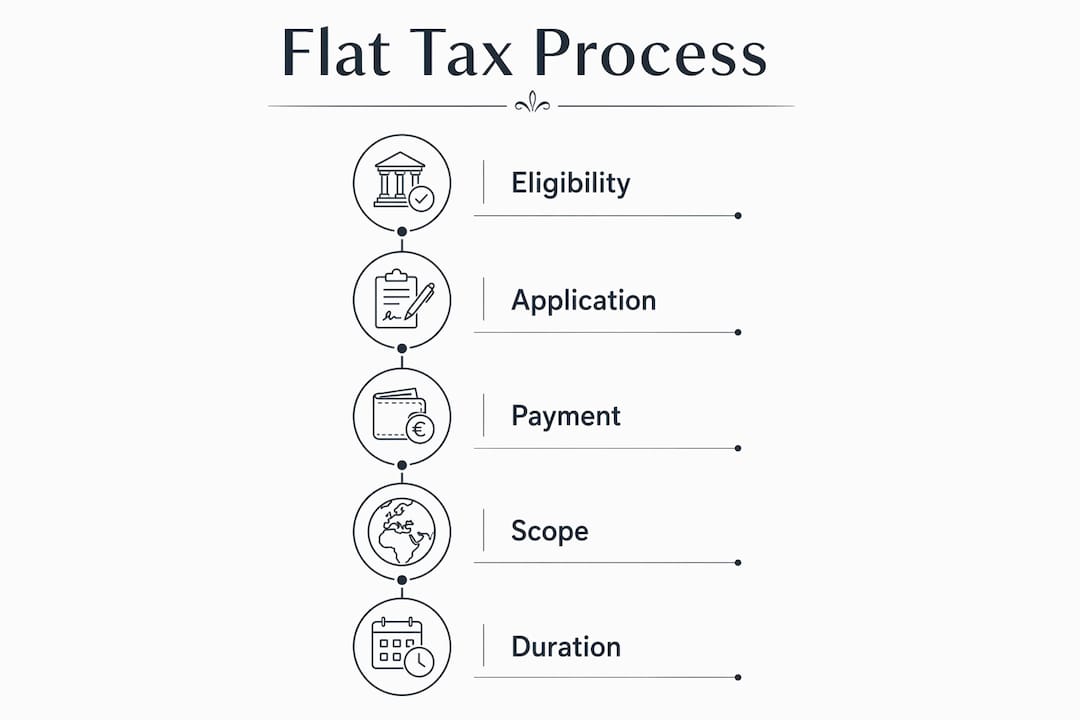
Key facts at a glance:
- Annual flat tax: €300,000 (main taxpayer), €50,000 (each qualifying family member) from January 1, 2026
- Eligibility: Must not have been Italian tax resident for at least 9 of the previous 10 years
- Duration: Up to 15 years, non-renewable
- Coverage: Foreign-source income only; Italian-source income stays on ordinary IRPEF rates
- Exclusion: Capital gains from qualified share disposals in the first 5 years are taxed ordinarily at 26%
- Reporting relief: No foreign asset declarations, no foreign wealth tax, no foreign inheritance tax
- Grandfathering: Those who established Italian residence before january 1, 2026 remain under the prior rate structure
The 2026 Budget Law (Law 199/2025) made the regime more selective. At €300,000 per year, the break-even point against ordinary taxation has shifted upward, refocusing the regime’s appeal on ultra-high-net-worth individuals rather than mid-tier earners. Anyone with foreign income below roughly €700,000 annually should run the numbers carefully before committing.
What are the eligibility requirements for Italy’s flat tax?
The core eligibility rule is straightforward: you must not have been an Italian tax resident for at least 9 of the 10 tax years immediately before transferring your residence to Italy. Nationality is irrelevant. An American, a British national, a Swiss citizen, or a UAE resident all qualify on equal footing, provided the non-residency window is met. Italian tax authorities verify this rigorously, and the burden of proof sits with the taxpayer.
What “habitual abode” means in practice
The 2026 law ties eligibility to the concept of “habitual abode” under Article 43, Paragraph 2 of the Italian Civil Code, which defines residence as the place where an individual has their habitual abode. This is more than a formal registration. Tax authorities look at where you actually live day-to-day, where your family is based, where you spend most of your time, and where your social and economic ties are centered. Registration in the Official Register of the Italian resident population creates a rebuttable presumption of residence, with legal effect from the date the enrollment request is submitted to the relevant municipality.
The interpretive uncertainty around “habitual abode” is one of the regime’s genuine risks. Someone who splits time between Milan and London, or who maintains a home and business interests in the US while spending winters in Tuscany, may face a challenge from the Italian Revenue Agency (Agenzia delle Entrate) over whether Italy is truly their habitual abode. Litigation risk here is real, and it has increased since the 2026 law brought the concept to the forefront.
Family member eligibility
Qualifying family members, as defined under the Italian Civil Code, can be included in the regime at an additional €50,000 per person per year. Each family member must also establish Italian tax residency and maintain it throughout the option period. Their eligibility depends on their own residency compliance and timely payment of the separate substitute tax.
Key eligibility requirements:
- Non-residency in Italy for at least 9 of the previous 10 tax years (applies to each person individually)
- Transfer of tax residence to Italy, with registration in the municipal population register
- Habitual abode established in Italy, supported by factual evidence of daily life, family presence, and economic activity
- Family members must independently satisfy residency conditions and pay the €50,000 annual substitute tax
- No nationality restriction; open to individuals of any citizenship
Pro Tip: File an advance tax ruling with the Agenzia delle Entrate before establishing Italian residence. The agency has 90–120 days to respond, and a positive ruling gives you legal certainty before you commit to the move. Silence from the agency after that window may be treated as tacit approval, but qualified legal counsel is strongly advised regardless.
How does the flat tax work in Italy: rates, scope, and duration
The mechanics are cleaner than most tax regimes, but the details matter.

Rate structure and payment timing
The substitute tax is paid in a single annual installment. The deadline is June 30 of each year, or July 30 with a 0.4% surcharge. There is no installment option and no partial payment. The tax is not deductible from any other Italian tax or contribution.
| Parameter | Main taxpayer | Each family member |
|---|---|---|
| Annual flat tax (from Jan 1, 2026) | €300,000 | €50,000 |
| Prior rate (before 2026) | €200,000 | — |
| Maximum duration | 15 years | 15 years (tied to main taxpayer) |
| Payment deadline | June 30 (or July 30 + 0.4%) | Same |
| Income covered | Foreign-source only | Foreign-source only |
| Italian-source income | Ordinary IRPEF rates | Ordinary IRPEF rates |
Individuals who established Italian residence before January 1, 2026 are not affected by the rate increase. They remain under the €200,000 structure for the remainder of their 15-year window, regardless of whether they had already filed a ruling request.
What income the regime covers and what it excludes
The substitute tax applies to all personal income generated outside Italy, covering foreign dividends, foreign rental income, foreign interest, foreign capital gains (with one critical exception), and foreign employment income earned abroad. Italian-source income of any kind falls outside the regime and is taxed under ordinary IRPEF progressive rates, which top out at 43%.
The critical exclusion: capital gains from qualified share disposals in the first 5 fiscal years of the regime are taxed at the ordinary rate of 26%, not covered by the flat tax. A “qualified” shareholding generally means a stake above certain thresholds in a non-listed company. After the 5-year window, these gains fall back under the flat tax umbrella.
Reporting exemptions and other tax interactions
Under the regime, taxpayers are exempt from foreign asset reporting obligations (the RW form in Italian tax returns), from the Italian wealth tax on financial assets held abroad (IVAFE), and from the wealth tax on real property held outside Italy (IVIE). Inheritance and gift tax applies only to assets located within Italy. Foreign assets transferred abroad are untaxed under Italian inheritance rules.
Property taxes on Italian real estate, including IMU (the main municipal property tax), still apply normally. The flat tax regime does not shelter Italian property ownership from local taxes. For a detailed breakdown of what you will owe on Italian property, the property tax obligations for foreign buyers are worth reviewing before acquisition.
The regime is also compatible with employment and professional activities carried out in Italy, which are taxed under ordinary IRPEF rules. A recent ruling by the Agenzia delle Entrate (december 2025) confirmed that the non-dom regime can now be combined with the inbound workers favorable tax regime under Article 5 of Legislative Decree 209/2023, opening additional planning opportunities for executives relocating to Italy.
How do you apply for Italy’s non-dom flat tax regime?
There are two entry points. You can elect into the regime either in the tax return for the first fiscal year in which you become an Italian tax resident, or in the return for the following fiscal year. The second option gives you a full year to assess your situation before committing.
Step-by-step application process
- Establish Italian tax residency. Register with your local municipality (Comune) and obtain your Italian tax code (codice fiscale). Legal effects of registration run from the date the enrollment request is submitted.
- File an advance ruling (optional but strongly recommended). Submit a ruling request to the Agenzia delle Entrate before or shortly after establishing residence. The agency has 90–120 days to respond. A positive ruling confirms eligibility and protects against future disputes.
- Elect the regime in your tax return. Exercise the option in the annual income tax return (Modello Redditi PF) for the first or second year of Italian residence.
- Pay the substitute tax by the deadline. Transfer €300,000 (plus €50,000 per included family member) by june 30, or by july 30 with the 0.4% surcharge.
- Maintain annual compliance. Repeat the payment each year. Missing a payment, even partially, terminates the regime immediately and permanently.
Documentation you will need
- Proof of non-residency in Italy for the 9-of-10-year qualifying period (foreign tax returns, foreign residency certificates, utility bills, lease agreements, employment records)
- Evidence of habitual abode transfer to Italy (municipal registration, lease or purchase contract for Italian home, school enrollment for children, Italian bank account activity)
- Identification documents and Italian codice fiscale
- For family members: individual residency documentation and separate payment records
Pro Tip: Time your arrival carefully relative to the Italian tax year, which runs january 1 through december 31. Establishing residence in the second half of the year means your first full tax year under the regime starts january 1 of the following year, giving you more time to organize documentation and structure assets before the first €300,000 payment falls due.
The advance ruling process is not mandatory, but tax practitioners widely treat it as best practice. The residency and visa process for Americans moving to Italy involves several overlapping legal steps, and coordinating the tax ruling with the immigration timeline reduces the risk of gaps in coverage.
What are the key exemptions, limitations, and planning risks?
The regime’s appeal is real, but so are its constraints. Getting the most out of it requires planning that starts before you land in Italy, not after.
Major exemptions
- Foreign asset reporting (RW form): fully exempt
- IVAFE (wealth tax on foreign financial assets): exempt
- IVIE (wealth tax on foreign real property): exempt
- Italian inheritance and gift tax on foreign assets: exempt
- Foreign income taxation: replaced by the €300,000 annual substitute tax
Limitations and compliance risks
The regime’s most unforgiving feature is its all-or-nothing structure. Missing the annual payment, even by a single euro, terminates the benefit immediately. There is no cure period, no reinstatement, and no partial credit for years already paid. The 15-year clock stops, and ordinary worldwide taxation resumes from that point forward.
Capital gains on qualified share disposals in the first 5 years are excluded from the flat tax and taxed at 26% under ordinary rules. Investors holding significant stakes in non-listed companies should restructure those holdings before arriving in Italy, or accept that those gains will face ordinary taxation for the first five years.
The regime is fundamentally elective and all-or-nothing in nature. Once you miss a payment or lose Italian residency, the benefit ends without any possibility of reinstatement. The burden of proof on both residency status and income source classification lies entirely with the taxpayer, which makes thorough pre-arrival structuring and ongoing legal advice not optional but necessary.
Strategic planning considerations
- Pre-arrival asset restructuring: Reorganize foreign portfolios before establishing Italian residence to maximize the income streams covered by the flat tax and minimize exposure to the qualified-share exclusion.
- Income source classification: Foreign income classification under Italian law is complex. Employment income, investment income, and business income may be treated differently even when all originate outside Italy. Get a formal classification opinion before filing.
- Double taxation treaties: Italy has tax treaties with over 90 countries. The flat tax does not automatically override treaty provisions. In some cases, you can elect out of the substitute tax for income from specific countries and instead claim treaty relief and a foreign tax credit under ordinary rules.
- Selective country opt-out: The regime allows you to exclude specific foreign countries from the flat tax and apply ordinary IRPEF rules to income from those countries instead, with a corresponding foreign tax credit. This can be advantageous when treaty rates in a particular country are lower than the effective rate implied by the €300,000 flat tax.
- Residency continuity: If you relocate out of Italy before the 15-year window closes, the regime ends in the tax year you lose Italian residence. Plan your exit as carefully as your entry.
The 2026 rate increase has narrowed the regime’s sweet spot. At €300,000 per year, the flat tax only makes financial sense if your foreign income is high enough that ordinary IRPEF would cost more. For most investors, that threshold sits well above €700,000 in annual foreign income, depending on the income mix and applicable treaties.
How does Italy’s flat tax compare to other European non-dom regimes?
Italy is not alone in offering a non-dom style tax incentive, but its structure differs meaningfully from the programs offered elsewhere in Europe.
| Country | Annual flat tax / rate | Eligibility window | Maximum duration | Foreign asset reporting |
|---|---|---|---|---|
| Italy | €300,000 lump sum | Non-resident 9 of prior 10 years | 15 years | Exempt |
| Portugal (NHR) | flat rate on qualifying income | First-time resident | 10 years | Required |
| Greece | €100,000 lump sum | Non-resident 9 of prior 10 years | 15 years | Exempt |
| Malta (HNWI) | — | Non-domiciled resident | Indefinite | Required |
| Switzerland (forfait) | Based on living expenses (5x rent) | Non-working foreign national | Indefinite | Exempt |
Italy’s lump-sum structure is the most straightforward for very high earners. Greece offers a similar model at €100,000, which is more accessible for mid-tier investors, though Italy’s broader treaty network and lifestyle infrastructure often tip the decision for American buyers. Portugal’s non-habitual resident (NHR) program, in its original form, offered a rate-based rather than lump-sum approach, which worked differently for earned income versus passive income.
A practical example for an American investor
Consider an American investor with the following annual foreign income: $2 million in US stock dividends, $800,000 in rental income from US properties, and $500,000 in capital gains from non-qualified US equity sales. Total foreign income: approximately $3.3 million.
Under Italy’s flat tax, the entire amount is covered by the €300,000 annual payment (roughly $330,000 at current exchange rates, though the tax is denominated in euros). Under ordinary IRPEF, the top 43% rate would apply to most of that income, producing a tax bill many times larger. The flat tax also eliminates the need to report foreign assets, file IVAFE returns, or navigate Italian inheritance tax on US holdings.
For international property investors pairing Italian residency with a property purchase, the regime creates a clean tax environment for foreign income while Italian rental income from the property is taxed separately under ordinary rules or the cedolare secca flat rate for residential leases.
Practical tips for investors and expatriates using Italy’s flat tax
Getting the regime right is as much about sequencing as it is about eligibility. The following considerations come up repeatedly for American and international clients navigating the process.
- Verify your 9-of-10 non-residency window with documentation before you move. Italian tax authorities check this rigorously. Foreign tax returns, foreign residency certificates, and employment records from the qualifying period are the strongest evidence.
- Structure your Italian property purchase alongside your residency plan. Buying property in Italy before establishing tax residency can complicate the habitual abode analysis. Coordinate the timing with your tax advisor.
- Do not rely on the flat tax to cover Italian rental income. If you buy a villa and rent it out, that income is Italian-source and taxed under ordinary rules or the cedolare secca regime. Budget accordingly.
- Account for the €300,000 payment in your liquidity planning. The payment is due in a single installment by june 30. Missing it ends the regime permanently.
- Review your US tax obligations separately. American citizens remain subject to US federal income tax on worldwide income regardless of Italian residency. The Italy-US tax treaty and the Foreign Tax Credit mechanism interact with the flat tax in ways that require specialist advice from a US-qualified tax attorney alongside Italian counsel.
- Consider the regime’s interaction with Italian succession law. Foreign assets are exempt from Italian inheritance tax under the regime, but Italian assets, including real estate, are not. If you plan to pass Italian property to heirs, factor Italian succession rules into your estate plan from the start.
Pro Tip: Arrive in Italy in the second half of the calendar year if your situation allows. Establishing residence after july 1 means your first full Italian tax year begins january 1 of the following year, giving you additional time to complete pre-arrival asset restructuring and file the advance ruling before your first €300,000 payment is due.
Working with advisors who understand both the Italian tax framework and the real estate market is not a luxury at this level. The investment advisory services that integrate tax planning with property acquisition decisions save clients from costly misalignments between their residency choice and their asset structure.
Key takeaways
Italy’s flat tax regime offers qualifying new residents a fixed €300,000 annual substitute tax on all foreign-source income, making it one of Europe’s most favorable structures for high-net-worth individuals with substantial overseas earnings.
| Point | Details |
|---|---|
| Eligibility threshold | Must not have been Italian tax resident for at least 9 of the prior 10 years; applies to each individual separately. |
| 2026 rate increase | Annual flat tax rose to €300,000 (main taxpayer) and €50,000 (per family member) from January 1, 2026. |
| All-or-nothing compliance | Missing the annual payment, even partially, terminates the 15-year benefit immediately with no reinstatement. |
| Italian income stays taxable | Foreign-source income is covered; Italian-source income, including local property rental, remains on ordinary IRPEF rates. |
| Livingitaly advisory | Livingitaly integrates flat tax planning with buyer-side property acquisition for American investors relocating to Italy. |
Why Italy’s flat tax is more nuanced than most guides admit
The regime looks clean on paper: pay €300,000, shelter your foreign income, enjoy 15 years of Italian life. The reality is more layered, and the 2026 rate increase has made the gaps harder to ignore.
The first thing most guides understate is the habitual abode problem. Italy’s tax authorities are not simply checking whether you registered at a Milan address. They are looking at where your life actually is, where your family lives, where you spend your time, and where your economic center of gravity sits. For Americans who maintain homes, businesses, and family ties in the US while spending part of the year in Italy, that analysis can go badly. The litigation risk around “habitual abode” has grown since the 2026 law made the concept central to eligibility, and a disputed residency determination does not just cost you the flat tax. It can trigger back-taxes on worldwide income under ordinary IRPEF rates.
The second underappreciated issue is the interaction with US tax obligations. American citizens do not escape US federal taxation by moving to Italy. The Foreign Tax Credit can offset some of the double taxation, but the mechanics are not automatic. The €300,000 flat tax is a lump sum, not a per-income-stream tax, which creates complications when trying to match it against specific US income categories for credit purposes. You need both Italian and US-qualified counsel working together, not sequentially.
The third point worth making is about the regime’s real target audience after 2026. At €300,000 per year over 15 years, the total cost of the regime is €4.5 million before family members. That is a meaningful commitment. The regime makes clear financial sense for individuals with foreign income well into the millions annually. For someone with €800,000 in foreign income, the math is tighter and the advance ruling process becomes even more critical to confirm that the structure actually delivers what it promises.
None of this makes Italy the wrong choice. For the right investor, the combination of the flat tax, Italy’s treaty network, the exemption from foreign asset reporting, and the lifestyle and real estate opportunity is genuinely compelling. But it rewards preparation, not impulse.
Livingitaly’s advisory approach for residency and investment clients
Pairing Italian residency with a property purchase is one of the most tax-efficient moves available to American high-net-worth investors right now, but only when the two decisions are coordinated from the start.

Livingitaly works exclusively on the buyer’s side, which means every recommendation, from property selection to legal due diligence to tax structuring, is built around your interests, not a seller’s commission. For clients pursuing the non-dom flat tax regime, that coordination matters at every stage: timing the property purchase relative to residency establishment, structuring ownership to align with the flat tax’s foreign-asset exemptions, and integrating Italian succession planning into the acquisition from day one.
The investment property advisory services cover the full acquisition cycle, including SPV and corporate structuring for investors who prefer to hold Italian real estate through an entity, renovation project management for buyers targeting historic properties, and ongoing property and rental management after closing. For Americans new to the Italian market, having a single advisory team that speaks both the tax language and the real estate language removes the coordination risk that typically falls through the gaps between separate advisors.
If you are considering Italian residency and want to understand how the flat tax interacts with a specific property or portfolio, Livingitaly offers a structured consultation to map the options before you commit.