
TL;DR:
- Most second homes in Italy are subject to IMU, a municipal property tax based on cadastral income and local rates. Owners must pay two installments annually, with reductions possible for certain rental contracts or relationships with relatives. Accurate calculation and timely payment depend on verifying cadastral data, municipal rates, and properly registering any applicable reductions.
Every second home in Italy is subject to IMU, the municipal property tax, regardless of whether you use it, rent it, or leave it empty. The annual bill follows one formula: rendita catastale × 1.05 × 160 × aliquota comunale. Three variables determine what you actually owe:
- Rendita catastale — the cadastral income recorded at the Agenzia delle Entrate for your specific unit
- Aliquota comunale — your municipality’s rate, which ranges from 0.76% up to 1.06% (7.6–10.6 per mille)
- Quota di possesso — your ownership share, if the property is co-owned
The tax is on possession, not income. A vacation home left empty all year still generates a full IMU bill.
Table of Contents
- What is IMU on a second home and why do you owe it?
- When do you pay IMU on a second home?
- How do you calculate IMU for a second home?
- What is your Comune’s IMU rate and how do you verify it?
- Which reductions and exemptions can apply to a second home?
- Worked example: calculating IMU for a sample second home
- How do you pay IMU and what mistakes should you avoid?
- When should you check or contest your rendita catastale?
- Practical strategies and when to consult a specialist
- Key Takeaways
- Why IMU clarity protects your investment
- Livingitaly can help you manage IMU and property tax compliance
- Practical sources and legal references
- FAQ
What is IMU on a second home and why do you owe it?
IMU (Imposta Municipale Propria) is a municipal property tax levied on the owner of record, or on whoever holds a real right over the property — usufruct, for example. “Second home” for IMU purposes means any residential property that is not your registered principal residence and habitual dwelling. This includes vacation homes, investment flats, properties held for future use, and even a garage or cellar that exceeds the one-per-category pertinence allowance attached to your primary residence.
Co-ownership does not eliminate the obligation; each co-owner pays IMU proportional to their registered share. A 50% owner pays half the annual bill, calculated independently.
Pro Tip: Buying under Italy’s agevolazioni prima casa (first-home purchase incentives) reduces registration and mortgage taxes at the notary — but it does not exempt you from IMU. The IMU exemption for a principal residence requires that you actually live there as your habitual dwelling and hold registered residency at that address. If you later move your residency elsewhere, the property becomes a second home for IMU purposes, even if you originally bought it under first-home incentives.
IMU liability also applies when a property is classified as a disposizione — held available but unoccupied. There is no use-based threshold to cross before the tax kicks in.
When do you pay IMU on a second home?
IMU is split into two annual payments:
- Acconto (advance payment) — due by June 16 each year, calculated at 50% of the prior year’s total IMU using the previous year’s aliquota
- Saldo (balance) — due by December 16, covering the remaining amount recalculated at the current year’s confirmed aliquota
If you acquire or sell a property during the year, the 15-day rule determines how months are counted. A month counts as a full month if you held ownership for at least 15 days within it; fewer than 15 days and that month drops out of the calculation entirely. Seller and buyer split the annual bill based on their respective months of ownership.
Practical steps to stay on top of deadlines:
- Check your Comune’s website in April or May to confirm whether a new delibera has been approved for the current year
- If no new delibera is published by late October, the prior year’s aliquote carry forward automatically
- Keep a copy of the delibera you relied on for the acconto — you may need it if the Comune issues a correction notice
How do you calculate IMU for a second home?
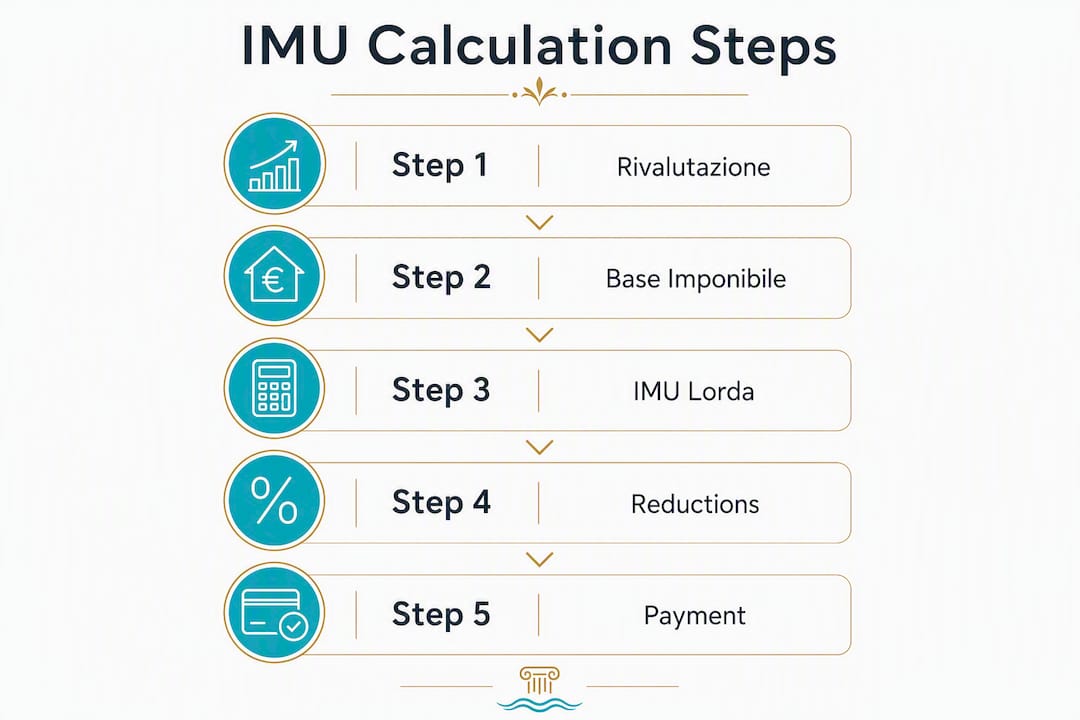
The calculation formula follows three steps:
Step 1 — Rivalutazione: Multiply the rendita catastale by 1.05 to apply the statutory 5% revaluation.

Step 2 — Base imponibile: Multiply that result by 160, the moltiplicatore for standard residential buildings (category A, excluding A/10).
Step 3 — IMU lorda: Multiply the base imponibile by the municipal aliquota expressed as a decimal (e.g., 10.6 per mille = 0.0106).
If you own a share of the property, multiply the IMU lorda by your ownership percentage. Round the final figure to the nearest euro for the F24 form.
To find your rendita catastale, pull a visura catastale through the Agenzia delle Entrate’s online portal or request it at any Agenzia delle Entrate office. The rendita is the figure listed under “rendita catastale” on the visura — not the market value, not the purchase price.
For the municipal aliquota, go directly to your Comune’s official website or the national delibere portal maintained by the Dipartimento delle Finanze. Never rely on a third-party estimate; rates change annually.
What is your Comune’s IMU rate and how do you verify it?
The statutory base rate for second homes is 0.76%; municipalities can raise it up to 1.06% (7.6–10.6 per mille) or set any rate within that range. Rates vary widely across Comuni, so you must verify the current rate for your location.
How to confirm the rate that applies to your property:
- Visit your Comune’s official website and search for “delibera IMU” or “aliquote IMU [year]”
- Check the Dipartimento delle Finanze portal, which publishes approved delibere for all Italian municipalities
- Call or visit the Ufficio Tributi at your Comune directly — they are required to provide the current aliquota on request
- If the Comune has not approved a new delibera by the late-October deadline, the previous year’s rate applies by law
Per-mille values convert simply: 10.6 per mille equals 1.06%, or 0.0106 as a decimal in your formula.
Which reductions and exemptions can apply to a second home?
Most second homes pay full IMU, but several legally recognized reductions exist:
- Canone concordato (25% reduction): Properties rented under a canone concordato contract (governed by L. 431/1998 and local territorial agreements) qualify for a 25% IMU reduction. The contract must be properly registered with the Agenzia delle Entrate. No separate application to the Comune is required — the registered contract is the documentation.
- Comodato to first-degree relatives (50% reduction): Lending the property free of charge (comodato d’uso gratuito) to a parent or child who uses it as their principal residence can reduce the taxable base by 50%. Conditions: the contract must be registered, the borrower must establish residency there, and the lender must own no more than two properties in Italy.
- Pensioners abroad (50% reduction, conditional): Owners registered with AIRE who receive a pension under an international social-security convention may qualify for a 50% reduction. This is not automatic and must be verified annually with supporting pension documentation. AIRE registration alone is not enough.
- Inagibilità / inabitabilità (50% reduction): A property certified as uninhabitable or structurally unfit qualifies for a 50% reduction. The condition must be certified by a municipal technical officer or a qualified professional and filed with the Comune.
- Historic properties: Properties classified as having historic or artistic interest may qualify for a reduced base imponibile under specific cultural-heritage rules.
Pro Tip: Falsely declaring residency at a property to claim the principal-residence IMU exemption is a serious offense. Tax authorities routinely cross-check utility consumption, vehicle registration, and school enrollment records against declared residency. A rejected claim triggers back taxes, interest, and penalties.
For the comodato reduction, keep the registered contract on file indefinitely. Comuni can and do request proof during audits, sometimes years after the reduction was first claimed.
Worked example: calculating IMU for a sample second home
Here is a realistic calculation for an apartment in a mid-size Italian city.
Base scenario:
| Step | Calculation | Result |
|---|---|---|
| Rendita catastale | Given | €700 |
| Rivalutazione (+5%) | €700 × 1.05 | — |
| Base imponibile | — × 160 | — |
| Municipal aliquota | 10.6 per mille (0.0106) | — |
| IMU lorda | — × 0.0106 | €1,246.56 → €1,247 |
| Acconto (June 16) | €1,247 × 50% | €624 |
| Saldo (December 16) | — | €623 |
Same property with canone concordato (25% reduction):
| Step | Calculation | Result |
|---|---|---|
| IMU lorda | €1,247 | — |
| 25% reduction | — | €935 |
| Acconto | — | €468 |
| Saldo | — | €467 |
The canone concordato reduction saves roughly €312 per year on this property. For a property with a higher rendita or a maximum municipal rate, the saving scales proportionally.
Round each payment to the nearest euro. If the total annual IMU is €257 or less, you may pay the full amount in a single December saldo rather than splitting it.
How do you pay IMU and what mistakes should you avoid?
IMU is paid via the F24 form, available through any Italian bank’s home banking platform, the Agenzia delle Entrate’s F24 web service, or a CAF (tax assistance center). The primary tax code for IMU on non-primary residential buildings is 3912 (“IMU altri fabbricati — quota Comune”).
Required fields on the F24:
- Codice tributo: 3912 for the Comune share
- Codice Comune: the four-character alphanumeric code for the municipality where the property is located (not where you live)
- Anno di riferimento: the tax year
- Acconto or saldo: mark the correct box — both cannot be checked simultaneously
- Importo: the rounded euro amount
Common mistakes to avoid:
- Using the wrong codice Comune — this is the most frequent error and can result in the payment being credited to the wrong municipality
- Failing to file separate F24 rows when you own properties in more than one municipality
- Not recording your ownership share when the property is co-owned
- Paying the full annual amount in June instead of splitting it correctly
Keep your F24 receipts for at least five years. If you want written confirmation that a payment was received and credited correctly, you can request a quietanza from the Comune’s Ufficio Tributi.

When should you check or contest your rendita catastale?
The rendita catastale is the foundation of every IMU calculation, so an incorrect value directly inflates your tax bill. Common causes of errors include outdated category classifications, renovations that were never updated in the cadastral records, and data-entry mistakes when the property was first registered.
Pull a visura catastale from the Agenzia delle Entrate to check the recorded rendita, category, and surface area. Compare it against similar units in the same building or street. A significant gap — say, your unit shows a rendita 40% higher than a comparable flat on the same floor — is a signal worth investigating.
If you find an error, the process runs through the Agenzia delle Entrate:
- File a request for a classamento or consistenza revision, supported by floor plans and comparable unit data
- The Agenzia reviews the submission and may send a technical inspector
- If approved, the corrected rendita applies from the date of the request, not retroactively — so act promptly
Disputes can take several months to resolve. In the meantime, pay IMU based on the current recorded rendita to avoid late-payment penalties, and then request a refund once the correction is confirmed.
Practical strategies and when to consult a specialist
Several legal moves can reduce your IMU exposure without any gray area:
- Register a comodato d’uso gratuito with a qualifying first-degree relative and ensure they establish actual residency
- Sign and register a canone concordato rental contract if you plan to rent the property long-term
- Verify your rendita catastale before the June acconto deadline each year — catching an error early saves both tax and interest
Situations that justify bringing in a specialist rather than handling IMU alone:
- You are registered with AIRE or receive a foreign pension and want to assess whether the 50% pensioner reduction applies to your case
- The property is co-owned through an Italian or foreign corporate structure
- You hold multiple properties across different municipalities and need consolidated compliance
- You suspect a cadastral misclassification but are unsure how to document the revision request
For international buyers and nonresident owners, property tax planning is rarely a one-time calculation. Municipal rates shift annually, cadastral records drift out of date, and reduction eligibility changes with personal circumstances. Livingitaly works with international clients on exactly these situations — connecting owners with qualified Italian tax professionals, supporting documentation for reductions, and integrating IMU planning into the broader cost analysis of owning property in Italy.
Key Takeaways
IMU on a second home in Italy is calculated as rendita catastale × 1.05 × 160 × municipal aliquota, with the June and December deadlines applying to every owner regardless of whether the property is occupied.
| Point | Details |
|---|---|
| Core formula | Rendita catastale × 1.05 × 160 × aliquota comunale gives your annual IMU base. |
| Municipal rates | The statutory base rate for non-primary residences is 0.76%; most Comuni set rates up to the 1.06% maximum. |
| Payment deadlines | Acconto by June 16, saldo by December 16; use F24 code 3912 for the Comune share. |
| Key reductions | Canone concordato cuts IMU by 25%; a registered comodato to a qualifying relative cuts the base by 50%. |
| Livingitaly support | Livingitaly connects nonresident and international owners with Italian tax specialists for IMU planning and documentation. |
Why IMU clarity protects your investment
Most buyers underestimate how much IMU shapes the true holding cost of an Italian property. A vacation apartment with a rendita of €700 in a high-rate municipality generates roughly €1,247 per year in IMU alone, before any maintenance, insurance, or utility costs. Over a ten-year hold, that is a meaningful line item that belongs in any honest underwriting model.
What I find consistently overlooked is the municipal rate variable. Buyers research purchase prices obsessively but rarely check the local aliquota before signing. Two comparable properties in neighboring towns can carry IMU bills that differ by 30% or more simply because one municipality set its rate at 7.6 per mille and the other at 10.6 per mille. That gap compounds every year.
The reductions are real, but they require discipline. A comodato arrangement that is not properly registered, or a canone concordato contract that lapses without renewal, loses its reduction retroactively in an audit. The paperwork is not complicated, but it has to be done correctly and maintained. For owners managing Italian property from abroad, that ongoing compliance is exactly where things tend to slip.
Livingitaly can help you manage IMU and property tax compliance
Calculating IMU correctly is straightforward once you have the right inputs. Getting those inputs right — a verified rendita, the current municipal aliquota, a properly registered reduction contract — is where international owners consistently run into trouble.

Livingitaly works with buyers and owners from the US, UK, and beyond to integrate IMU and property tax planning into the full picture of owning in Italy. That means connecting you with qualified Italian tax professionals, supporting the documentation needed for reductions like canone concordato or comodato, and flagging cadastral discrepancies before they become multi-year overpayments. For nonresident owners navigating AIRE status, pension conventions, or complex ownership structures, having a specialist in your corner from the start avoids the kind of errors that take years to unwind.
If you are buying or already own property in Italy and want a clear picture of your annual tax exposure, start with Livingitaly’s advisory services to get the numbers right before they surprise you.
Practical sources and legal references
| Source | What it covers | Why it’s useful |
|---|---|---|
| Dipartimento delle Finanze — Base imponibile IMU | Statutory formula, multipliers, and base imponibile rules | Primary legal source for the calculation formula |
| Agenzia delle Entrate — Codici tributo IMU | F24 tax codes for IMU payments | Look up code 3912 and other IMU codes here |
| Studio Mattonai — IMU 2026 scadenze e novità | 2026 deadlines, pertinence rules, luxury property exceptions | Practical summary of current-year rules |
| Sky TG24 — IMU 2026 calcolo e scadenze | Visura catastale access, cadastral revision steps | Guidance on checking and contesting rendita |
| PMI.it — IMU guida in 10 passi | Worked examples and second-home rate context | Practical calculation walkthrough with sample figures |
This article provides general information about Italian property tax rules. It is not professional tax or legal advice. Confirm current rates, deadlines, and eligibility conditions with the Agenzia delle Entrate, your Comune’s Ufficio Tributi, or a qualified Italian tax professional.
FAQ
How much does IMU on a second home typically cost per year?
For a property with a rendita catastale of €700 and a municipal rate of 10.6 per mille, the annual IMU comes to roughly €1,247. Higher rendite or lower municipal rates shift that figure proportionally.
When is IMU not owed on a second home?
IMU is not owed when the property qualifies as your registered principal residence and habitual dwelling. A few narrow exemptions apply — certified uninhabitable properties, certain rural buildings, and properties subject to documented abusive occupation — but standard second homes, including empty vacation properties, are always taxable.
What are the IMU 2026 deadlines for second homes?
The acconto is due by June 16, 2026, and the saldo by December 16, 2026. If a Comune has not published a new delibera by late October, the prior year’s aliquote apply to the saldo calculation.
Does AIRE registration exempt you from IMU on a second home?
No. AIRE registration alone does not grant an IMU exemption. A 50% reduction may be available to pensioners registered with AIRE who receive a pension under an international social-security convention, but it must be verified annually with supporting documentation.
Can Livingitaly help with IMU calculations and reductions?
Yes. Livingitaly connects international and nonresident property owners with qualified Italian tax professionals and supports the documentation needed for reductions such as canone concordato and comodato, as well as cadastral revision requests.