
TL;DR:
- Renovation costs in Italy vary from €300 to over €1,300 per square meter, depending on the project scope. Regional differences, permit requirements, and energy-efficiency incentives significantly influence the final budget. Proper planning, detailed quotes, and understanding tax incentives can reduce the net expense for homeowners.
Renovating a house in Italy typically costs a moderate to high amount per square meter, varying significantly by the depth of the work. A light refresh of a smaller apartment can cost a moderate amount, depending on the scope and specifics. A full renovation of a medium-sized apartment generally involves a substantial investment, varying with quality and location. For a complete renovation of a 100 m² apartment, costs typically run between €60,000 and €120,000 depending on the finish level, region, and systems included, as detailed in current market data and major market guides. Those numbers shift significantly based on where in Italy the property sits, whether you’re replacing the electrical and plumbing systems, and whether energy-efficiency upgrades qualify for Bonus Ristrutturazioni or Ecobonus deductions through the Agenzia delle Entrate. The single most common budgeting mistake is treating €/m² as a flat number. It isn’t.
Table of Contents
- What do renovation costs in Italy actually look like per square meter?
- Sample budgets for 50, 80, and 100 m² apartments
- Why do renovation prices vary so much across Italy?
- How do tax incentives and financing work for Italian renovations?
- How do you get a reliable renovation quote?
- Where can you save without hurting the result?
- How long does a renovation in Italy actually take?
- Questions to ask every contractor before signing
- How labor and materials split in Italian renovation budgets
- What insurance and warranty obligations apply during renovation?
- What does a renovation actually cost when you add taxes and fees?
- Key Takeaways
- The real cost of going it alone in Italy
- How Livingitaly supports your renovation from start to finish
- Useful sources
- FAQ
What do renovation costs in Italy actually look like per square meter?
The Italian market organizes renovation work into four practical bands. Understanding which band your project falls into is the fastest way to sanity-check any quote you receive.
Light renovation (€300–€500/m²): Cosmetic work only. Fresh plaster and paint, new flooring over existing substrate, updated fixtures in one bathroom, no changes to layout or systems. Suitable for properties that are structurally sound and have compliant electrical and plumbing already in place.
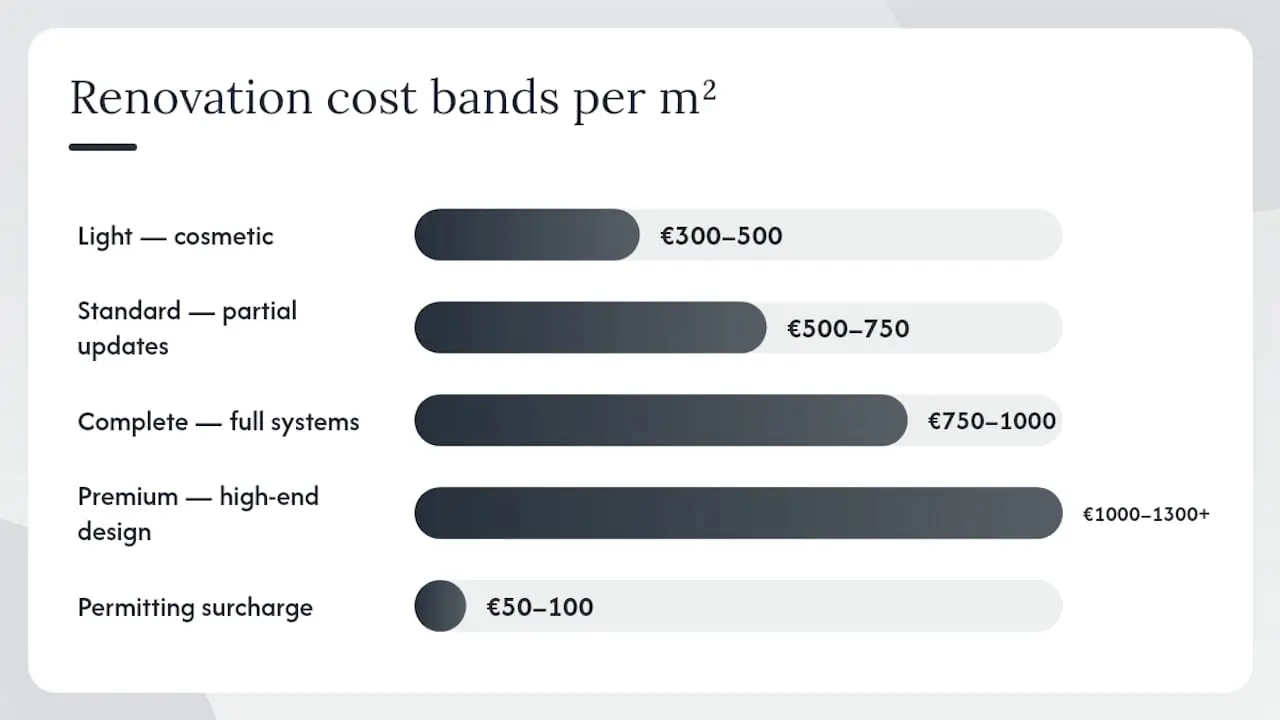
Standard renovation (€500–€750/m²): The most common band for apartments bought to live in or rent. Includes new flooring, full redecoration, one or two bathroom upgrades, partial kitchen renewal, and targeted system updates (e.g., replacing the boiler or upgrading the electrical panel without full rewiring). Layout stays largely intact.
Complete renovation (€750–€1,000/m²): Full systems replacement (electrical, plumbing, heating), new windows and doors, complete bathroom and kitchen fit-out, possible minor layout changes. This is the right band for properties that haven’t been touched in 20+ years or that need to meet current energy and safety standards.
Premium/design renovation (€1,000–€1,300+/m²): High-end finishes, bespoke joinery, underfloor heating, smart-home systems, full architectural design service. Often applies to historic properties, luxury apartments in city centers, or projects with a Soprintendenza (heritage authority) involvement.
One important trigger for jumping between bands: structural work, load-bearing wall removal, or a property under a vincolo storico (heritage listing) can push a standard-band project into the complete or premium band almost immediately, because the permitting, engineering, and supervision costs alone add €50–€100/m² before a single tile is laid. Benchmark data for 2026 confirms these band definitions and provides territorial multipliers for adjusting them to your region.
Sample budgets for 50, 80, and 100 m² apartments
Renovation costs vary widely depending on location and intervention level, with regional price adjustments and contingency budgeting advised for accurate estimation.
Key assumptions: These figures exclude VAT (typically 10% on renovation works for primary residences, 22% otherwise), professional fees beyond a basic geometra, furniture, and appliances. They also exclude any permit fees, which vary by municipality. A full renovation of 100 m² can reach €60,000–€120,000 once regional factors and finish level are applied.
One practical note on scaling: proportional math works reasonably well between 80 m² and 150 m². Below 60 m², expect the €/m² to run 10–15% higher than the table suggests, because fixed costs (project management, permit fees, mobilization) don’t shrink proportionally with the apartment size.
Why do renovation prices vary so much across Italy?
The gap between a renovation quote in Milan and one in Calabria for the same scope of work can easily reach 25–30%. Four factors drive most of that difference.
Labor costs are the biggest variable. Northern Italy, particularly Lombardy and the Veneto, has higher wage baselines for skilled tradespeople. The south has lower labor costs, though contractor availability and logistics can offset some of that saving.
Logistics and materials delivery add cost in islands (Sicily, Sardinia) and remote mountain areas. Ferry transport for materials, longer supply chains, and fewer competing suppliers push island renovation costs roughly 15–20% above the national baseline.
Regulatory and heritage complexity hits hardest in historic city centers. A property in Rome’s centro storico or Florence’s UNESCO zone may require Soprintendenza approval for any external change, adding months to the timeline and thousands in specialist fees.
Local demand matters too. In Milan and Rome, contractor capacity is tight and prices reflect it. Benchmark data puts the territorial adjustments at roughly North +5–10%, Center as the baseline, South −15%, and islands +20%.
In practice: a complete renovation priced at €85,000 in Rome might cost €90,000–€95,000 in Milan, €70,000–€72,000 in Naples, and €100,000–€102,000 in Palermo or Cagliari. For investors weighing north vs. south Italy as a purchase strategy, renovation cost differentials are a real input into the return calculation, not just a footnote.
How do tax incentives and financing work for Italian renovations?
Tax deductions that reduce your net cost
Italy’s Bonus Ristrutturazioni allows homeowners to deduct renovation expenses from their IRPEF (personal income tax) over ten years. The standard deduction rate is 50% on eligible expenses up to €96,000 per property unit for qualifying works on first homes; the rate drops to 36% on expenses up to €48,000 for other properties. These rules are subject to annual budget law changes, so always verify current thresholds directly with the Agenzia delle Entrate before committing to a budget.
The Ecobonus applies specifically to energy-efficiency upgrades (insulation, heat pumps, high-efficiency windows) and can reach higher deduction percentages for qualifying interventions. ENEA manages the technical data transmission process for Ecobonus claims — homeowners must submit the required documentation through the ENEA portal within 90 days of completing the works. Missing that window forfeits the deduction.
A practical illustration: a €50,000 complete renovation on a first home at 50% deduction over 10 years means €2,500 back per year in tax credits. That’s real money, but it requires you to have sufficient IRPEF liability to absorb it. Non-residents and low-income owners may not fully benefit.
One non-negotiable procedural requirement: all payments for deductible works must be made via bonifico parlante (a specific bank transfer format that includes the tax code of the payee, the invoice number, and the relevant legal reference). Cash payments disqualify the expense from any deduction. Also check property tax implications when planning a renovation that changes the property’s cadastral category or value.
Financing options compared
| Option | Typical amount | Duration | Speed | Best for |
|---|---|---|---|---|
| Personal renovation loan | €5,000–€75,000 | 2–10 years | Fast (days) | Small to mid projects, no collateral |
| Renovation mortgage top-up | €20,000–€150,000+ | 10–30 years | Slower (weeks) | Large projects, lower annual cost |
| Dedicated bank product (e.g., BNL Ristrutturazione) | Varies by lender | Up to 10 years | Medium | Mid-range projects with existing relationship |
Findomestic and Poste BancoPosta both offer dedicated renovation loan products with defined maximums and repayment terms. Personal loans are faster to arrange but carry higher annual interest rates than a mortgage top-up. For projects above €60,000–€70,000, the lower rate on a mortgage restructuring often outweighs the convenience of a personal loan, even accounting for the longer approval process.
How do you get a reliable renovation quote?
A quote that wins on price but loses on scope is the most expensive quote you’ll ever accept. Here’s the process that actually protects you.
- Prepare a written project brief before contacting any contractor. Include floor plan dimensions, photos of every room, your target finish level, and a list of known issues (damp patches, old wiring, cracked walls). Contractors who quote without this information are guessing.
- Request a detailed preventivo with a full capitolato. A proper quote breaks down every activity separately: demolition, rough works, electrical, plumbing, heating, tiling, flooring, painting, windows, and finishing. It lists materials by brand and specification, labor hours or unit rates, and a payment milestone schedule. A single-line “complete renovation €X” is not a quote.
- Get at least three quotes after an on-site sopralluogo (site visit). Quotes prepared without a site visit are unreliable. Compare them line by line, not just on total price.
- Identify which permits are required. A CILA (Comunicazione di Inizio Lavori Asseverata) covers most internal works without structural changes. A SCIA is needed for more significant interventions. A full Permesso di Costruire applies to structural changes, extensions, or changes of use. Your geometra or architect files these; factor their fees (typically 5–8% of works value for a geometra, higher for an architect with full design service) into the budget.
- Confirm the contractor’s VAT registration and insurance before signing anything. Ask for their DURC (contribution compliance certificate) to verify workers are properly registered. This matters for your bonus deduction eligibility and your legal protection.
Where can you save without hurting the result?
The layout is the most expensive thing to change. Keeping the kitchen, bathrooms, and utility connections in their existing positions saves on plumbing rerouting and structural work. On a 100 m² apartment, preserving the layout can save €8,000–€15,000 compared to a full reconfiguration.
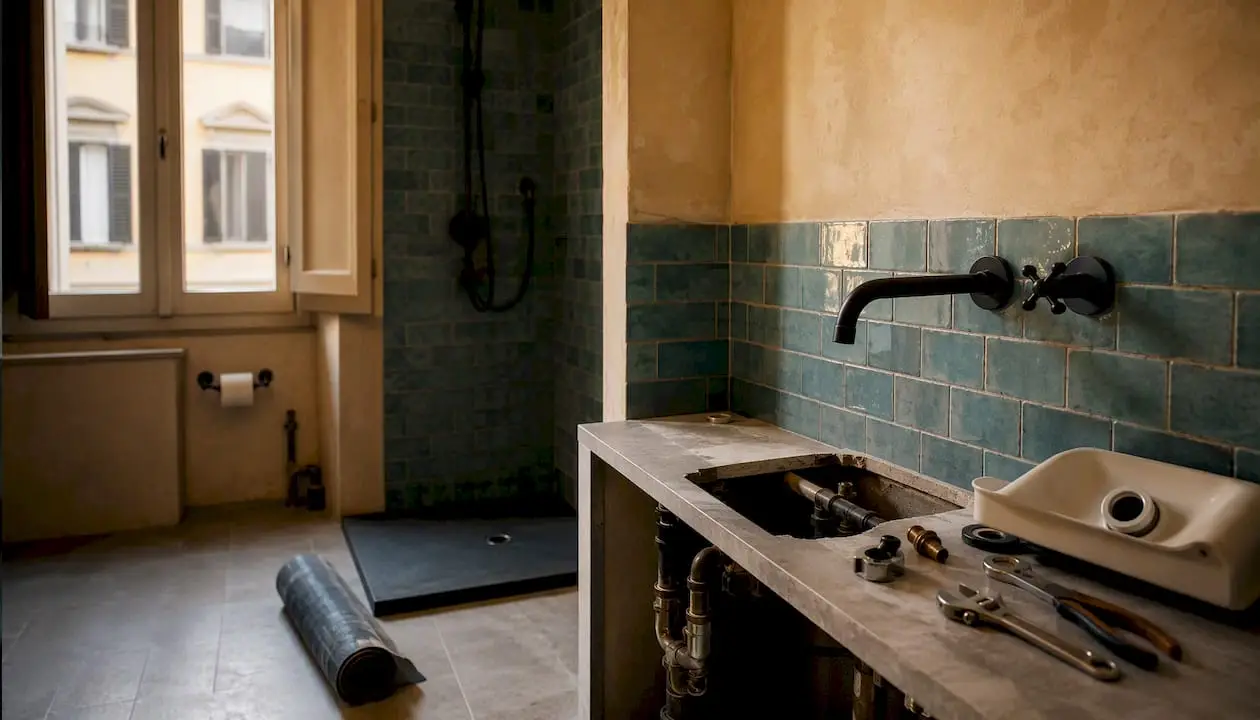
Mid-range finishes in low-visibility areas (utility rooms, storage, secondary bedrooms) rarely affect resale value. Spending €15/m² on ceramic tile in a storage room versus €60/m² makes no difference to a future buyer. Spend the difference on the kitchen and main bathroom, where buyers actually look.
Where cuts reliably backfire: cheap windows. Low-quality double glazing saves €2,000–€4,000 upfront but costs more in heating bills and often needs replacing within 10 years. The same logic applies to insulation. Skimping on thermal performance disqualifies you from Ecobonus deductions and leaves you with a property that’s expensive to heat.
Phasing works is a legitimate strategy for spreading cost. Doing structural and systems work in phase one, then finishes in phase two 12–18 months later, keeps the property habitable sooner and lets you absorb the second tranche of cost without a large loan. The risk: contractor availability and material prices may shift between phases. Lock in the phase-two scope and pricing in writing before phase one begins.
For investors comparing renovation cost structures across Mediterranean markets, the Mallorca renovation cost analysis offers a useful parallel on how logistics, heritage rules, and labor markets shape budgets in similar southern European contexts.
How long does a renovation in Italy actually take?
Timelines in Italy run longer than most buyers expect, partly because of the permitting system and partly because skilled contractors are often booked months in advance.
Light renovation (cosmetic only): 4–8 weeks on site, assuming no permit is required and materials are pre-ordered.
Standard renovation (partial systems, no structural work): 8–16 weeks on site after a CILA is filed. CILA processing is typically 5–10 business days, but filing preparation takes 2–4 weeks if drawings need to be produced.
Complete renovation (full systems, possible SCIA): 4–6 months on site. Add 4–8 weeks for SCIA processing and 2–4 weeks for design and documentation. In historic centers where Soprintendenza approval is required, add another 60–120 days minimum.
The most common delay drivers are: materials with long lead times (custom windows, specific tiles, bespoke joinery), contractor scheduling conflicts when the project runs over, and change orders mid-project. Every change order after demolition is complete costs two to three times what it would have cost in the design phase. Freeze the scope before work starts.
Questions to ask every contractor before signing
These aren’t polite conversation starters. They’re filters.
- Do you carry responsabilità civile (public liability) and all-risks construction insurance? Can you show the policy?
- What is the warranty period on your work, and is it in writing in the contract?
- Are all workers on your team employed with regular contracts (contratto di lavoro regolare)? Can you provide a current DURC?
- What is your payment schedule, and will you accept payment by bank transfer with a bonifico parlante for deductible works?
- Who is the direttore dei lavori (site supervisor), and how often will they be on site?
- What is your process when hidden problems are discovered (e.g., asbestos, structural cracks)?
Red flags that should end the conversation: a quote with no line-item breakdown, any request for cash-only payment, no written contract offered, no VAT invoice, and a contractor who can start “immediately” when every other reputable firm in the area has a 3-month backlog.
On insurance: Italian law requires the contractor to carry insurance covering third-party damage and worker injuries. For projects above a certain threshold, a coordinatore per la sicurezza (safety coordinator) is legally required. Ask who fills that role and confirm it in the contract.
How labor and materials split in Italian renovation budgets
On a typical complete renovation in Italy, labor accounts for roughly 40–50% of the total cost and materials for the remaining 50–60%. That ratio shifts depending on the work type: highly skilled trades like electrical and plumbing are more labor-intensive, while flooring and tiling are more materials-driven.
Italian labor costs carry significant social contribution overhead. A contractor’s invoice includes not just the worker’s wage but INPS contributions, INAIL (workplace injury insurance), and the contractor’s margin. This is why cash-in-hand offers look attractive but are legally and financially dangerous: they disqualify you from tax deductions, expose you to liability if a worker is injured, and offer no recourse if work is defective.
Materials pricing in Italy is broadly in line with northern European markets for standard products. Premium Italian brands (Porcelain tile from Marazzi or Florim, fixtures from Duravit or Grohe) carry a 20–40% premium over equivalent-quality imports. For investment properties, mid-tier Italian brands offer the best balance of quality perception and cost.
What insurance and warranty obligations apply during renovation?
Italian law imposes specific obligations on contractors and, in some cases, on property owners. Knowing them protects your budget and your legal position.
Contractor insurance: Any contractor operating legally must carry responsabilità civile verso terzi (third-party liability) covering damage to neighboring properties, common areas, or third parties. For projects involving structural work, all-risks construction insurance is standard practice and should be contractually required.
Worker injury coverage: INAIL (the national workplace injury authority) coverage is mandatory for all registered workers. If a contractor uses unregistered labor and a worker is injured on your property, the property owner can face legal liability. The DURC document confirms the contractor’s compliance.
Post-completion warranty: Under Italian civil law (Article 1667 of the Civil Code), contractors are liable for defects in workmanship for two years after delivery, and for hidden structural defects for ten years. For new construction or major structural renovation, a polizza decennale postuma (10-year structural warranty insurance) is legally required. Confirm in writing which warranty applies to your project and that it is backed by an insurance policy, not just a contractual promise.
Safety coordinator: For projects involving more than one contractor simultaneously, a coordinatore per la sicurezza in fase di progettazione and coordinatore per la sicurezza in fase di esecuzione are legally required under Legislative Decree 81/2008. Your geometra or architect typically fills this role; confirm it is included in their fee.
What does a renovation actually cost when you add taxes and fees?
The €/m² figures discussed throughout this article are net of VAT and professional fees. Here’s what the full picture looks like on a complete renovation of a 100 m² apartment in central Italy.
| Cost component | Estimated amount | Notes |
|---|---|---|
| Base renovation works | €85,000 | Complete band, central Italy baseline |
| VAT at 10% (primary residence) | €8,500 | 22% applies if not primary residence |
| Geometra / architect fees | €5,000–€8,500 | 6–10% of works value |
| CILA / SCIA permit fees | €500–€1,500 | Varies by municipality |
| APE (energy certificate) | €150–€300 | Required pre- and post-works |
| Safety coordinator | €800–€1,500 | Required for multi-contractor sites |
| Contingency (12%) | €10,200 | On base works only |
| Total estimated outlay | €110,150–€115,500 | Before any bonus deduction |
| Less: 50% Bonus Ristrutturazioni (over 10 years) | up to €48,000 | On eligible works up to €96,000 cap |
| Net cost after deductions (10-year horizon) | ~€62,000–€67,500 | Subject to IRPEF liability |
VAT at the reduced 10% rate applies to renovation works on residential properties used as primary residences. The 22% rate applies to second homes and investment properties unless specific conditions are met. A commercialista can confirm which rate applies to your specific situation before you sign contracts.
Key Takeaways
Renovation costs in Italy range from €300/m² for cosmetic work to €1,300+/m² for premium complete renovations, and the Bonus Ristrutturazioni can reduce your net outlay by up to 50% on eligible works up to €96,000.
| Point | Details |
|---|---|
| Cost bands by intervention level | Light: €300–€500/m²; Standard: €500–€750/m²; Complete: €750–€1,000/m²; Premium: €1,000–€1,300+/m². |
| Systems are the biggest line item | Electrical, plumbing, and heating represent 25–40% of total renovation cost on a complete project. |
| Regional adjustment matters | Northern Italy runs 5–10% above the national baseline; southern Italy runs ~15% below; islands run ~20% above. |
| Always budget a contingency | Add 10–15% to the base works estimate for hidden issues; never treat the contractor’s quote as the ceiling. |
| Livingitaly advisory reduces risk | Livingitaly’s restoration project management covers contractor selection, permit coordination, and budget control for international buyers renovating in Italy. |
The real cost of going it alone in Italy
Most renovation disasters aren’t caused by bad luck. They’re caused by a predictable sequence: a buyer accepts the lowest quote without a detailed capitolato, discovers hidden works mid-project, runs out of contingency, and either accepts substandard finishes or takes on emergency debt to finish.
What actually protects a renovation budget isn’t a bigger contingency. It’s having someone in the room who has seen 50 projects go wrong and knows exactly which questions to ask before a single wall comes down. That means a geometra who files permits correctly the first time, a project manager who compares quotes line by line rather than total price, and an advisor who knows which contractors in a given city actually deliver what they promise.
The bonus rules are the other place where money quietly disappears. A 50% deduction on €96,000 of eligible works is worth €48,000 in tax credits over ten years. Missing the bonifico parlante requirement, failing to file with ENEA within 90 days, or misclassifying works can forfeit that entirely. These aren’t obscure technicalities. They’re the difference between a renovation that costs €85,000 net and one that costs €133,000.
For international buyers especially, the combination of language barriers, unfamiliar permit systems, and distance from the property makes professional oversight not a luxury but a straightforward financial protection.
How Livingitaly supports your renovation from start to finish
Buying and renovating a property in Italy from abroad is genuinely complex, and the complexity concentrates in exactly the places where mistakes are most expensive: contractor selection, permit compliance, and bonus documentation.

Livingitaly works exclusively on the buyer’s side. For clients combining a purchase with a renovation, the firm provides end-to-end restoration project management that covers property assessment, contractor vetting, capitolato review, permit filing, and quality control through to handover. The advisory model means Livingitaly’s incentive is aligned with yours: a project delivered on time, on budget, and compliant with Italian law.
Services relevant to renovation projects include: buyer-side property finding and due diligence, renovation scope and budget advisory, local contractor selection and quote comparison, CILA/SCIA permit coordination, Bonus Ristrutturazioni and Ecobonus documentation support, and post-renovation property management. For investors, the firm also advises on how renovation choices affect rental yield and resale value across different Italian markets.
To discuss your project, visit Livingitaly’s investment advisory page or contact the team directly for an initial consultation.
Useful sources
- Agenzia delle Entrate — Agevolazioni per le ristrutturazioni edilizie
- Costi ristrutturazione casa — MyGreenHome
- Benchmark Prezzi Ristrutturazione 2026 — Ristrutturalo
- Quanto costa ristrutturare al mq — CosaCiFaccio
- Ristrutturazione casa 2026 — Bricoworld
- BNL — Prestito Ristrutturazione
- Findomestic — Prestito ristrutturazione casa (supporto)
- Poste — Prestito Bancoposta Ristrutturazione Casa
Bonus rules in Italy change with each annual budget law. Always verify current thresholds and rates directly with the Agenzia delle Entrate or a qualified commercialista before committing to a budget.
This article provides general information about renovation costs and incentives in Italy. It is not professional legal, tax, or financial advice. Confirm current rules and your specific eligibility with the Agenzia delle Entrate or a qualified professional before making financial decisions.
FAQ
How much does a full renovation of a 100 m² house in Italy cost?
A complete renovation of a 100 m² apartment in Italy typically costs €60,000–€120,000 depending on finish level, region, and whether full systems replacement is included. Including VAT, professional fees, and contingency, the total budget usually reaches €110,000–€115,000 before any bonus deductions.
What can you renovate with €30,000?
A light-to-standard renovation of a 50–60 m² apartment covers new flooring, redecoration, bathroom upgrades, and cosmetic work but excludes full systems replacement or structural work.
How do you renovate a house with a €50,000 budget?
€50,000 is enough for a standard renovation of a 70–80 m² apartment at the central Italian price baseline, including partial systems updates and mid-range finishes. Prioritize systems (electrical, plumbing) over cosmetic upgrades, keep the existing layout, and reserve 10–12% as contingency.
What can you do with €20,000 for a renovation?
€20,000 covers a light cosmetic renovation of a 50–60 m² apartment: fresh plaster and paint, new flooring over existing substrate, and minor fixture updates. Full bathroom or kitchen replacement, systems work, or new windows are not realistic within this budget on a standard-sized apartment.
Does the Bonus Ristrutturazioni apply to second homes?
Yes, but at a lower rate. The standard deduction for second homes is 36% on eligible expenses up to €48,000, compared to 50% on up to €96,000 for first homes. Always verify current rates with the Agenzia delle Entrate before budgeting, as rates are subject to annual legislative changes.