
What is a power of attorney in Italy and why do foreigners need one?
A Power of Attorney in Italy, formally called a Procura, is a legal document that authorizes a designated person to act on your behalf for specific Italian legal, financial, or real estate matters. Under the Italian Civil Code, it is a unilateral instrument: only the principal’s signature is required for validity. The agent’s signature is not needed.
Foreigners use a Procura most often when they cannot physically be in Italy to sign a property deed, manage an inheritance, open a bank account, or handle administrative filings. For Americans buying Italian real estate, a properly drafted Procura is frequently the only practical way to close a transaction without flying to Italy twice.
A few facts worth knowing before you start:
- Italian law recognizes two main types: Procura Generale (General) and Procura Speciale (Special)
- Article 1392 of the Italian Civil Code governs the formal requirements, including the critical “form symmetry” rule
- The document must identify both the principal and the agent with full legal details, including the Italian tax code (Codice Fiscale)
- For real estate, the Procura must be executed as a public deed or authenticated private deed
- Foreign-executed documents generally require an apostille and a certified Italian translation
- Execution at an Italian consulate abroad avoids the apostille requirement entirely
Table of Contents
- What are the two types of Italian Powers of Attorney?
- How do you formalize and validate a Power of Attorney for Italy?
- What do costs, duration, and limitations look like in practice?
- Why US Powers of Attorney usually fail in Italy and what experts recommend
- Livingitaly helps American buyers handle Italian property transactions with confidence
- Key Takeaways
What are the two types of Italian Powers of Attorney?
Italian law recognizes two primary types of Procura, each suited to different situations. Choosing the wrong one is one of the most common and costly mistakes foreigners make.
Procura Generale grants broad, ongoing authority across multiple legal and administrative matters. It must be registered with a notary and kept in official legal records. The notary provides authenticated copies as needed. This type stays valid until the principal revokes it, or until either party dies or loses legal capacity. Because of its wide scope, Italian banks and administrative bodies sometimes still require a separate Special Power for specific assets or accounts, even when a General Power exists.
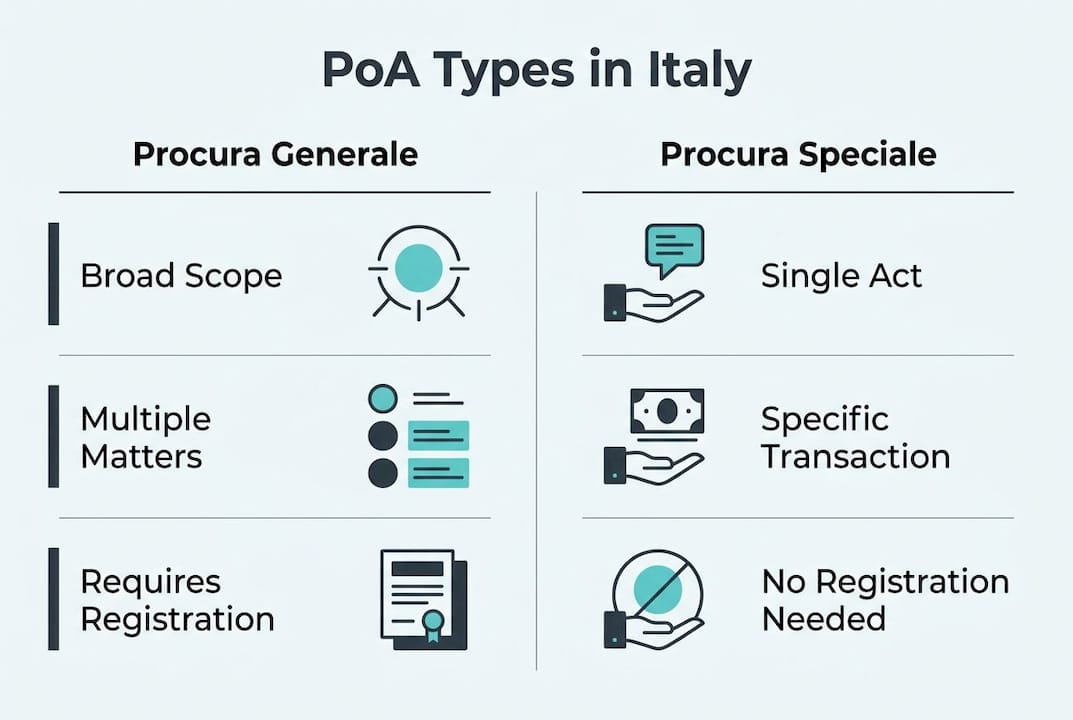
Procura Speciale is limited to one specific act or transaction. It is the standard instrument for property purchases and sales, and it expires automatically once that transaction is completed. No registration is required; the original document goes directly to the agent.
| Feature | Procura Generale | Procura Speciale |
|---|---|---|
| Scope | Broad, multiple matters | Single act or transaction |
| Duration | Until revoked or death | Ends on task completion |
| Registration | Required with notary | Not required |
| Form required | Public deed | Public deed for real estate |
| Common use | Ongoing asset management | Property sale or purchase |
| Revocation notice | Must notify agent and third parties | Terminates automatically |
Italian law also distinguishes between a Procura Sostanziale (for non-judicial acts like signing contracts or managing property) and a Procura alle Liti (for court representation, governed by Articles 83–84 of the Italian Code of Civil Procedure). These are separate instruments and cannot be used interchangeably.
How do you formalize and validate a Power of Attorney for Italy?
The single most important rule in Italian law for Powers of Attorney is form symmetry, codified in Article 1392 of the Italian Civil Code. A Procura must be executed in the same legal form as the act it authorizes. Since real estate sales require a public deed (atto pubblico), the Procura authorizing that sale must also be a public deed. A simple notarized signature is not enough for property transactions.

Your two main execution routes from the US
Route 1: Italian consulate abroad. You appear at an Italian consulate in the US, where consular staff execute the document with full notarial authority. The result is immediately valid in Italy. No apostille or translation is required because the consulate operates under Italian jurisdiction. Drafting takes one to two days; the signing appointment is typically immediate once scheduled.

Route 2: US notary plus apostille. You sign before a US notary public, then obtain an apostille from your state’s Secretary of State office. The apostille authenticates the notary’s signature for international use. The document then requires a certified Italian translation before it can be used in Italy.
Pro Tip: The correct sequence is non-negotiable: notarization first, apostille second, certified Italian translation third. Reversing the order, or getting the translation sworn before the apostille is attached, causes rejection by Italian authorities.
Step-by-step validation for a US-executed Procura
- Have an Italian lawyer or notary draft the Procura in bilingual format (Italian and English)
- Sign the document before a US notary public
- Obtain an apostille from the Secretary of State in the state where the notary is commissioned
- Send the apostilled document to a certified Italian translator in Italy
- The translator swears the translation before an Italian court
- Deliver the complete package (original, apostille, sworn translation) to the Italian notary handling your transaction
- For a Procura Generale, register with the Italian Revenue Agency (Agenzia delle Entrate)
The document must include the full legal name, date and place of birth, current address, citizenship, and Codice Fiscale for both principal and agent. For a property transaction, it must also specify the exact cadastral details of the property involved. Vague language is a common reason Italian notaries reject a Procura outright.
What do costs, duration, and limitations look like in practice?
Costs vary depending on execution method and document complexity. Typical expenses for a Procura Speciale executed abroad and prepared for Italian use include notary fees in Italy of roughly €100–€200, US apostille fees that vary by state, and sworn translation costs that depend on document length. Consular fees vary by location; check directly with your nearest Italian consulate for current pricing.
Duration works differently for each type. A Procura Speciale expires the moment the specified transaction closes, which protects you from unauthorized post-closing actions by the agent. A Procura Generale remains active until you formally revoke it. You can also set an explicit expiration date in either type when drafting.
Scope limitations matter as much as duration. The power granted covers only what the document explicitly states. Italian banks and administrative bodies frequently require a Special Power that names the specific account number or cadastral reference, even when a broad General Power exists. Overly vague grants get rejected.
Key facts on costs, duration, and limitations:
- Typical total cost for a straightforward Procura Speciale is usually between €100 and €200 when executed abroad
- A Procura Speciale automatically ends when the specified transaction is complete
- In joint property ownership, all co-owners must sign separate Powers of Attorney for the transaction to be valid
- Revocation must be communicated in writing to both the agent and any third parties who have dealt with the agent, per Article 1393 of the Italian Civil Code
- Until a third party receives notice of revocation, transactions they complete in good faith with the former agent may remain legally binding
- A conflict of interest between agent and principal can render the act voidable under applicable Italian law
Why US Powers of Attorney usually fail in Italy and what experts recommend
Standard US Durable Powers of Attorney are routinely rejected by Italian notaries for property transactions. The reason is structural, not bureaucratic. A US Durable PoA is a broad-spectrum common law instrument. It does not satisfy the notarial public deed form that Article 1392 requires for real estate. Italian notaries have no obligation to accept it, and most will not.
This is not just an Italian preference. Under the lex situs rule in private international law, all formalities for immovable property are governed by the law of the country where the property sits. An Italian notary rejecting a US Durable PoA is applying a rule that American and English courts would themselves recognize.
The practical consequence: if your agent arrives at an Italian notary’s office with a standard US Durable PoA to sign a property deed, the transaction stalls. You then need to execute a new, Italy-specific Procura Speciale before an Italian consulate or a local notary following a bilingual draft, adding weeks and cost to the process.
Expert best practices and compliance checklist for US buyers:
- Never assume a US Durable PoA will work for Italian property; have an Italian lawyer review it first
- Use a bilingual Procura Speciale drafted to Italian standards rather than adapting a US template
- Execute at an Italian consulate in the US whenever possible to eliminate the apostille and translation steps
- Confirm with the Italian notary handling the underlying transaction before choosing your execution method
- Name the specific property by cadastral reference in the Procura, not just by address
- Verify that all co-owners have signed separate Powers of Attorney before the closing date
- Time the apostille and translation correctly: notarization first, apostille second, translation third
- Keep a copy of the revocation procedure ready if circumstances change before closing
Livingitaly helps American buyers handle Italian property transactions with confidence
Buying property in Italy from the US involves layers of legal formality that catch even experienced buyers off guard. A rejected Procura can delay or kill a transaction entirely.

Livingitaly works exclusively on the buyer’s side, coordinating legal due diligence, notarial procedures, and the full documentation chain so that nothing falls through the cracks. For American clients, that includes ensuring your Power of Attorney meets Italian notarial standards before it ever reaches the closing table. Whether you are purchasing a luxury home in Italy or building an investment portfolio, Livingitaly’s advisory team manages the process from property identification through deed signing. Get in touch with Livingitaly’s buyer advisory team to start your Italian property search with the legal groundwork already in place.
Key Takeaways
A valid Italian Power of Attorney for property transactions must meet the form symmetry rule under Article 1392 of the Italian Civil Code, and standard US Durable Powers of Attorney almost always fail that test.
| Point | Details |
|---|---|
| Form symmetry rule | Under Article 1392, a Procura for real estate must be a public deed, matching the form of the property deed itself. |
| Two main types | Procura Generale covers broad ongoing matters; Procura Speciale is limited to one transaction and expires automatically on completion. |
| US PoA validity | Standard US Durable Powers of Attorney are routinely rejected by Italian notaries for property deals due to form requirements. |
| Correct execution sequence | Notarize first, obtain apostille second, then get a certified Italian translation; reversing the order causes rejection. |
| Livingitaly advisory | Livingitaly manages the full legal and documentation process for American buyers, including Power of Attorney compliance for Italian property transactions. |