
The elective residency visa is the primary legal pathway for non-EU citizens to live in Italy long-term without holding a job. It grants the right to reside in Italy based entirely on stable passive income, not employment. For Americans and Britons drawn to the Italian lifestyle, retirement, or simply a change of pace, this visa is the most direct Italy residency option available. Getting it right requires understanding the income thresholds, documentation standards, and tax consequences before you submit a single form.
What are the elective residency Italy requirements?
The elective residence visa Italy requires proof of stable passive income, not a job offer or business plan. Passive income thresholds typically range from €31,000 to €40,000 annually for a single applicant, though some consulates set the bar as high as €50,000. That range reflects consular discretion, meaning two applicants with identical incomes can receive different outcomes depending on which consulate they apply through.

Qualifying income sources include pensions, dividends, rental income from foreign properties, and annuities. Employment of any kind is prohibited, including remote work for foreign clients. This is a hard legal line, not a gray area.
Beyond income, the Italy elective residence visa requirements include:
- Private health insurance valid in Italy, covering full medical expenses, obtained before you arrive
- Proof of Italian address, either a registered rental contract or property ownership documentation
- A clean criminal record from your home country
- A complete, professional application dossier tailored to your specific consulate’s expectations
Pro Tip: Consular approval is discretionary. Two applicants with the same income can get different results based on how their dossier is assembled. Work with a professional who knows your specific consulate’s preferences before you submit.
The prohibition on work is absolute. If you plan to continue earning through freelance contracts or remote employment, the elective residency visa is not the right instrument. The elective visa versus investor visa distinction matters here: the investor visa accommodates active business involvement, while the elective visa is built exclusively around passive income.
How does the Italy residency visa process work step by step?
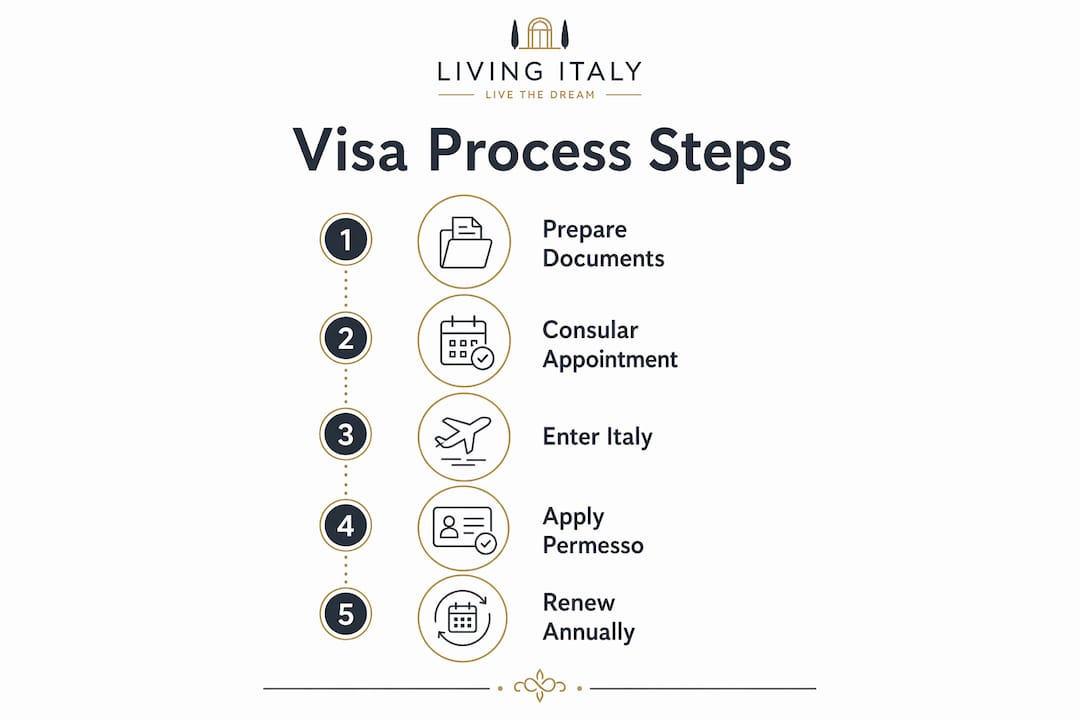
The Italy residency visa process runs in two distinct stages: securing the visa at your home country consulate, then converting it into a residence permit once you arrive.
- Apply for the Type D long-stay visa at the Italian consulate in your jurisdiction. Processing regularly exceeds 90 days, so plan well ahead of your intended move date.
- Secure your Italian address before you arrive. You need a registered lease, property ownership proof, or a formal declaration of hospitality from an Italian resident. Missing this step is one of the most common reasons applications stall.
- Enter Italy on your Type D visa. The clock starts immediately.
- Submit the permesso di soggiorno application within 8 working days of arrival. This means submitting the postal kit (known as the Kit Giallo) at a designated post office, not receiving the physical residence card. The physical card can take months to arrive.
- Keep your post office receipt (ricevuta) safe. This document proves your application is in process and allows you to legally remain in Italy, access services, and sign contracts while you wait.
- Attend your appointment at the local immigration office (Questura) when notified.
- Renew annually for the first year, then every two years. After five years of continuous legal residence, you qualify for EU long-term residency status.
Pro Tip: The 8-day deadline is non-negotiable. Missing it can invalidate your legal stay. Set a calendar reminder the moment you land and go to the post office within your first week.
The initial residence permit is valid for one year and renewable. Consistent renewals build toward permanent EU residency after five years, and Italian citizenship becomes possible after ten years of continuous legal residence.
What are the residency obligations and long-term benefits?
Elective residency is not a part-time arrangement. You must reside continuously in Italy to maintain your status. Extended absences can break the continuity required for long-term residency and citizenship applications.
The long-term benefits are substantial for those who commit fully:
- EU long-term residency after five years of continuous legal residence, provided you pass an Italian A2 language test and maintain a clean criminal record
- Italian citizenship eligibility after ten years of continuous legal residence
- Access to the National Health Service (SSN) through voluntary registration, with income-based contributions
- Freedom of movement across the Schengen Area once you hold the long-term EU permit
Tax residency is the obligation most applicants underestimate. Spending more than 183 days per year in Italy triggers Italian tax residency. That means you must declare worldwide income to the Italian tax authority (Agenzia delle Entrate). Foreign pensions, dividends, and rental income all become reportable. Italy has tax treaties with the US and UK that provide credits to avoid double taxation, but the reporting burden is real and requires professional management.
| Milestone | Requirement | Benefit |
|---|---|---|
| Year 1 | Passive income proof, health insurance, Italian address | Legal residence, SSN access |
| Year 5 | Continuous residence, A2 Italian, clean record | EU long-term residency permit |
| Year 10 | Continuous residence, language, integration | Italian citizenship eligibility |
Synchronized immigration and tax planning is not optional at this stage. Failing to file correctly can result in penalties that far exceed any tax savings you hoped to achieve.
Does buying property in Italy help with elective residency?
Buying property in Italy does not automatically grant residency or satisfy visa requirements. This is one of the most persistent misconceptions among American and British applicants.
Property ownership alone does not confer residency. You still need to meet the passive income threshold, hold valid health insurance, and submit a complete visa application through your consulate. What property ownership does provide is the address documentation required for the application. A registered deed or ownership certificate satisfies the Italian address requirement, where a rental contract would otherwise be needed.
If you do not yet own property, a formal declaration of hospitality from an Italian resident can serve as a temporary address solution. Many applicants use this while their purchase completes. Timing matters: you need the address documentation before you apply for the visa, not after.
Pro Tip: Coordinate your property purchase timeline with your visa application. Livingitaly works with buyers to align property acquisition with residency and tax planning, so the two processes reinforce rather than delay each other.
Location choice carries financial weight beyond lifestyle preference. Certain municipalities in southern Italy offer the 7% flat tax regime for qualifying retirees. Choosing to register your residence in one of those towns rather than a major northern city can produce a significant tax difference over a decade. The right property location is both a lifestyle and a financial decision.
What are the financial and tax implications of elective residency?
Elective residency triggers Italian tax residency once you spend more than 183 days per year in Italy. From that point, worldwide income must be declared, and specific foreign asset taxes apply.
Key financial obligations include:
- IVAFE: 0.2% annual tax on foreign financial assets held abroad
- IVIE: 1.06% annual tax on foreign real estate held outside Italy
- Worldwide income reporting to the Agenzia delle Entrate, with treaty credits available
The most significant opportunity for retirees is the 7% flat tax regime. This regime applies to foreign pension and passive income for retirees who relocate to qualifying municipalities with fewer than 30,000 residents, primarily in southern Italy. The benefit runs for ten fiscal years. In 2026, the program expanded to include municipalities up to 30,000 residents, widening the pool of eligible locations considerably.
| Tax | Rate | Applies To |
|---|---|---|
| IVAFE | 0.2% | Foreign financial assets |
| IVIE | 1.06% | Foreign real estate |
| 7% flat tax | 7% | Foreign income for qualifying retirees in southern municipalities |
| Standard income tax | Progressive rates | All other Italian tax residents |
Understanding Italian property tax obligations before you commit to a location prevents costly surprises. The difference between registering in a qualifying southern municipality versus a major city can mean tens of thousands of euros over the ten-year benefit window.
Key Takeaways
Elective residency in Italy requires stable passive income, a complete consular dossier, and synchronized tax and immigration planning to succeed long-term.
| Point | Details |
|---|---|
| Income threshold | Passive income of €31,000–€40,000 annually is required; some consulates demand up to €50,000. |
| 8-day deadline | Submit the postal residence permit kit within 8 working days of arrival or risk losing legal status. |
| Property and residency | Buying property does not grant residency; it only satisfies the address documentation requirement. |
| Tax residency trigger | Spending more than 183 days in Italy triggers worldwide income reporting obligations. |
| 7% flat tax opportunity | Retirees in qualifying southern municipalities can apply a 7% flat rate on foreign income for 10 years. |
What I’ve learned from watching applicants get this wrong
The elective residency visa looks straightforward on paper. In practice, it catches people off guard at every stage.
The most common failure point is not income. Most applicants who reach the application stage have sufficient funds. The failures happen in documentation: health insurance obtained after the application date, an address that is not formally registered, or a dossier assembled without understanding the specific consulate’s expectations. Consular approval is discretionary, and that discretion cuts both ways.
The second failure point is the 8-day permesso deadline. People arrive exhausted from moving, spend a few days settling in, and suddenly realize they are on day seven. The post office kit process is not intuitive for someone new to Italy, and doing it wrong means starting over.
The third, and most financially damaging, failure is treating tax planning as an afterthought. Applicants who move without understanding IVAFE, IVIE, and the 7% flat tax opportunity often pay far more than necessary for years before they realize it. The 7% regime in particular requires you to register in the right municipality from the start. You cannot retroactively move your tax domicile and claim the benefit for prior years.
The elective residency visa is a genuine lifestyle tool for retirement and long-term relocation. It works well for people who treat it as a structured legal and financial project, not a paperwork formality.
— MG
How Livingitaly supports your move to Italy
Relocating to Italy under the elective residency visa involves property, tax, and immigration decisions that interact with each other at every step. Getting one wrong can delay or derail the others.
Livingitaly works exclusively on the buyer’s side, helping American and British clients find, evaluate, and acquire property in Italy while coordinating with tax and legal advisors to align the purchase with residency goals. Whether you are looking at a farmhouse in Calabria to access the 7% flat tax or an apartment in Tuscany for lifestyle reasons, the property investment advisory process at Livingitaly is built around your specific residency and financial objectives. Reach out to explore how a structured, buyer-focused approach can make your Italian relocation both legally sound and financially smart.
FAQ
What income is required for the elective residency visa in Italy?
The elective residency visa requires stable passive income typically between €31,000 and €40,000 annually for a single applicant, though some consulates set thresholds up to €50,000. Qualifying sources include pensions, dividends, rental income, and annuities.
Can I work remotely while living in Italy on an elective residency visa?
No. The elective residency visa prohibits all forms of employment, including remote work for foreign clients. Any active income disqualifies you from this visa category.
Does buying property in Italy give me residency?
Buying property does not grant residency. It satisfies the address documentation requirement for the visa application, but you still need to meet income thresholds and submit a full consular application.
How long does it take to get permanent residency in Italy?
After five years of continuous legal residence, you can apply for EU long-term residency. Italian citizenship becomes available after ten years, subject to language and background requirements.
What is the 7% flat tax for retirees in Italy?
The 7% flat tax applies a single flat rate to all foreign-sourced income for retirees who relocate to qualifying municipalities with fewer than 30,000 residents, primarily in southern Italy. The benefit lasts for ten fiscal years.