
VRBO is the better choice for families booking whole-home vacation rentals in beach, lake, and mountain destinations. Airbnb wins for solo travelers, couples, and anyone who wants variety, global reach, or a shorter, more spontaneous trip. That’s the short answer. The longer one depends on fees, inventory, and how you actually travel.
| Factor | Airbnb | VRBO |
|---|---|---|
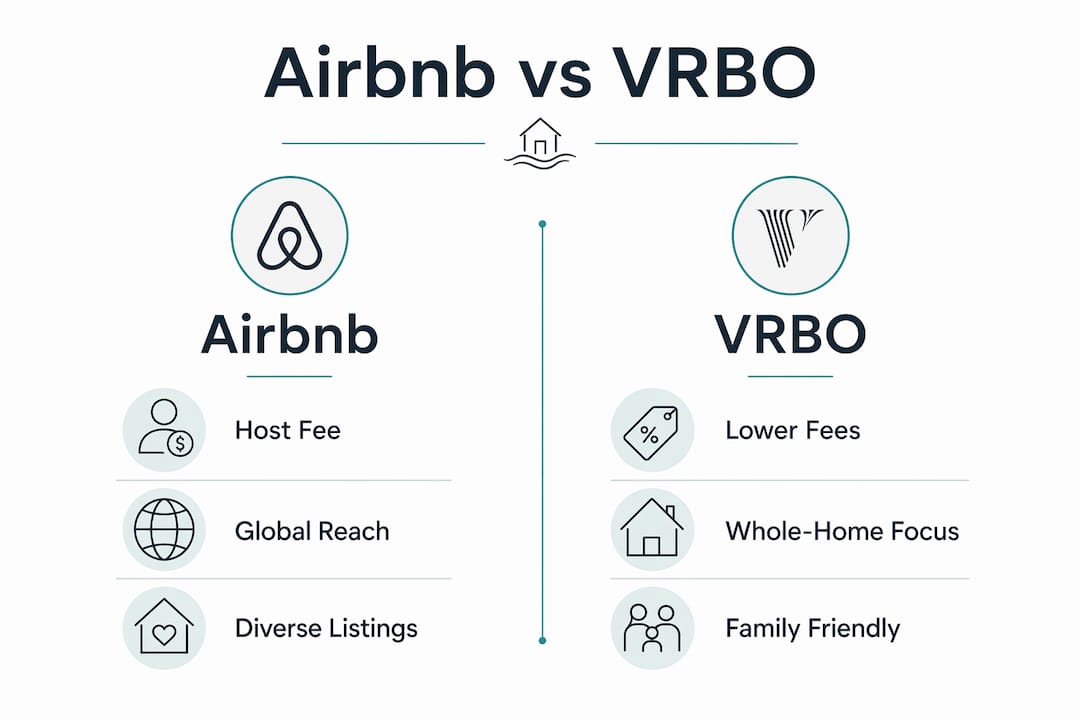
| Host fee | 15.5% (host-only model) | ~8% (5% + 3% processing) |
| Guest fee | None (built into price) | 6–15% added at checkout |
| Listings | 8M+ worldwide | ~2.2 million, U.S.-focused |
| Property types | Rooms, homes, unique stays | Whole homes only |
| Best for | Solo, couples, urban, unique stays | Families, groups, beach/ski/lake |
| Booking lead time | Often last-minute | Weeks to months ahead |
| Cancellation flexibility | Generally more flexible | Often stricter |
How do Airbnb and VRBO fees actually compare?
Fee structures are where most travelers get confused, and the confusion is understandable because both platforms restructured their models recently.

Airbnb now predominantly uses a host-only fee of 15.5% of the booking subtotal, mandatory for any host connected through property management software. Guests see no separate service fee at checkout. The listed price is the price, before taxes and cleaning. A smaller group of individual hosts still uses the older split model, where the host pays roughly 3% and the guest pays around 14% on top.
VRBO charges hosts approximately 8% total: a 5% commission on the rental amount plus a 3% payment processing fee. Guests then pay an additional service fee of 6–15% at checkout, which means the total price guests see on VRBO is often higher than what they see on Airbnb for a comparable property.
Here’s a concrete example of what that looks like on a $200/night booking:
| Fee component | Airbnb (host-only) | VRBO |
|---|---|---|
| Host service fee | 15.5% | 8% |
| Guest service fee | — | 6–15% |
| Host receives | $169* | $184* |
| Guest pays | $200 | $220* |
A few other factors push the final price in either direction:
- Cleaning fees apply on both platforms and hit hardest on short stays
- VRBO also offers an annual subscription model, though it is no longer available to new hosts
- Taxes are added on top of everything on both platforms
Pro Tip: Always compare checkout totals, not nightly rates. A lower base rate on VRBO can flip once the guest service fee appears. On Airbnb’s host-only model, what you see is essentially what you pay.
Experts note that total prices for entire-home rentals on both platforms often align more closely than travelers expect once all fees are included. The confusion mostly comes from how and when each platform reveals those costs.
What kinds of properties can you find on each platform?
The inventory difference between these two platforms is the most fundamental distinction, and it shapes everything else.
Airbnb lists over 8 million active properties across more than 220 countries. That includes:
- Entire homes, apartments, and condos
- Private rooms within a host’s home
- Shared spaces (a couch, a room in a shared apartment)
- Unique stays: treehouses, yurts, tiny homes, converted barns, houseboats
- Urban studios ideal for solo travelers or couples
VRBO lists roughly 2.2 million properties, concentrated in the U.S. and classic vacation destinations. Every single listing is a whole home. No shared spaces, no private rooms, no host-occupied properties. VRBO requires a private entrance, a kitchen, and a private bathroom. That policy is a feature, not a limitation, if you’re booking a beach week with your extended family and want the place entirely to yourselves.
Geographically, VRBO’s inventory skews heavily toward leisure markets: beach towns like Destin and Myrtle Beach, mountain communities like Breckenridge and Park City, and lake destinations across the Midwest and South. Airbnb covers all of those markets too, but its real advantage is urban density and international reach. For a weekend in New York, Chicago, or San Francisco, Airbnb has far more options at far more price points.

The practical upshot: if you want a private room in Austin for a conference, VRBO can’t help you. If you want a six-bedroom lake house in Michigan for a family reunion, VRBO is where you should start.
What do real users say about each platform?
Customer sentiment on both platforms reflects their different audiences rather than one being objectively better than the other.
Airbnb draws a broader, more diverse user base, which produces a wider spread of reviews. High scores from travelers who found exactly the quirky loft or mountain cabin they wanted sit alongside complaints about last-minute cancellations, cleanliness inconsistencies, or surprise fees. The platform’s sheer scale means quality control is uneven by nature. VRBO reviews tend to cluster around family-friendliness, reliability, and host professionalism, partly because many VRBO properties are managed by local agencies rather than individual owners. A lake house in Michigan might have detailed reviews discussing dock access, kayak storage, and how well the yard works for kids.
Cancellation experience is a recurring theme in user feedback for both platforms. Airbnb guests on flexible listings often report smooth refunds for last-minute changes, while VRBO guests booking peak-season beach or ski properties frequently encounter stricter terms. VRBO cancellation policies tend to be stricter because guests book further in advance for longer stays, and hosts price those weeks accordingly.
One pattern worth noting: VRBO guests are generally described by hosts as lower-risk. Families traveling for planned vacations cause less property damage and generate fewer disputes than the broader mix of travelers on Airbnb. That’s not a knock on Airbnb, it’s just a demographic reality.
How did Airbnb and VRBO become the two dominant platforms?
Airbnb launched in 2008 as a way for people to rent out spare rooms in their homes. It grew by targeting urban travelers and budget-conscious guests who wanted something more personal than a hotel. Today it holds roughly 44% of the global short-term rental market, operates in over 220 countries, and has expanded well beyond shared rooms into luxury estates and one-of-a-kind properties.
VRBO’s story is more complicated. The brand started as “Vacation Rentals by Owner” in 1995, focused entirely on whole-home rentals for families. HomeAway acquired VRBO in 2006, then Expedia Group acquired HomeAway in 2015. By 2020, HomeAway was fully consolidated into VRBO, making VRBO the single surviving brand under Expedia’s umbrella. Today VRBO benefits from cross-promotion across Expedia, Hotels.com, and Hotwire, which increases listing visibility for travelers who start their search on those platforms.
VRBO currently holds approximately 20–25% of the U.S. vacation rental market. Its global footprint is smaller than Airbnb’s, but in North America’s classic leisure markets, it punches well above that share. The VRBO vs HomeAway question, by the way, has a simple answer: they’re the same platform now.
Demographics, the 80/20 rule, and cancellation behavior
Who actually books on each platform tells you more than any fee chart.
Airbnb attracts Millennials, Gen Z, solo travelers, digital nomads, and urban adventurers. Stays average 2–5 nights. Bookings often happen within one to two weeks of arrival. VRBO’s core demographic is families and multi-generational groups, typically aged 35–55, booking 5–10 nights, often months in advance around school schedules and seasonal travel windows.
That demographic split drives the cancellation behavior difference. Airbnb’s flexible options suit last-minute city trips. VRBO’s stricter policies make sense for a family that booked a beach house in january for july and needs the host to hold that week off the calendar.
The 80/20 rule applies here for property managers: most list on both platforms, using Airbnb for urban and short-stay demand while relying on VRBO for leisure and family bookings. Channel management software keeps calendars synchronized across both platforms to prevent double bookings. For travelers, this means many properties appear on both sites, so comparing checkout totals on both before booking is always worth the two minutes it takes.
- Airbnb guests book shorter stays, more spontaneously, and cancel more often
- VRBO guests plan further ahead, stay longer, and tend to follow through on bookings
- In luxury segments above $500 per night, VRBO’s audience of mature, family-oriented travelers is generally a better fit for high-end whole-home properties
- Travelers who want something unusual (a treehouse, a converted silo, a yurt) will almost always find more options on Airbnb
Pro Tip: If you’re booking a large vacation home in a beach or ski destination, check VRBO first. If you’re booking a city apartment for a long weekend or want something architecturally interesting, start on Airbnb.
What do hosts need to do to list on each platform?
Both platforms require hosts to verify their identity before listing, but the requirements diverge from there.
Airbnb uses a government ID verification process for all hosts and guests. Hosts can earn Superhost status by maintaining a 4.8+ average rating, a 90%+ response rate, fewer than 1% cancellations, and at least 10 completed stays per year. Superhost status brings a badge, improved search placement, and priority customer support. Airbnb also allows co-hosting, where a second person manages the listing on the primary host’s behalf.
VRBO’s Premier Host program has a similar structure but different thresholds. There’s no specific rating cutoff, though strong reviews are expected. Hosts must respond within 24 hours and maintain a low cancellation rate. VRBO also requires that listings be whole homes with a private entrance, kitchen, and bathroom. Shared spaces and private rooms are categorically ineligible. For property managers connecting through software, VRBO requires them to become the merchant of record, which is a meaningful operational decision that individual hosts don’t face.
Both platforms run background checks on hosts in certain markets, and both have policies against discriminatory listing practices. Airbnb’s policies on this are more extensively documented, partly because its larger and more diverse host base has generated more enforcement history.
How do Airbnb and VRBO handle safety for travelers?
Both platforms have built out meaningful protections, though the mechanics differ.
Airbnb’s AirCover program provides up to $3 million in host damage protection and $1 million in host liability insurance, automatically and at no cost to hosts. For guests, Airbnb’s rebooking assistance kicks in if a listing is significantly misrepresented or a host cancels close to arrival. The resolution process can be slow, with many hosts reporting waits of several weeks for damage claims, but the coverage ceiling is high.
VRBO provides $1 million in primary liability insurance for all bookings made through the platform. For property damage, VRBO relies on host-set refundable deposits or a damage protection program funded by a non-refundable guest fee. Hosts have more direct control over damage recovery on VRBO because they set the deposit amount themselves rather than waiting for the platform to mediate.
For travelers, the most practical safety advice on either platform is the same: read recent reviews carefully, look specifically for mentions of last-minute cancellations or cleanliness problems, and never pay outside the platform’s official system. VRBO explicitly warns guests to pay only through its platform to remain covered under its booking protections.
Which platform offers better customer support?
Neither platform has a reputation for fast, frictionless support, and both have improved over the past few years without fully solving the problem.
Airbnb offers phone, chat, and email support, with Superhosts receiving priority access. Its self-help resources and community forums are extensive, which helps with common issues. The challenge is scale: with millions of active listings and bookings, support queues during peak travel periods can be long, and resolution outcomes for disputes vary considerably by case.
VRBO’s support runs through Expedia Group’s customer service infrastructure, with phone and chat options. Premier Hosts get priority support. For damage disputes specifically, VRBO’s security deposit model gives hosts more direct control than Airbnb’s mediated claims process. Both platforms have dedicated host support lines, and both experience hold times during busy periods.
The honest assessment: if something goes seriously wrong with a booking on either platform, expect the process to take time and require documentation. Travelers who book properties with strong recent reviews and clear cancellation policies face far fewer support situations in the first place.
Key Takeaways
Airbnb wins on variety and global reach; VRBO wins on whole-home privacy and family-focused inventory, making the right choice almost entirely dependent on your trip type and group size.
| Point | Details |
|---|---|
| Fee structure | Airbnb charges hosts 15.5% (host-only model); VRBO charges ~8% but adds a 6–15% guest fee at checkout. |
| Inventory size | Airbnb lists 8M+ properties in 220+ countries; VRBO has ~2.2 million, mostly U.S. leisure markets. |
| Best traveler fit | Airbnb suits solo travelers, couples, and city trips; VRBO suits families and groups wanting whole-home privacy. |
| Cancellation flexibility | Airbnb offers more flexible options for short stays; VRBO policies tend to be stricter for peak-season bookings. |
| Dual listing strategy | Most property managers list on both platforms and use channel management software to sync calendars. |
Thinking about owning a vacation property in Italy and listing it on platforms like Airbnb or VRBO? The Italian market offers strong rental yields in destinations like Tuscany, Rome, and the Amalfi Coast, but navigating the purchase process as a foreign buyer requires local expertise. Livingitaly’s buyer advisory services cover everything from property identification and legal due diligence to tax planning and rental management, so you can own and operate a vacation rental in Italy with confidence.
Investors looking at Italian vacation properties for short-term rental income can also explore how professional property management in Italy works across platforms, including guidance on which listing strategy fits your property type and target guests.