
A contratto locazione turistica is a lease for a residential property rented to tourists for no more than 30 days, signed by a private owner acting outside a business structure. Stay under that threshold with the same guest, and the contract skips mandatory registration with the Agenzia delle Entrate entirely. Cross it, and you’re in different legal territory with different tax rules and different paperwork.
Before you sign anything, three things need to be locked down. First, check whether your property has a Codice Identificativo Nazionale (CIN) and confirm it appears in every ad and in the contract itself. Second, verify the stay with any single guest doesn’t exceed 30 days, because that number drives which legal regime applies. Third, if you’re booking through Airbnb or Booking.com, confirm the platform is withholding 21% tax on your behalf and reporting the contract data on schedule.
Here’s what needs your attention this week, in order of urgency:
- CIN status: register the property in the Ministero del Turismo’s national database (BDSR) if you haven’t already, and display the code everywhere the unit is advertised.
- Alloggiati PS communication: confirm you or your platform submits guest data to the local police portal within 24 hours of check-in.
- Withholding and tax election: decide between cedolare secca and ordinary IRPEF taxation, and confirm any intermediary is applying the correct 21% withholding.
Pro Tip: Set a recurring calendar reminder for June 30 each year. That’s the deadline for intermediaries to transmit prior year contract data to the Agenzia delle Entrate, and missing it triggers penalties even if your taxes were paid correctly.
Key Takeaways
A contratto locazione turistica works only when duration stays under 30 days, CIN registration is complete, and fiscal reporting matches whichever tax regime the owner has elected.
| Point | Details |
|---|---|
| Confirm the 30-day limit | Check every guest stay against the 30-day cap that defines the tourist lease regime. |
| Register and display your CIN | Get the Codice Identificativo Nazionale from the Ministero del Turismo and show it in ads and contracts. |
| Verify intermediary withholding | Confirm platforms like Airbnb or Booking.com apply the 21% withholding correctly and report it by June 30. |
| Separate caparra from deposito | Define each deposit type distinctly in the contract to avoid dispute ambiguity. |
| Consult Living Italy for scaling decisions | Living Italy’s advisory and property management services support owners moving from one unit into a managed portfolio. |
Table of Contents
- What Is a Contratto Locazione Turistica, Legally Speaking?
- How Do Cedolare Secca and Intermediary Withholding Work?
- What Clauses Belong in a Contratto Locazione Turistica?
- Caparra Confirmatoria or Deposito Cauzionale: Which Do You Need?
- What Cancellation Policy Should You Use?
- What Local Registration Steps Come Before You List a Property?
- How Do You Document Cleaning and Inventory to Avoid Disputes?
- What Happens If You Get Compliance Wrong?
- Where Can You Find Reliable Contract Models?
- When Should You Bring in a Lawyer, Accountant, or Property Manager?
- What Are the Landlord’s and Guest’s Rights During the Stay?
- How Does a Tourist Lease End or Get Renewed?
- Do You Need Insurance for a Tourist Rental Property?
- Do Zoning and Local Housing Rules Affect Your Tourist Lease?
- How Are Disputes Resolved Under a Tourist Lease?
- What I’ve Seen Go Wrong, and How Living Italy Helps
- Get Help Managing Your Tourist Rental Compliance and Taxes
- Where to Verify the Rules Yourself
- Sources
- FAQ
What Is a Contratto Locazione Turistica, Legally Speaking?
A contratto locazione turistica sits inside the broader category the tax code calls “locazione breve,” or short-term rental: a lease of no more than 30 days, signed by a natural person acting outside any business activity, for a residential unit. The tourist purpose just describes the guest’s intent (a vacation stay rather than, say, a temporary work assignment), but the legal machinery that governs duration, registration, and taxation is the locazione breve framework defined under article 4 of Decreto Legge 50/2017, later reinforced by Legge 96/2017.
That 30-day ceiling isn’t arbitrary. It’s the line that separates a short-term rental exempt from mandatory registration from a lease that falls under ordinary tenancy rules and the Codice Civile’s more rigid framework for residential contracts.
The Agenzia delle Entrate defines locazione breve as a lease of residential property for no more than 30 days, concluded by individuals not acting through a business, and such contracts are exempt from the standard registration obligation that applies to longer leases.
A separate category, the contratto transitorio, covers a different situation entirely: leases longer than 30 days tied to a temporary, documented need (a work contract, a university enrollment) rather than tourism. Under article 5 of the residential leasing law, transitory contracts over 30 days carry documentary requirements the tourist regime doesn’t, and mislabeling a long stay as “transitory” without the required paperwork risks having the whole agreement requalified under the ordinary 4+4 tenancy regime, which comes with tenant protections you almost certainly didn’t intend to grant.
Who can actually use the tourist regime? Any private individual renting out a residential unit they own, provided they’re not operating as a business. The line blurs fast once you own several units. Legal guidance increasingly flags that managing multiple properties on a continuous basis can tip you into entrepreneurial activity, which brings VAT registration and a different fiscal profile entirely, as Studio Montinaro notes in its analysis of the short-term lease template.
A few things every contratto locazione turistica must get right:
- Duration stated explicitly, with a hard stop at 30 days per guest.
- Confirmation the lessor is acting as a private individual, not through a business.
- Identification of the property matching its CIN registration.
- A clearly stated tourist or leisure purpose, distinguishing it from a transitory work or study lease.
How Do Cedolare Secca and Intermediary Withholding Work?
Owners of short-term rentals can opt for cedolare secca, a flat substitute tax that replaces IRPEF, regional and municipal surtaxes, and registration tax on the rental income. It’s optional. If you don’t elect it, rental income gets added to your other income and taxed at ordinary IRPEF brackets, which for most owners with other earnings works out considerably worse.
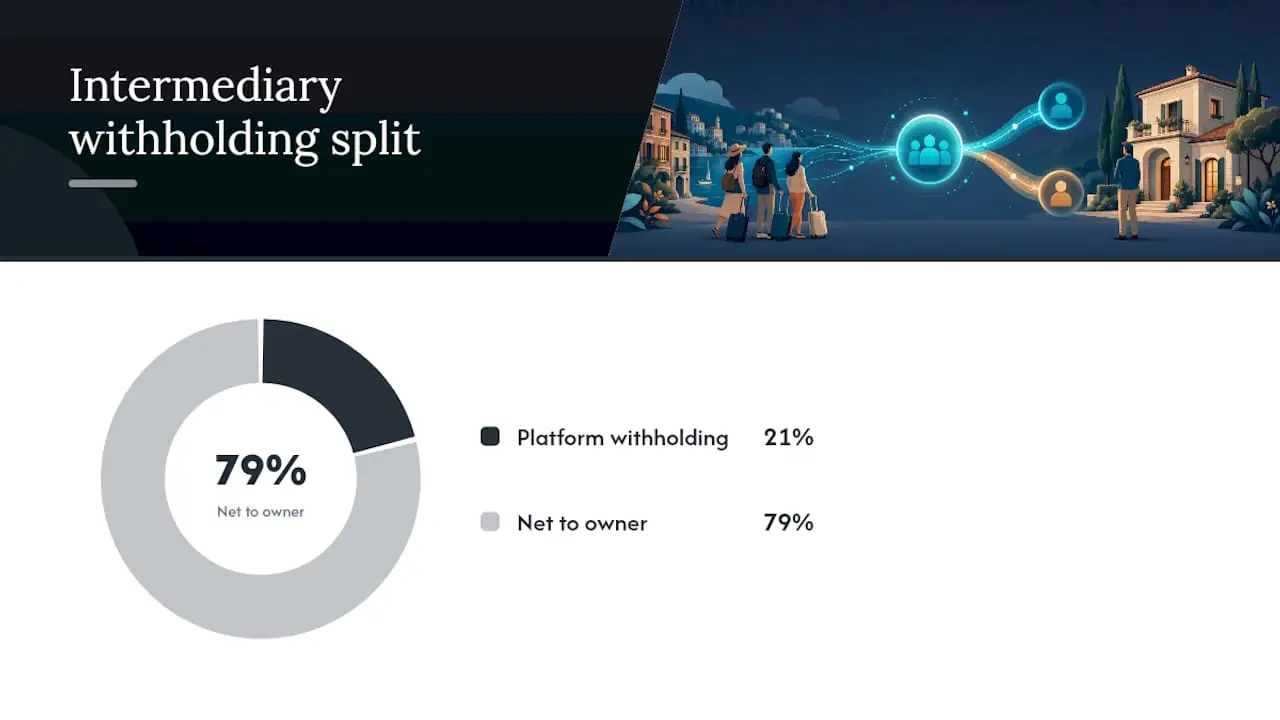
The number that catches owners off guard is the intermediary withholding. When a platform like Airbnb or Booking.com collects payment on your behalf, it’s legally required to act as a withholding agent and apply a 21% withholding on the rent before passing along your net proceeds. That withholding is treated as an advance payment toward your cedolare secca liability, not an extra tax on top of it, so you reconcile the two when you file.
Intermediaries also carry a reporting duty that has nothing to do with your own tax return. They must transmit contract data (guest names, dates, amounts) to the Agenzia delle Entrate by June 30 of the year following the rental. Miss that deadline, or file it inaccurately, and the penalty runs €250 to €2,000, though the fine is halved if the intermediary corrects the filing within 15 days of the original deadline.
Here’s the step-by-step for staying compliant on the tax side:
- Decide between cedolare secca and ordinary IRPEF taxation before your first rental of the year, since it affects how income gets reported.
- Track every booking, whether direct or through a platform, and reconcile withheld amounts against gross rent received.
- If renting directly without an intermediary, remember no withholding applies. You’re responsible for declaring and paying the full amount yourself.
- File the relevant section of your annual tax return (Redditi PF or 730, depending on your situation) reflecting either the flat cedolare secca rate or ordinary income inclusion.
- Keep contract copies, payment records, and CIN documentation for at least five years in case of an audit.
Some practitioners point out that owners of a single second home often prefer the locazione breve regime specifically because it sidesteps VAT registration and the more complex compliance load that applies to accommodation businesses, as long as they stay within the private-individual boundaries described in analysis of the 2026 short-term rental rules.
When to call an accountant instead of doing it yourself: if you’re renting more than one or two units, if you’re a non-resident owner unfamiliar with Italian filing systems, or if you’ve received any communication from the Agenzia delle Entrate questioning your classification. A flat tax regime for high-net-worth individuals may also interact with your rental income depending on your residency status, which is worth reviewing with a specialist before assuming cedolare secca is your best option.
What Clauses Belong in a Contratto Locazione Turistica?
An enforceable tourist lease needs specific, unambiguous data up front: full identification of both parties, the property’s address and CIN, precise check-in and check-out dates, the maximum number of occupants, and an explicit statement that the stay serves a tourist or leisure purpose.
Beyond the mandatory basics, a well-drafted contract addresses the things that actually generate disputes later. Templates built for this purpose typically bundle in a signed inventory, a house rules annex, and a price list for optional extras, precisely because verbal understandings about who pays for what tend to fall apart the moment a guest disputes a charge.
Clauses worth including, phrased as prompts you can expand into full legal language:
- Total price, payment schedule, and accepted payment methods.
- Whether cleaning is included in the price or billed separately, and at what rate.
- Caparra versus deposito cauzionale, defined separately with distinct return conditions.
- Cancellation tiers tied to specific date windows before arrival.
- Full inventory of furnishings, appliances, and linens, referenced as a signed annex.
- House rules covering noise, smoking, pets, and maximum guests.
- Insurance and liability limits for damage to the property or injury on premises.
- Check-in and check-out times, and the procedure if either party needs flexibility.
- A dispute resolution clause specifying jurisdiction or mediation before litigation.
| Clause category | What it needs to specify |
|---|---|
| Identification and duration | Parties, property address, CIN, exact dates, occupant count |
| Financial terms | Total price, payment method, deposit amount, cleaning fee treatment |
| Operational rules | Check-in/out times, house rules, inventory reference |
| Risk allocation | Insurance coverage, liability caps, cancellation tiers |
Pro Tip: If your property sits in a Comune with its own tourist tax rules, add a specific clause stating how and when that tax is collected from the guest, rather than folding it silently into the nightly rate. Municipal auditors look for this line specifically.
Caparra Confirmatoria or Deposito Cauzionale: Which Do You Need?
You need to pick one, and they’re not interchangeable. A caparra confirmatoria, governed by article 1385 of the Codice Civile, is a sum paid at booking that the landlord can keep outright if the guest cancels without justification, or that the guest can claim double back if the landlord cancels. A deposito cauzionale, by contrast, is a refundable security amount held against damage or unpaid extras, with no penalty function attached. It’s simply returned once the property is checked and nothing is owed.
Confusing the two in your contract language is one of the fastest ways to lose a dispute, because a judge will interpret ambiguous deposit clauses against whoever drafted them, which is usually you.
Common practical figures, drawn from templates circulating among Italian short-term rental owners:
- Booking deposits (caparra) commonly sit around 20–30% of the total stay price, collected at reservation.
- Security deposits (deposito cauzionale) are often handled as a card pre-authorization rather than a cash transfer, which avoids the awkward step of manually refunding money.
- Full balance is typically due at or before check-in, with the caparra credited against the total.
A clean workflow for handling the deposit side:
- Photograph the property’s condition at check-in with timestamps, focusing on anything a guest might later claim was pre-existing damage.
- Have the guest countersign a brief condition acknowledgment referencing the inventory annex.
- At check-out, repeat the photographic record before releasing the deposit hold.
- Release the deposit within a stated window (commonly 7 to 14 days) unless a specific, itemized deduction applies.
- If deducting for damage, provide a dated invoice or repair estimate, not just a verbal claim.
Pro Tip: Write the retention clause so it requires photographic evidence and an itemized cost before any deduction, not just a claim of damage. Vague language like “at the owner’s discretion” is exactly the phrase a small claims judge will strike down first.
What Cancellation Policy Should You Use?
Most owners do best picking one of three cancellation tiers and stating it plainly rather than leaving refund terms to negotiation after the fact. Flexible policies refund almost everything up to a day or two before arrival; moderate policies split the difference; strict policies protect the owner’s income at the cost of guest goodwill. If you’re also listing on Airbnb or Booking.com, your direct-booking contract terms should mirror whatever policy you’ve set on the platform, or you’ll end up applying two different rules to two different guests staying under identical circumstances.
| Timing before check-in | Typical refund outcome |
|---|---|
| More than 30 days | Full refund minus a small processing fee |
| — | Partial refund, often 50% |
| Less than 7 days | No refund, caparra retained |
A force majeure clause needs its own separate language, distinct from ordinary cancellation. Define what qualifies (natural disaster, government travel restriction, documented medical emergency) and what remedy applies: a voucher for a future stay, a partial refund, or a rebooking option. Without this clause, a guest who can’t travel because of a flight cancellation or sudden lockdown has no contractual basis to expect anything, which tends to generate ugly disputes and one-star reviews rather than clean resolutions.
Cancellation and deposit clauses need to reference each other explicitly. If your policy says the caparra is forfeited on late cancellation, say so directly in both the cancellation section and the deposit section, so there’s no argument later about which clause governs.
What Local Registration Steps Come Before You List a Property?
Registering for a CIN through the Ministero del Turismo’s national accommodation database (BDSR) is now mandatory for any property used as a tourist rental, and the code must appear in every advertisement and in the contract itself. Omitting it isn’t a paperwork technicality; it exposes you to fines and can get a listing pulled from major platforms.
Separately, Alloggiati Web (the questura’s guest reporting portal) requires you to transmit identifying data for every guest within 24 hours of their arrival. This obligation exists independent of your tax filings and applies whether you rent directly or through a platform, though many intermediaries handle this step on your behalf as part of their service.
Tourist tax (imposta di soggiorno) varies by Comune, both in rate and in how it’s collected and remitted, so there’s no single national answer here. Before finalizing any contract template, confirm with your municipality:
- The exact per-night rate and whether it varies by season or accommodation type.
- Whether you collect it directly from guests or the platform remits it automatically.
- How often you must report and pay collected amounts to the Comune.
- Whether any exemptions apply (minors, medical stays, length-of-stay caps).
For a first-time host bringing a property to market, the practical order of operations looks like this: confirm zoning allows short-term tourist use, register for CIN, set up Alloggiati Web access, check the local tourist tax structure, then finalize the contract template before accepting a single booking.
| Task | Where to handle it |
|---|---|
| CIN registration | Ministero del Turismo BDSR portal |
| Guest data transmission | Alloggiati Web (questura) |
| Tourist tax setup | Local Comune office |
| Tax regime election | Agenzia delle Entrate filing |
Municipal variation is a genuine trap. What holds true in one region can differ meaningfully in another, and regional differences between north and south extend well beyond property prices into how aggressively local authorities enforce tourist tax collection and registration compliance.
How Do You Document Cleaning and Inventory to Avoid Disputes?
A standard inventory annex should list every piece of furniture, every major appliance, and every set of linens provided, itemized enough that a guest can’t credibly claim something was missing that was actually there. Present this list at check-in, ideally alongside the physical walkthrough, not buried in a PDF the guest never opens.

Photographic evidence, timestamped at both check-in and check-out, does more to prevent deposit disputes than any clause you can write. A checklist-driven contract approach that pairs a signed inventory with a photo log at both ends of the stay gives you documentary proof if a damage claim ever escalates.
On cleaning, decide upfront whether it’s bundled into the nightly rate or billed as a separate line item, and state that choice explicitly. If you charge extra for mid-stay cleaning or late checkout, list those as optional add-ons with fixed prices rather than negotiating them ad hoc.
A workable inventory template includes:
- Room-by-room furniture and appliance list.
- Linen count (sheets, towels, per-bed and per-bathroom).
- Kitchen equipment and consumables provided versus expected to be replenished by the guest.
- Existing damage or wear noted before arrival, with photos referenced by date.
- Emergency contact information and basic house operating instructions.
| Cost item | Treatment |
|---|---|
| Standard end-of-stay cleaning | Bundled into nightly rate or fixed line item |
| Mid-stay cleaning request | Optional add-on with stated price |
| Extra linen change | Optional add-on with stated price |
| Damage beyond normal wear | Deducted from deposit with photo and invoice evidence |
What Happens If You Get Compliance Wrong?
The most common infractions are surprisingly basic: no CIN displayed in an ad, PS Alloggiati data never transmitted, intermediary withholding applied incorrectly or not at all, and operating enough units that the activity should have been classified as a business from the start.
Legal guidance on short-term lease templates warns that owners running multiple properties on a continuous basis risk having their activity requalified as entrepreneurial, which triggers VAT registration and a materially different tax and compliance burden than the private-individual regime allows.
That requalification risk is the one owners underestimate most. It’s not a single bright line (like exactly three units), but a pattern the tax authority evaluates based on frequency, organization, and scale, as Studio Montinaro’s guidance on the short-term lease template makes clear. Once requalified, you’re not filing a simple cedolare secca return anymore. You’re opening a partita IVA, charging VAT, and dealing with an entirely different reporting cycle.
If you receive a notice questioning your classification or a fine for a missing CIN, don’t ignore it and don’t guess at a response. Gather your contracts, CIN documentation, and booking records, and get a consultation with an accountant or lawyer before replying. Fixing an error within a stated correction window (as with the 15-day reduction on intermediary reporting fines) is often far cheaper than contesting a finalized penalty.
Where Can You Find Reliable Contract Models?
A handful of template providers build models specifically around the tourist and short-term rental regime, and the difference between a good one and a weak one usually comes down to what’s included beyond the bare-bones lease text. Look for a model that bundles in a deposit mechanics section, a sample cancellation tier structure, and fields pre-formatted for CIN and municipal tourist tax entries, since templates like the one from Captain Legal build in exactly those elements rather than leaving them for the owner to draft from scratch. Providers like DokiCasa also offer downloadable contract models aimed at short-term hosts, though as with any template, you’re responsible for confirming it reflects the current CIN and withholding rules before you sign anything.
Before signing any contract, whether a customized template or one drafted from scratch, run through this checklist:
- Duration stated and confirmed under 30 days per guest, or explicitly handled as a transitory contract with the required documentation.
- CIN present in both the ad and the contract text.
- Tax regime election (cedolare secca or IRPEF) matches your actual filing plan.
- PS Alloggiati transmission process confirmed and assigned to a specific person or platform.
- Deposit type (caparra versus deposito cauzionale) clearly labeled with distinct return conditions.
- Insurance coverage confirmed for liability and property damage.
- Municipal tourist tax rate and remittance process verified with the Comune.
Customizing a model is fine, and often necessary given municipal variation, but don’t strip out the mandatory fields (CIN, duration, party identification) to make the contract shorter. Those aren’t optional stylistic choices; they’re the elements that make the contract legally sound in the first place.
When Should You Bring in a Lawyer, Accountant, or Property Manager?
A few concrete triggers should move you from DIY to professional help without much debate. Owning more than two or three units is one. Being a non-resident owner unfamiliar with Italian tax filing systems is another. Frequent bookings across multiple platforms with inconsistent withholding practices is a third, since reconciling several intermediaries’ reporting against your own records gets genuinely difficult by hand.
- Count your units and rental frequency. One occasional rental rarely needs a lawyer; three or more units rented continuously usually does.
- Assess your residency status. Cross-border owners face additional filing complexity that a local accountant can navigate far faster than you can alone.
- Review local regulation complexity. Some Comuni layer extra permits or zoning restrictions on top of the national framework.
- Ask whether you’ve received any communication questioning your classification. If yes, get professional input before responding.
When you do consult an accountant or lawyer, bring your CIN documentation, prior year contracts, booking platform statements, and a clear statement of your goals (are you optimizing for tax efficiency, or trying to resolve a compliance notice?). Vague requests waste billable time.
Property management makes sense once the operational load (guest communication, cleaning coordination, deposit handling, PS Alloggiati transmission) starts eating more time than the rental income justifies, in which case a full-service property management arrangement can streamline your operations efficiently. A full-service property management arrangement should specify exactly which of these tasks are covered, and whether tax filing support is included or handled separately by an accountant.
What Are the Landlord’s and Guest’s Rights During the Stay?
The landlord’s core obligation is delivering the property in the condition described in the inventory annex, functioning and clean, on the stated check-in date. Beyond that, the landlord retains the right to enforce house rules (noise limits, guest caps, pet policies) as stated in the contract, and to retain the deposit for documented damage.
The guest’s core rights mirror that: quiet enjoyment of the property for the contracted period, without unannounced landlord visits, and a refund or remedy under whatever cancellation and force majeure terms the contract specifies. Guests also have a right to receive tourist tax collection details clearly, rather than discovering an undisclosed charge at checkout.
Neither party can unilaterally alter the price or duration once the contract is signed, barring an amendment both sides agree to in writing. This is worth stating explicitly in the contract, because verbal changes agreed during a stay (an extra night, a different checkout time) create ambiguity about what actually governs if a dispute arises later.
How Does a Tourist Lease End or Get Renewed?
Because a contratto locazione turistica is capped at 30 days by definition, it naturally terminates at the end of the stated period. There’s no renewal in the traditional sense. If the same guest wants to extend, you’re either signing a brand new short-term contract for the additional days, keeping the total stay within 30 days, or moving into transitory contract territory if the combined stay pushes past that limit and involves a documented non-tourist reason.
Early termination by the guest is governed by whatever cancellation tier you’ve set. Early termination by the landlord, outside of documented force majeure, exposes you to returning double the caparra under article 1385 of the Codice Civile, since that’s the penalty a landlord faces for backing out of a confirmed booking without cause.
If you want to keep renting to the same guest across multiple bookings throughout a year, treat each stay as its own separate, fully executed contract. Stacking bookings without new paperwork each time is exactly the pattern that raises requalification questions.
Do You Need Insurance for a Tourist Rental Property?
Standard homeowner’s insurance policies frequently exclude short-term rental activity, so confirm with your insurer before your first booking whether your existing coverage extends to paying guests. If it doesn’t, you’re looking at either a rider on your existing policy or a dedicated short-term rental insurance product.
Coverage worth confirming specifically: liability for guest injury on the property, damage caused by guests beyond what the deposit covers, and loss of rental income if the property becomes unusable due to an insured event. Some booking platforms include limited host protection as part of their service, but that coverage is often narrower than owners assume, and it typically doesn’t replace a standalone policy.
If you’re renting a property you also use personally part of the year, check whether your policy distinguishes between owner-occupied periods and guest-occupied periods, since some insurers price or exclude coverage differently depending on which applies at the time of an incident.
Do Zoning and Local Housing Rules Affect Your Tourist Lease?
Zoning matters more than most first-time hosts expect. Some Comuni restrict short-term tourist rentals in specific residential zones, cap the number of days per year a unit can be rented, or require a separate change-of-use permit if the property wasn’t originally classified for tourist accommodation.
Historic centers in cities with heavy tourist pressure have, in several cases, introduced stricter local rules than the national framework requires, sometimes including caps on the total number of short-term rental licenses issued in a given district. Checking with your Comune before listing isn’t just about tourist tax rates; it’s about confirming the use is permitted at all under local housing regulations, separate from the national CIN requirement.
Condominium rules add another layer. Even where municipal zoning permits tourist rentals, a building’s condominio regulations can restrict or prohibit short-term guest turnover, and that internal rule is enforceable against you as a unit owner regardless of what the Comune allows.
How Are Disputes Resolved Under a Tourist Lease?
Most disputes in tourist leases involve small sums (a disputed deposit deduction, a cleaning fee argument) that make full civil litigation impractical for either side. A well-drafted contract should specify a first step of direct negotiation with a defined response window, followed by mediation through a local chamber of commerce mediation body before either party escalates further.
For genuinely small claims, the Giudice di Pace (Justice of the Peace) handles disputes below a set monetary threshold and offers a faster, less formal process than ordinary civil court. Stating this venue explicitly in your contract’s dispute resolution clause saves both parties from arguing over jurisdiction if things go sideways.
Booking platform disputes follow a separate track entirely: Airbnb and Booking.com both run internal resolution processes for damage claims and cancellation disagreements, and those often resolve faster than any court process, though they only apply to bookings made through the platform itself, not direct reservations.
What I’ve Seen Go Wrong, and How Living Italy Helps
The mistake I see most often isn’t malicious noncompliance. It’s owners who genuinely believe a verbal understanding with a guest, or a template downloaded once and reused for years, is enough. It usually holds up fine until the first real dispute, at which point the gaps (an undefined deposit type, no photographic record, a tax election never actually filed) become expensive fast.
The second pattern is scale creep. An owner starts with one property rented occasionally, it works well, they add a second unit, then a third, and nobody stops to ask whether they’ve quietly crossed into territory the tax authority would classify as a business. That’s exactly the moment a conversation with an advisor pays for itself many times over, because the cost of fixing a requalification after the fact dwarfs the cost of structuring it correctly from day one.
Living Italy works with international owners specifically at this intersection, coordinating local tax planning with property management support so the compliance side doesn’t fall entirely on an owner who’s managing a property from another country. For owners scaling from one unit into a small portfolio, the investment property advisory side helps map out whether continuing under the private regime still makes sense.
Get Help Managing Your Tourist Rental Compliance and Taxes
If you’re weighing whether to handle CIN registration, tax elections, and guest reporting yourself or hand it to someone local, that’s exactly the gap Living Italy’s advisory services close for international owners. Unlike a template download or a generic accountant unfamiliar with your specific situation as a foreign owner, Living Italy coordinates legal due diligence, tax planning, and day-to-day property management under one advisory relationship, so you’re not juggling three separate professionals who’ve never spoken to each other about your property.
That matters most for owners who bought in Italy from the US or UK and are now trying to figure out whether a second property, or a small portfolio, makes financial sense once you account for the fiscal thresholds and compliance load covered above. Living Italy’s buyer’s advisory service starts before you even sign, structuring the purchase itself with an eye toward how you’ll actually operate the property afterward. If you’re already an owner sorting through CIN registration, tax elections, or considering whether to bring in property management, book a consultation to walk through your specific situation and get a clear next step.
Where to Verify the Rules Yourself
- Agenzia delle Entrate: the authoritative source for locazione breve definitions, withholding rates, and reporting deadlines.
- Ministero del Turismo BDSR portal: the mandatory registration point for your property’s CIN.
- Questura Alloggiati Web portal: where guest arrival data must be transmitted within 24 hours.
- Your Comune’s tourism or tax office: the only reliable source for local tourist tax rates and remittance schedules.
- Model contract providers: services such as Captain Legal’s short-term lease template and DokiCasa offer downloadable models, though always cross-check them against current CIN and withholding rules before use.
Treat official government sources as final authority on tax and registration questions. Templates and guides are useful starting points, but they don’t override what the Agenzia delle Entrate or your Comune actually requires.
This article is general information, not a substitute for advice from a qualified lawyer. Consult a qualified legal professional about your own circumstances before acting on anything here.
Sources
- Contratti di locazione breve – Che cos’è – Agenzia delle Entrate
- Contratto di locazione turistica: come scriverlo bene con caparre, cancellazioni, pulizie e responsabilita
- MODELLO Contratto di locazione breve di immobile ad uso turistico – Studio Montinaro
- Art. 5 (contracts of transitory use) – Brocardi
FAQ
How Does a Tourist Lease Contract Actually Work?
What New Rules Apply to Tourist Rentals?
The CIN (Codice Identificativo Nazionale) is now mandatory for tourist rental properties and must be displayed in every advertisement and contract, with the code obtained through the Ministero del Turismo’s national database.
What Obligations Does a Landlord Have Under This Regime?
Landlords must confirm the 30-day duration limit, register for a CIN, transmit guest data through Alloggiati Web within 24 hours of arrival, collect any applicable tourist tax, and correctly report or withhold taxes on rental income.
How Long Can a Tourist Lease Contract Last?
A contratto locazione turistica is capped at 30 days per guest; a stay intended to run longer must either be split into separate contracts staying under that limit or structured as a transitory contract with the documentation that regime requires.
Do I Need a Lawyer to Draft a Tourist Lease Contract?
Not for a single occasional rental using a well-built template, but owners with multiple units, cross-border residency issues, or a compliance notice from the tax authority should get advisory support, which is where services like Living Italy’s property management and buyer advisory can help.