
Due diligence immobiliare in Italy is a coordinated, multi-disciplinary verification process covering legal, urban/technical, cadastral, and fiscal checks that every buyer must commission before signing any binding purchase agreement. If you are buying property in Italy as an international investor, your immediate next step is to appoint a buyer-side team and request the core documents from the seller before you commit to anything in writing.
Pro Tip: The notary (notaio) is not your due-diligence team. Italian notaries verify title continuity and register the deed, but they do not perform on-site technical surveys or reconstruct the property’s stato legittimo. Relying on notarization alone as your protection is the single most common and costly mistake foreign buyers make, according to due diligence professionals in Italy.
Key Takeaways
Commissioning a coordinated, four-pillar due diligence before any binding agreement is the single most important action an international buyer can take in the Italian property market.
| Point | Details |
|---|---|
| Commission before signing | Order due diligence before the preliminary agreement, not after — findings must inform your negotiation. |
| Cover all four pillars | Legal, urban/technical, cadastral, and fiscal checks each reveal risks the others cannot catch. |
| Appoint a buyer-side lead | One project manager coordinates the notaio, geometra, avvocato, and commercialista and sequences their work. |
| Expect 4–8 weeks | Standard residential due diligence takes 4–8 weeks; historic or complex properties can run to 12 weeks. |
| Livingitaly for international buyers | Livingitaly provides coordinated, bilingual buyer-side due diligence with local access to Italian registries and Comune archives. |
Table of Contents
- What does due diligence immobiliare actually cover in Italy?
- Which documents should you request before signing anything?
- Who do you hire, and what does each professional deliver?
- What are the red flags that kill deals in Italy?
- How long does due diligence take, and what does it cost?
- How to commission due diligence: a scope-of-engagement template
- How Livingitaly structures buyer-side due-diligence support
- Why buyer-side due diligence is non-negotiable
- Get a buyer-side due-diligence quote from Livingitaly
- Sources
- FAQ
What does due diligence immobiliare actually cover in Italy?
Italian property due diligence is not a single certificate or a standard form. It is a bespoke investigative process built around four pillars, each of which can independently kill a deal or change its price.
- Legal pillar. Verifies the chain of title, confirms the seller’s right to sell, and searches for ipoteche (mortgages), pignoramenti (attachments), and any pending legal actions registered at the Conservatoria dei Registri Immobiliari. A hidden mortgage that was never formally discharged can follow the property to the new owner.
- Urban/technical pillar. Establishes the property’s stato legittimo by comparing the built state against every municipal authorized title (permesso di costruire, SCIA, CILA, DIA, condono). This requires a certified professional survey and access to Comune archives. Unauthorized works discovered after the rogito become the buyer’s liability.
- Cadastral pillar. Confirms that the planimetria on file at the Catasto matches the actual layout of the property. Cadastral conformity is a separate requirement from urban conformity — a property can be cadastrally aligned but urbanistically irregular, or vice versa.
- Fiscal pillar. Calculates the real tax exposure of the purchase: registration tax, IMU, eligibility for prima casa relief, outstanding municipal taxes, and any fiscal implications of the seller’s ownership history (inheritance, donation, corporate ownership).
Which documents should you request before signing anything?
A practical property acquisition checklist for Italy runs in two phases: what to request at the offer stage, and what to verify formally before the rogito.
At the offer stage, request from the seller:
- Visura ipotecaria (from the Conservatoria): check for active mortgages, annotations, and any registered encumbrances. Any unresolved ipoteca must be discharged before or at the rogito.
- Visura catastale and planimetria: confirm the registered owner, the cadastral category, and that the floor plan matches the actual layout.
- Titoli edilizi (building permits): permesso di costruire, any SCIA/CILA/DIA filed over the property’s history, and any condono applications with their outcomes.
- APE (Attestato di Prestazione Energetica): check the issue date (must be current), the energy class, and whether it was issued by a qualified professional.
- Certificato di agibilità: confirms the building meets habitability standards. Its absence does not automatically block a sale, but it creates significant post-purchase risk and affects mortgage eligibility.
- Certificazioni degli impianti: electrical, gas, plumbing, and heating system compliance certificates. Missing certificates shift liability to the buyer.
- Condominium documents: last three years of verbali assemblea, the condominium’s financial statements, and a letter from the administrator confirming no outstanding arrears. Unresolved condominium debts may transfer to the buyer under Italian law.
Before the rogito, re-verify:
- Updated visura ipotecaria (within 10–15 days of signing).
- Confirmation that any agreed-upon remedial works or discharges are formally registered.
- Updated APE if more than 10 years have elapsed since the last one.
Who do you hire, and what does each professional deliver?
| Professional | Core checks | Deliverable |
|---|---|---|
| Notaio | Title continuity, registry formalities, ispezione ipotecaria | Nota di trascrizione, title opinion |
| Avvocato | Contractual risk, preliminary agreement, protective clauses | Legal opinion, annotated preliminary |
| Geometra / Ingegnere / Architetto | Stato legittimo, on-site survey, municipal title reconstruction | Relazione Tecnica Integrata |
| Commercialista | Tax exposure, prima casa eligibility, fiscal history of seller | Fiscal impact memo |
The Agenzia delle Entrate manages access to Catasto and ispezione ipotecaria records. Free access is typically limited to owners or registered rights-holders; third parties, including buyers, usually face formal, fee-based access channels. This is why a local professional is not optional — it is the only practical way to obtain certified copies efficiently.

Appoint one person as your buyer-side project manager before any other step. That person sequences the work: the geometra’s site survey and the access-to-acts request at the Comune must start early, because municipal archives can take weeks to respond. The avvocato reviews the preliminary only after the technical and cadastral findings are in hand. The commercialista’s fiscal memo should be ready before you negotiate the final price.
Pro Tip: Request access to the Comune’s Ufficio Tecnico (or Sportello Unico per l’Edilizia) as early as possible. Municipal archives for older properties can take 3–6 weeks to produce certified copies of building permits. Starting this process after you have already signed the preliminary leaves you no room to renegotiate if unauthorized works surface.
What are the red flags that kill deals in Italy?
Most purchase failures are predictable. The most damaging issues for foreign buyers cluster around a handful of recurring problems:
- Unauthorized building works. Extensions, internal reconfigurations, or added rooms built without permits. The buyer inherits the obligation to regularize or demolish.
- Unresolved ipoteche or pignoramenti. A mortgage the seller claims is paid but has never been formally discharged at the Conservatoria. The property cannot transfer clean title until it is.
- Planimetria mismatch. The floor plan on file at the Catasto does not match the actual layout. This blocks the rogito under Italian law until corrected.
- Missing certificato di agibilità. Common in older properties and rural buildings. Without it, the property may be unmortgageable and difficult to resell.
- Condominium arrears. Under Italian law, the buyer can become liable for up to two years of unpaid condominium fees from the previous owner.
- Donation or succession provenance. Properties acquired by the seller through a donation or inheritance carry specific legal risks for the buyer, including potential claims from forced heirs (legittimari) for up to 20 years.
- Environmental or seismic exposure. Properties in high seismic-risk zones (Zone 1 or 2) or near industrial sites require additional structural and environmental checks.
For international buyers, the risk of missing these issues is higher because language barriers, unfamiliarity with Italian registries, and distance from the Comune make informal verification unreliable.
How long does due diligence take, and what does it cost?
| Phase | Typical duration |
|---|---|
| Document screening and initial requests | 3–5 days |
| Municipal access and title reconstruction | 3–6 weeks |
| On-site technical survey | 1–3 days (on-site) + 5–10 days for report |
| Legal review and title opinion | 5–10 days after documents received |
| Fiscal impact memo | 3–5 days |
| Final pre-rogito checks (updated visura) | 2–3 days |
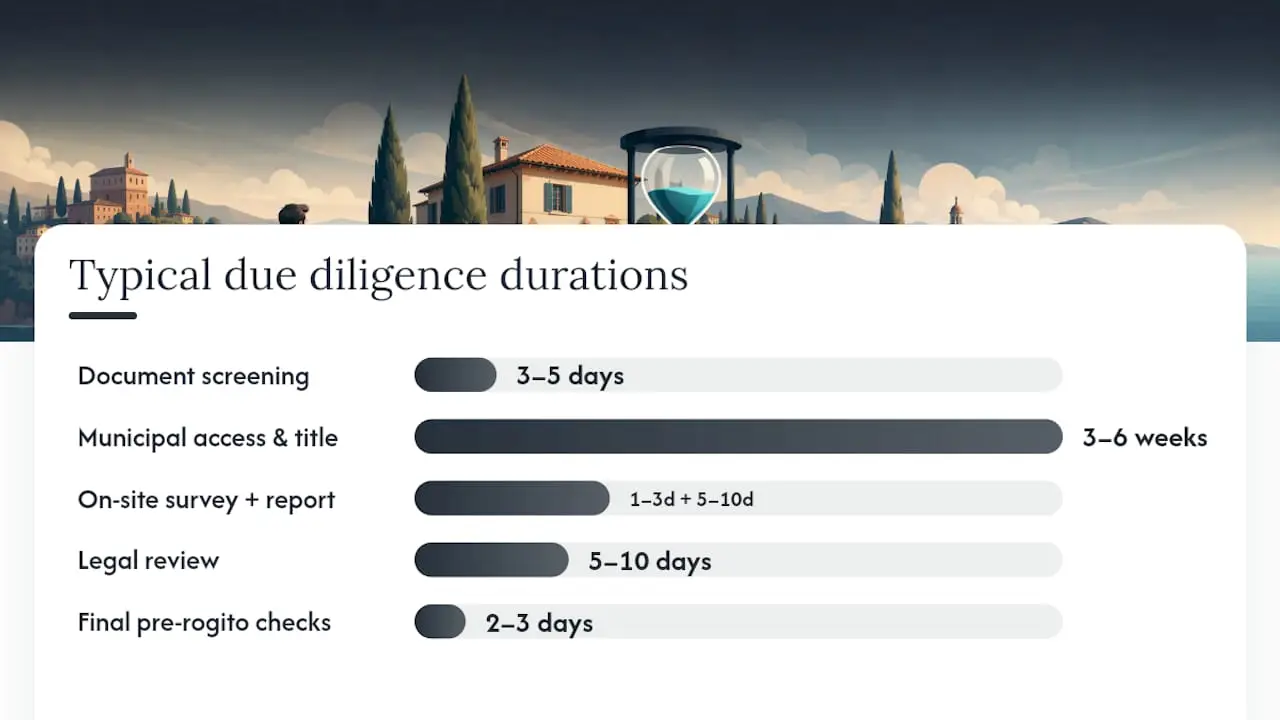
The total elapsed time for due diligence in Italy generally spans several weeks, often around a month or two for standard residential properties; more complex or historic cases may take longer.
Costs for due diligence services vary widely depending on property complexity and location. Typical expenses include technical surveys, legal reviews, fiscal memos, and municipal access fees, summing to several thousand euros for a fully coordinated package prior to notary fees.
Urgency surcharges apply when buyers compress timelines. Re-checking the visura ipotecaria within 15 days of the rogito is standard practice and should be budgeted as a line item from the start.
How to commission due diligence: a scope-of-engagement template
When you instruct a due-diligence team, send a written scope that covers:
Scope items to specify:
- Full property identification (address, cadastral references, foglio/particella/subalterno)
- The four pillars to cover and the specific documents required under each
- Deliverable formats (bilingual Italian/English reports preferred for international buyers)
- Milestone schedule with delivery dates
- Update obligations (updated visura required within 15 days of rogito)
- Access authorization for Comune, Conservatoria, and Catasto
- Confidentiality clause and data handling
Sample milestone schedule:
- Week 1: Document request to seller; initial screening memo delivered
- Weeks 2–3: Municipal access request filed; on-site survey completed
- Weeks 4–6: Relazione Tecnica Integrata delivered; title opinion and fiscal memo delivered
- Week 7: Consolidated due-diligence report and negotiation checklist delivered
- Pre-rogito (T-10 days): Updated visura ipotecaria and final confirmation
Contractual protections to require:
- Limitation of liability clause tied to the scope of work
- Obligation to update findings if the rogito is delayed beyond 30 days
- Clear instructions for who holds power of attorney for archive access
- Defined escalation procedure if red flags are discovered mid-process
Comparing how Italy structures these checks against how buyer verification works in other European markets is useful context: the Italian system places more responsibility on the buyer to commission independent checks, rather than relying on a standardized seller disclosure process.
How Livingitaly structures buyer-side due-diligence support
Livingitaly’s buyer advisory service is built around one principle: the buyer’s interests and the seller’s interests are not the same, so the buyer needs their own team. For international investors, that means a single point of contact who coordinates every specialist, translates every document, and integrates due-diligence findings into the negotiation.
What Livingitaly includes in a standard due-diligence package:
- Buyer advocacy and project management of the full professional team
- Coordination of Comune access-to-acts requests and Conservatoria searches
- Bilingual (Italian/English) versions of all key reports
- Screening memo at offer stage
- Relazione Tecnica Integrata from a qualified geometra or engineer
- Title and ipoteca report from the Conservatoria
- Fiscal impact memo covering purchase taxes, IMU, and prima casa eligibility
- Negotiation checklist with protective clauses for the preliminary agreement
For investors evaluating property investment in Italy from the US or UK, the practical advantage is access: Livingitaly’s local professionals have direct relationships with Comune offices and Conservatoria staff, which compresses the municipal access phase materially. Bilingual reports mean findings go directly into your negotiation without a translation lag.
Why buyer-side due diligence is non-negotiable
The cases that stay with you are not the ones where a deal collapsed. They are the ones where a buyer almost signed a preliminary on a property with three unauthorized extensions and a donation-provenance title that exposed them to a forced-heir claim. Early due diligence surfaced both issues in week three. Without those checks, the buyer would have owned a property they could not resell cleanly for years.
The Italian market rewards prepared buyers. Sellers and their agents know when a buyer has done their homework, and that knowledge shifts the negotiation dynamic in ways that a lower offer alone never does.
Get a buyer-side due-diligence quote from Livingitaly
Livingitaly’s buyer advisory team handles the full due-diligence process for international investors purchasing property in Italy, from the first document request through the final pre-rogito check. You get one coordinated team, bilingual reports, and findings integrated directly into your negotiation strategy.
To receive an accurate quote, send Livingitaly the following:
- Property address and cadastral references (if available)
- Any listing documents or seller-provided materials you already have
- Your planned purchase timeline and target signing date
- Intended use (primary residence, rental investment, restoration project)
Livingitaly typically provides a project proposal within 48 hours of receiving these materials. The next step is a short introductory call to confirm scope and timeline. Start the conversation here.
Sources
- Due diligence immobiliare: controlli prima dell’acquisto
- Prima dell’acquisto e bene – Agenzia delle Entrate
- Due Diligence immobiliare: checklist tecnica-operativa per una compravendita senza sorprese
- Quali sono le domande da fare quando si acquista una casa
- Cosa controllare prima di comprare casa
- Due diligence immobiliare per stranieri – IVI
This article is general information, not a substitute for advice from a qualified lawyer. Consult a qualified legal professional about your own circumstances before acting on anything here.
FAQ
What is due diligence immobiliare in Italy?
It is a coordinated, multi-disciplinary verification process covering legal, urban/technical, cadastral, and fiscal checks that a buyer commissions before signing any binding purchase agreement in Italy.
Does the Italian notary handle due diligence for the buyer?
No. The notary verifies title continuity and registers the deed but does not perform on-site technical surveys or reconstruct the property’s stato legittimo. Independent technical and legal checks are the buyer’s responsibility.
When should due diligence start in an Italian property purchase?
Before the preliminary agreement (compromesso). Findings must be in hand before you commit to a binding deposit, so the process should begin as soon as you identify a property seriously.
How long does a full due-diligence process take in Italy?
Typically 4–8 weeks for a standard residential property. Properties with complex permit histories, historic status, or contested titles can take up to 12 weeks.
Can Livingitaly manage the entire due-diligence process for international buyers?
Yes. Livingitaly coordinates the full professional team, handles access to Italian registries and Comune archives, and delivers bilingual reports integrated with negotiation support for buyers purchasing property in Italy.