
- Private seller: 9% registro + 2% ipotecaria + 1% catastale, calculated on the cadastral value if you request prezzo-valore
- Company seller with IVA: 10% IVA (or 22% for luxury) on the sale price + €200 each for registro, ipotecaria, catastale
- Who collects: your notaio collects all taxes at the rogito and forwards them to the Agenzia delle Entrate
- Buyer advocacy: Livingitaly works exclusively on the buyer’s side, modeling both tax scenarios before you sign anything
Pro Tip: Pull the visura catastale before making an offer. The rendita catastale printed on it is the number that drives your entire tax bill under prezzo-valore, and small differences in rendita produce sizable cash differences in what you owe.
Key Takeaways
| Point | Details |
|---|---|
| Tax regime depends on seller type | Private seller triggers 9% registro + fixed €50 each for ipotecaria and catastale; company with IVA triggers 10% or 22% IVA + €200 each. |
| Prezzo-valore can save tens of thousands | Request it explicitly in the deed; the base is rendita × 1.05 × 120 for second homes. |
| All taxes paid at rogito | The notaio collects and forwards registro, ipotecaria, catastale (or IVA) to the Agenzia delle Entrate on closing day. |
| IMU starts January 1 of purchase year | Calculate it from the rendita and your Comune’s published rate; it applies pro rata from the month of acquisition. |
| Livingitaly models both tax scenarios | The firm runs the registro and IVA calculations before you sign and coordinates the prezzo-valore request with your notaio. |
Table of Contents
- What taxes do you pay when buying a second home in Italy?
- How the prezzo-valore option can cut your tax bill
- What the notaio does and when taxes are actually paid
- Other costs to budget beyond the acquisition taxes
- Your pre-rogito checklist for international buyers
- Why the tax paperwork is where deals go wrong
- Livingitaly helps you model the full tax picture before you commit
- Sources
- FAQ
What taxes do you pay when buying a second home in Italy?
The Italian tax system splits second-home acquisitions into two distinct regimes, and the seller’s legal status is the dividing line.
Private seller (or company not applying IVA)
The Agenzia delle Entrate sets the imposta di registro at 9% for second homes, compared to 2% for a primary residence. The imposta ipotecaria and imposta catastale are fixed at €50 each in this scenario. The minimum registro due is €1,000.
The tax base is normally the declared sale price, but buyers who request prezzo-valore at the deed can substitute the cadastral value, which is almost always lower.
Company seller applying IVA
When the seller is a developer or company that applies VAT, the transfer flips to an IVA transaction. Registro, ipotecaria, and catastale each become a fixed €200, for a combined €600.
| Tax | Private seller (no IVA) | Company seller (with IVA) |
|---|---|---|
| Imposta di registro | 9% (min €1,000) | Fixed €200 |
| Imposta ipotecaria | Fixed €50 | Fixed €200 |
| Imposta catastale | Fixed €50 | Fixed €200 |
| IVA | Not applicable | 10% or 22% |
| Tax base | Cadastral value (prezzo-valore) or sale price | Sale price |

The contrast matters more than it looks. On a €400,000 apartment with a cadastral value of €120,000, the private-seller path with prezzo-valore produces a registro bill of roughly €10,800. Neither path is automatically cheaper; it depends entirely on how far the cadastral value sits below the market price.
How the prezzo-valore option can cut your tax bill
Prezzo-valore lets you pay registro, ipotecaria, and catastale on the cadastral value of the property rather than the price you agreed to pay. The Agenzia delle Entrate allows it when the buyer is a private individual purchasing a residential dwelling, and the sale is not subject to IVA.
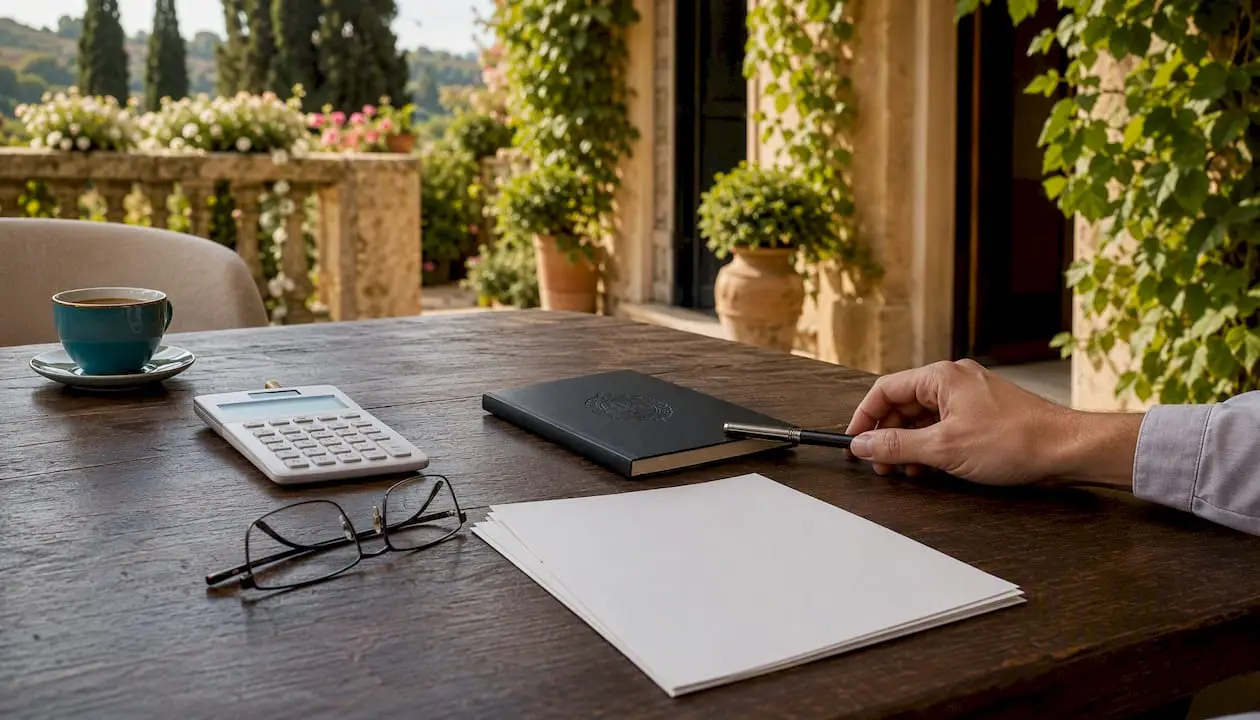
How the cadastral value is calculated
The formula: rendita catastale × 1.05 × 120 = cadastral value for a second home.
The multiplier 120 applies to second homes.
Worked example
Suppose the property’s rendita catastale is €800 and the agreed sale price is €350,000.
Without prezzo-valore, registro would be calculated on €350,000, producing a bill of €31,500. The saving here is over €22,000. Practical worked examples confirm this pattern across a range of rendita values.
Three conditions must all be met:
- The buyer is a private individual (not a company)
- The property is a residential dwelling
- The sale is not subject to IVA
The critical operational point: prezzo-valore must be requested explicitly in the deed at the moment of signing. You cannot add it afterward. Tell your notaio before the rogito, not during it.
What the notaio does and when taxes are actually paid
The notaio is not just a witness. Under Consiglio Nazionale del Notariato guidance, the notary performs full legal due diligence: verifying the property’s cadastral records, checking for mortgages or liens, confirming urban planning conformity, and ensuring the deed meets every formal requirement. The notaio then collects all taxes at the rogito and pays them directly to the Agenzia delle Entrate during registration.
For international buyers, the timeline typically runs:
- Preliminary contract (compromesso): signed weeks or months before closing; a deposit (usually 10–20% of the price) changes hands here
- Rogito (final deed): taxes are paid the same day; the notaio registers the deed and transfers funds to the tax authority
- Registration: completed within a few days of the rogito; the buyer receives the registered deed
Documents the notaio will need from you: valid passport, Italian codice fiscale, proof of funds, and any powers of attorney if applicable.
Pro Tip: If you cannot travel to Italy for the rogito, you can grant a power of attorney to a trusted representative. Livingitaly’s guide on power of attorney in Italy walks through exactly how to execute this from abroad, including apostille requirements.
Other costs to budget beyond the acquisition taxes
Taxes are the largest line item, but not the only one. A realistic budget for spese acquisto seconda casa includes several additional categories.
Notary fees (onorario) vary by transaction value and complexity, typically ranging from €1,500 to €4,000 for a standard residential purchase. Requesting prezzo-valore can also reduce the notaio’s fee, since some fee scales reference the cadastral value rather than the sale price. NotaiOnline provides fee calculators that show how multipliers and transaction values interact.
Confirm whether the agent represents the seller, the buyer, or both.
Technical and urban conformity checks cover a surveyor’s report, energy performance certificate (APE), and verification that the property’s actual layout matches its cadastral plan. Budget €500–€1,500 depending on property size and condition.
There is also a separate notary fee for the mortgage deed.
Ongoing: IMU. Italy’s Imposta Municipale Propria applies to all second homes from January 1 of the year of purchase, calculated pro rata by months of ownership. The formula uses the rendita catastale, a revaluation coefficient, and the municipal rate (set by each Comune). For a full picture of recurring property taxes in Italy, check your specific Comune’s published IMU rates, which vary meaningfully between municipalities.
Pro Tip: Ask your notaio for a written cost estimate (preventivo) before signing the preliminary contract. A good preventivo breaks out registro, ipotecaria, catastale, onorario, and disbursements separately so you can see exactly where every euro goes.
Your pre-rogito checklist for international buyers
Step-by-step actions before signing
- Confirm whether the seller is a private individual or a company, and whether the sale is subject to IVA or registro
- Obtain the visura catastale and note the rendita catastale
- Check the cadastral category (A/1, A/8, A/9 trigger 22% IVA if the seller is a developer)
- Ask the notaio for a written tax estimate showing both the IVA scenario and the registro/prezzo-valore scenario
- Confirm prezzo-valore eligibility and instruct the notaio to include the request in the deed
- Obtain your codice fiscale from the Italian consulate or an Italian tax office before the rogito
- Arrange a power of attorney if you cannot attend in person
- Verify your residency status: AIRE registration or Italian residency affects certain tax treatments; see Livingitaly’s guide on visa and residency rules for the implications
Questions to ask your notaio or buyer adviser
- “Is this sale subject to IVA or to imposta di registro?”
- “Can we apply prezzo-valore, and what is the cadastral value?”
- “What will you collect from me at the rogito, itemized?”
- “Does the cadastral plan match the actual property layout?”
- “Are there any outstanding mortgages, liens, or urban planning irregularities?”
Why the tax paperwork is where deals go wrong
Most international buyers focus on the purchase price and overlook the tax structure until the notaio sends the preventivo. By then, two costly mistakes are already baked in.
The first is missing prezzo-valore. Buyers who don’t request it explicitly at the deed pay registro on the full sale price. On a €300,000 property, that’s the difference between roughly €9,000 and €27,000 in registro alone. The request takes one sentence in the deed; the cost of forgetting it can run to tens of thousands of euros.
The second is misreading the cadastral category. Buyers who don’t verify the category before signing the preliminary contract have no leverage to renegotiate once the deed is being drafted.
A third, quieter mistake: underestimating IMU. Second-home owners pay IMU every year, and municipal rates vary enough that the same property in two different towns can carry meaningfully different annual bills. Getting the Comune’s current rate before purchase, not after, lets you factor it into your return calculations.
Livingitaly helps you model the full tax picture before you commit
Livingitaly works exclusively on the buyer’s side, which means the tax analysis happens before you sign anything, not after. For international buyers navigating tasse acquisto seconda casa, the firm runs both the registro and IVA scenarios against the actual rendita catastale of the property you’re considering, confirms prezzo-valore eligibility, and coordinates directly with the notaio to ensure the request appears in the deed.
The service covers the full acquisition cost stack: taxes, notary fees, agency commissions, technical checks, and an IMU estimate for year one. You get a single written cost estimate you can use to make a properly informed offer.
To get started, send Livingitaly the visura catastale and the draft preliminary contract. The team will return a written tax scenario within a few business days. Request your pre-offer tax estimate or review the full range of buyer advisory services to see how the process works end to end.
Sources
- Acquisto di una casa: le imposte – Agenzia delle Entrate
- Acquistare Un’abitazione – Consiglio Nazionale Del Notariato
- Imposta di Registro Seconda Casa 2026: 9% sulla Rendita Catastale, Esempi e Come Calcolarla
- Notaionline
- Comprare la seconda casa – il registro al 9%
This article is general information, not a substitute for advice from a qualified financial advisor. Consult a qualified financial professional about your own circumstances before acting on anything here.
FAQ
What is the registro tax rate for a second home in Italy?
When does IVA apply instead of registro on a second-home purchase?
IVA applies when the seller is a company (impresa) that has not opted out of VAT on the transaction.
Can I request prezzo-valore if I’m buying from abroad?
Yes, nationality and residency abroad do not disqualify you from prezzo-valore. The conditions are that you are a private individual, the property is residential, and the sale is not subject to IVA. You must instruct your notaio to include the request in the deed before signing.
What ongoing taxes will I owe as a second-home owner in Italy?
IMU (Imposta Municipale Propria) is the main annual charge. It is calculated from the rendita catastale multiplied by a revaluation coefficient and the municipal rate set by your Comune. It becomes payable pro rata from January 1 of the year you acquire the property.
How can Livingitaly help with second-home taxes before I make an offer?
Livingitaly runs a pre-offer tax analysis covering both the registro and IVA scenarios, confirms prezzo-valore eligibility using the actual rendita catastale, and provides a written cost estimate including notary fees and first-year IMU. Send the visura catastale and draft preliminary contract to get started.