
For most U.S. buyers purchasing property in Italy, a fixed-rate mortgage is the stronger choice. Here is the short version: if you plan to hold the property for more than five years, a fixed-rate mortgage locks in predictable monthly payments for the life of the loan, which matters enormously when you are also managing currency conversion between dollars and euros. Variable or adjustable-rate mortgages (ARMs) offer a lower introductory rate, but the payment shock risk after the initial period, layered on top of exchange-rate exposure, creates a compounding uncertainty most international buyers are not positioned to absorb.
Key reasons fixed-rate financing tends to fit the U.S.-buyer-in-Italy profile:
- Payment certainty: Your principal-and-interest payment never changes, making multi-currency budgeting far more manageable.
- Time horizon: Most buyers planning a long-term hold, a vacation home, or a rental investment benefit from the budgeting stability a fixed rate provides.
- Currency exposure: Dollar-to-euro swings already introduce unpredictability; a variable rate adds a second moving part.
- Refinancing complexity: Restructuring a cross-border mortgage is harder than a domestic one, so locking in a rate upfront avoids that friction later.
Livingitaly’s buyer-side advisory team works with international clients at every stage of this decision, from lender introductions to contract-term review and tax structuring.
Table of Contents
- Fixed vs variable mortgage: how do the two types compare?
- What ARM contract terms do you need to confirm before signing?
- How do U.S. buyers typically finance property in Italy?
- How do you choose between fixed and variable for your purchase?
- Worked examples: fixed vs ARM and the stress test
- How Livingitaly helps you structure financing and what to do next
- How does your credit profile affect eligibility and rates?
- What are the tax implications of fixed and variable mortgages in Italy?
- How do inflation and interest rate trends affect your mortgage rate?
- What are your refinancing options for fixed and variable mortgages?
- Key Takeaways
- What Livingitaly sees most often
- Useful sources and tools for further research
Fixed vs variable mortgage: how do the two types compare?
The core trade-off is predictability versus initial cost.
Fixed-rate mortgages lock in your interest rate for the entire loan term. Whether you choose a 15-year or 30-year product, the rate you sign at closing is the rate you pay on the last day of the loan. The CFPB confirms that ARMs, by contrast, start with a lower introductory rate and then adjust periodically based on a specified index plus a lender margin, exposing borrowers to future payment increases.
Adjustable-rate mortgages carry a fixed period first (common structures are 5/1, 7/1, or 10/1), then reprice annually. The initial rate is usually lower, which can look attractive on paper, but the payment after the first adjustment can be materially higher.

| Dimension | Fixed-Rate | ARM (e.g., 5/1) |
|---|---|---|
| Predictability | High — rate never changes | Low after initial period |
| Initial rate | Higher | Lower |
| Payment shock risk | None | Significant at each adjustment |
| Best for | Long-term hold (5+ years) | Short-term hold or sale before reset |
| Refinancing complexity | Moderate | Higher — timing matters |
| Currency risk interaction | Stable, easier to hedge | Compounded by rate variability |
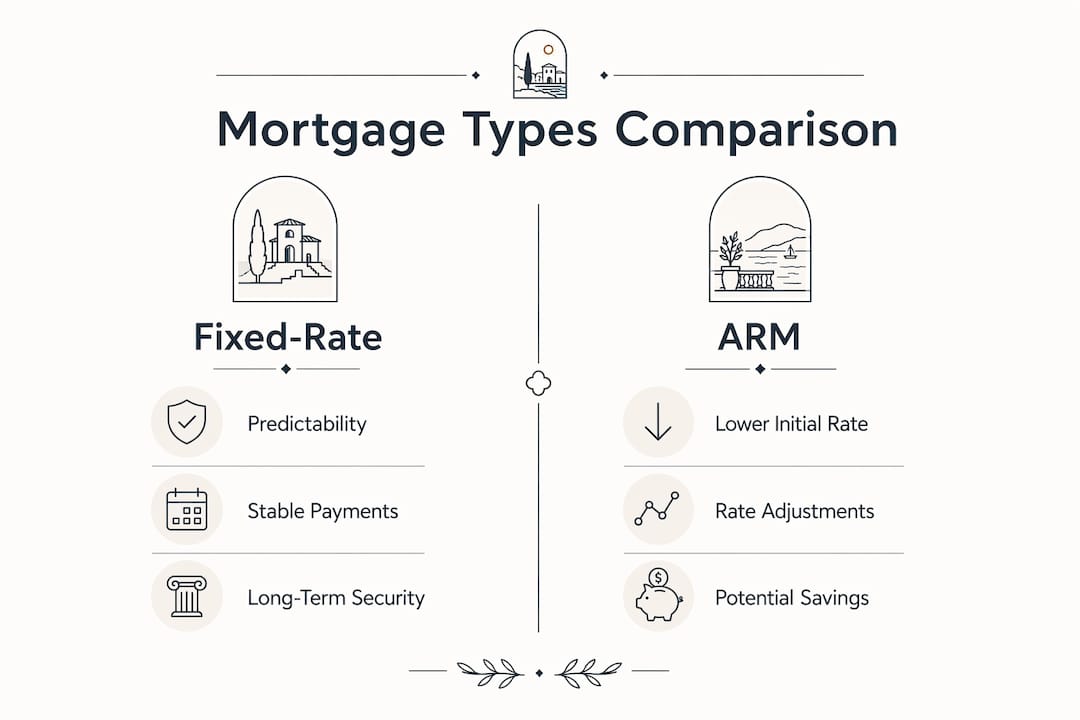
For a U.S. buyer holding an Italian property for a decade or more, the ARM’s lower introductory rate rarely justifies the compounding uncertainty of rate resets plus dollar-euro fluctuations.
What ARM contract terms do you need to confirm before signing?
Before committing to a variable-rate loan, the CFPB recommends confirming five specific contract elements. Each one directly affects what your worst-case monthly payment could be.
Adjustment frequency tells you how often the rate can change after the fixed period ends. A 5/1 ARM adjusts once per year after year five; a 5/6 ARM adjusts every six months.
Index is the benchmark the lender uses to set your new rate. Common U.S. indexes include SOFR (Secured Overnight Financing Rate) and the one-year Treasury. Know which one your loan uses and where it has traded historically.
Margin is the fixed percentage the lender adds on top of the index. If the index is 4.5% and the margin is 2.5%, your new rate is 7%. The margin never changes; only the index moves.
Periodic cap limits how much the rate can increase at any single adjustment. A 2% periodic cap means a rate of 5% cannot jump above 7% in one reset, even if the index warrants it.
Lifetime cap sets the absolute ceiling above your initial rate. A 5% lifetime cap on a 6% starting rate means you can never pay more than 11%, regardless of market conditions.
Pro Tip: Add the margin to the index’s historical peak, then apply the lifetime cap. That number is your worst-case rate. Plug it into a standard mortgage calculator to see the maximum monthly payment. If that payment is unaffordable in dollars after converting from euros at a stressed exchange rate, the ARM is the wrong product for you.
Here is a quick narrative example. Suppose you take a 5/1 ARM at 6.31% on a $400,000 loan. After year five, the index has risen to 5.5% and your margin is 2.5%, giving a new rate of 8%. Your periodic cap limits the first adjustment to 2%, so the rate moves to 8.31% (6.31% + 2%). At that rate, your monthly payment on the remaining balance climbs by several hundred dollars. If the index stays elevated, the next adjustment could push you to the lifetime cap.
How do U.S. buyers typically finance property in Italy?
Two main routes exist: an Italian non-resident mortgage from an Italian bank, or financing arranged in the United States secured against existing assets. A third, less common path is a mix of both.
Italian non-resident mortgages are available but come with stricter terms than resident loans. Non-resident buyers typically face:
- Down payment: a substantially higher portion of the purchase price than residents typically pay.
- Documentation: Two to three years of tax returns, proof of income, bank statements, and a credit report translated and apostilled.
- Timeline: Pre-approval takes four to eight weeks; full approval and closing typically runs three to five months from offer acceptance.
- Closing costs: Budget 3%–5% of the purchase price for notary fees, registration tax, agency fees, and lender charges.
Currency risk is the factor most buyers underestimate. If you borrow in euros and your income is in dollars, a 10% dollar depreciation against the euro effectively raises your monthly payment by 10% in dollar terms. Two practical mitigations: use a currency-hedging service to lock forward exchange rates on recurring payments, or make a larger down payment to reduce the euro-denominated loan balance.
Freddie Mac’s research consistently shows that shopping multiple lenders and comparing APRs and closing costs can save thousands over a loan’s life. That principle applies equally to Italian lenders, where rate spreads between institutions can be meaningful.
Timeline summary:
- Pre-approval and document preparation: 4–8 weeks
- Property offer and acceptance: 1–4 weeks
- Mortgage application and appraisal: 6–10 weeks
- Final approval and closing: 2–4 weeks
Mortgage markets move daily based on bond yields, so locking your rate when you are within 30–60 days of closing is generally the right call.
How do you choose between fixed and variable for your purchase?
Work through these steps before you sign anything.
- Determine your hold period. Planning to sell within five years? An ARM’s lower initial rate may save money if you exit before the first reset. Holding longer? Fixed wins on certainty.
- Run the stress test. Take the ARM’s starting rate, add the lifetime cap, and calculate the monthly payment at that ceiling. Can you afford it in dollars at a stressed exchange rate?
- Compare APR, not just the rate. APR folds in mandatory fees and points, giving a fuller picture of actual loan cost. Two loans with the same nominal rate can have very different APRs.
- Ask lenders these specific questions: What index does the ARM use? What is the margin? What are the periodic and lifetime caps? Are there prepayment penalties? Is there a floor rate below which the ARM cannot fall?
- Factor in your exit strategy. If you plan to rent the property, fixed-rate payments make cash-flow modeling far more reliable. If you plan to refinance in three years, confirm there are no prepayment penalties that would erode the savings.
- Get at least three loan estimates and compare them line by line on APR and closing costs.
Worked examples: fixed vs ARM and the stress test
An ARM’s lower initial payments can reverse into higher payments once adjustment caps apply. The numbers below use sample rates from Bankrate as of late July 2026 and are illustrative, not guaranteed.
| Loan type | Sample rate | Loan amount | Monthly payment (P&I) | Worst-case rate | Worst-case payment |
|---|---|---|---|---|---|
| 30-year fixed | 6.74% | $400,000 | — | 6.74% (unchanged) | — |
| 5/1 ARM | 6.31% | $400,000 | — | 11.31% (5% lifetime cap) | — |
The ARM saves roughly $59 per month in the initial period. After the lifetime cap applies, the same loan costs nearly $1,500 more per month. That gap, converted to euros at a stressed exchange rate, is the number to stress-test.
Step-by-step stress test:
- Start with the ARM’s initial rate (6.22%).
- Add the lifetime cap (5%) to get the ceiling rate (11.22%).
- Calculate the monthly payment on the remaining balance at 11.22% for the remaining term.
- Convert that payment to dollars at a pessimistic exchange rate (e.g., EUR/USD at 1.15 instead of today’s rate).
- Confirm that payment fits your budget without straining other obligations.
Pro Tip: Ask your Italian lender whether the loan includes a conversion clause that lets you switch from variable to fixed mid-term. Some Italian banks offer this, and it can serve as a built-in safety valve if rates rise sharply after your fixed period ends.
How Livingitaly helps you structure financing and what to do next
Engaging a buyer-side advisor reduces financing risk in ways a lender’s own representative cannot. Livingitaly works exclusively on the buyer’s side, which means every recommendation is made in your interest, not the bank’s.
Specific services relevant to your mortgage decision:
- Lender introductions: Access to Italian banks and brokers experienced with non-resident buyers.
- Contract-term review: Line-by-line review of ARM caps, margin, index, and prepayment clauses before you sign.
- Tax and structuring advice: Guidance on whether to purchase personally or through an SPV, and how that affects mortgage eligibility and Italian property taxes.
- Currency planning: Coordination with currency specialists to hedge euro-denominated payments.
- Closing support: Representation at the notary and review of final closing costs.
The simplest next step is a finance review consultation. In that meeting, Livingitaly will map your financing options, identify the lender profiles that match your profile as a non-resident buyer, and flag any contract terms that need negotiation. Visit the buyer advisory page to request a consultation, or explore the full services overview to understand the complete scope of support available.
How does your credit profile affect eligibility and rates?
Italian lenders assess non-resident borrowers on a combination of factors: income stability, debt-to-income ratio, credit history, and the loan-to-value ratio of the property. A U.S. credit score does not transfer directly to Italy; lenders typically request a credit report from a recognized U.S. bureau (Equifax, Experian, or TransUnion) alongside tax returns and bank statements.
A stronger financial profile, specifically a low debt-to-income ratio and a clean credit history, generally unlocks better rates and higher loan-to-value ratios. Buyers with thinner credit files or irregular income (common among self-employed buyers) often face higher margins on variable-rate products or stricter fixed-rate terms. Preparing a clean, well-documented financial package before approaching lenders is one of the highest-return steps you can take.
What are the tax implications of fixed and variable mortgages in Italy?
For non-resident buyers, Italian mortgage interest is generally not deductible against Italian income tax unless the property qualifies as a primary residence, which requires Italian residency. If you purchase as an investment property or vacation home, the tax treatment differs. Buyers who establish Italian residency may access deductions on primary-home mortgage interest, subject to Italian tax authority rules.
On the U.S. side, the IRS allows deduction of mortgage interest on a second home, subject to the standard limitations on total mortgage debt. Whether your Italian property qualifies depends on how it is used and how the loan is structured. A tax advisor familiar with both Italian and U.S. tax law is worth engaging early. Livingitaly’s property tax guidance covers the Italian side of this equation in detail.
This article is general information, not tax or legal advice. Confirm your specific situation with a qualified professional and the relevant tax authorities.
How do inflation and interest rate trends affect your mortgage rate?
Fixed-rate mortgage pricing in the U.S. tracks closely with Treasury bond yields, particularly the 10-year note. When inflation rises, bond yields tend to follow, and fixed mortgage rates move up with them. As of late July 2026, the average 30-year fixed rate sits at approximately 6.46%, with the 5/1 ARM at 6.22%.
Variable rates, by definition, track an index that reflects current monetary policy. When central banks raise rates to fight inflation, ARM holders absorb the increase at each adjustment. Italian variable-rate mortgages typically track the Euribor (Euro Interbank Offered Rate), which means your rate exposure is tied to European Central Bank policy, not the Federal Reserve. That is a meaningful distinction: your income may be in dollars tied to U.S. economic conditions, while your loan rate responds to European ones.
What are your refinancing options for fixed and variable mortgages?
Refinancing a cross-border mortgage is possible but more complex than a domestic transaction. For a fixed-rate loan, refinancing makes sense when Italian or U.S. rates drop materially below your current rate and the closing costs of the new loan are recovered within your planned remaining hold period.
For ARM holders, refinancing into a fixed rate before the first adjustment is a common strategy, particularly when the rate environment is rising. Some Italian lenders include a conversion clause that allows switching from variable to fixed within the same loan, avoiding a full refinancing process. Confirm whether this clause exists and what the conversion rate formula is before signing the original loan.
Prepayment penalties vary by lender and loan type. Italian regulations have historically capped prepayment penalties on residential mortgages, but the specific terms depend on your contract. Always confirm the penalty structure before refinancing.
Key Takeaways
For most U.S. buyers purchasing property in Italy, a fixed-rate mortgage delivers the payment certainty needed to manage cross-border currency exposure and long-term budgeting.
| Point | Details |
|---|---|
| Fixed rate wins for long-term holds | Buyers holding five or more years benefit from payment certainty that simplifies dollar-to-euro budgeting. |
| Stress-test every ARM offer | Calculate the maximum monthly payment using the initial rate plus the lifetime cap before committing. |
| Non-resident down payments run higher | Italian lenders typically require 40%–50% down from non-resident buyers, compared to 20%–30% for residents. |
| APR beats nominal rate for comparisons | Always compare APR across lenders; it includes fees and gives a true picture of total loan cost. |
| Get buyer-side advisory early | Livingitaly’s contract-term review and lender introductions reduce financing risk before you sign anything. |
What Livingitaly sees most often
The buyers who come to us having already committed to a variable-rate product are almost always the ones who underestimated two things: how quickly an ARM’s payment can climb after the fixed period, and how much currency volatility amplifies that increase in dollar terms. The preference we see among long-term owners is overwhelmingly fixed-rate, and that preference tends to hold even when the initial ARM rate looks compelling on a spreadsheet.
Useful sources and tools for further research
The sources below support the figures and guidance in this article and are worth bookmarking for your own rate comparisons and stress tests.
- Bankrate mortgage rates: Daily updated 30-year fixed, 15-year fixed, and ARM rates with lender comparisons.
- CFPB ARM explainer: The authoritative plain-language breakdown of ARM mechanics, caps, and payment shock risk.
- Freddie Mac PMMS: Weekly primary mortgage market survey; useful for tracking rate trends over time.
- MortgageResearch rate tracker: Daily rate snapshots and APR guidance.
- Yahoo Finance mortgage rates: Zillow lender marketplace averages for 30-year fixed, 15-year fixed, and 5/1 ARM.
On APR vs. interest rate: the nominal rate tells you the cost of borrowing; APR tells you the cost of the loan. When comparing offers from Italian and U.S. lenders, always request the APR and confirm which fees are included. A loan with a lower rate but higher origination fees can cost more over five years than a slightly higher-rate loan with minimal fees.