
Fractional ownership Italy is defined as deeded equity ownership of a share in an Italian property, held through a corporate structure that grants proportional usage rights, shared costs, and full resale potential. Unlike a timeshare, fractional ownership provides genuine equity documented as ownership shares in a legal entity. Professional programs typically offer 1/8 to 1/10 shares, granting 44–52 days of annual usage, with entry prices ranging from approximately €65,000 to over €218,000. Italy’s legal and tax frameworks make this model particularly attractive for international investors seeking luxury homes in Italy without the full cost and management burden of sole ownership.
How is fractional ownership structured legally in Italy?
The most effective legal vehicle for fractional ownership in Italy is the property-specific Società a Responsabilità Limitata, or SRL. This is the Italian equivalent of a limited liability company. Each property sits inside its own SRL, and investors hold equity shares in that company rather than a direct deed to the real estate itself.
Why the SRL structure protects investors
A property-specific LLC isolates each owner from the liabilities of other co-owners and from debts tied to other properties. If one investor faces financial difficulty, that problem cannot spread to the property or to other shareholders. Share transfers are also far simpler under this structure. Selling your fractional interest means transferring company shares, not executing a full real estate conveyance, which reduces notary costs and transaction complexity.

The SRL also makes governance enforceable. The company’s bylaws define voting thresholds, usage scheduling, maintenance responsibilities, and exit procedures. Investors know exactly what they can and cannot do before they sign.
Alternative structure: the Società Semplice
The Società Semplice is a lighter corporate vehicle suited to family groups or small circles of friends buying a vacation home together. Income is taxed directly to shareholders under Article 5 of the Italian Tax Code (TUIR), avoiding the double taxation that can arise in other corporate forms. This transparency makes it popular for holiday properties where rental income is minimal and the priority is personal use.
The Società Semplice works well for tight-knit groups with aligned interests. For larger investor pools or commercial fractional programs, the SRL remains the stronger choice because it offers cleaner liability separation and easier share transferability.
The danger of default joint ownership
Default Italian joint ownership, known as comproprietà, is the structure that results when buyers purchase a property together without a corporate wrapper. Under Article 1105 of the Italian Civil Code, all ordinary management decisions require unanimous consent. That means one dissenting co-owner can block a repair, a rental agreement, or a sale. Deadlocks are common, and resolving them through Italian courts is slow and expensive.
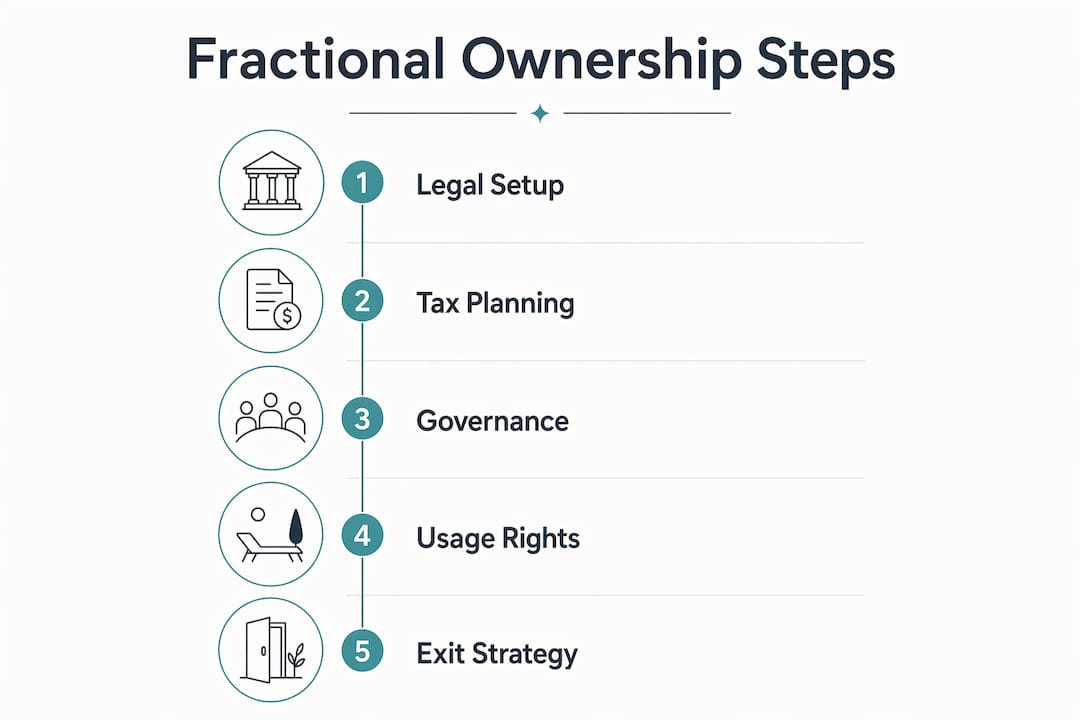
Structured fractional programs avoid this entirely by placing ownership inside a legal entity with pre-agreed governance rules.
Pro Tip: Always verify that the fractional program uses a property-specific corporate entity before committing capital. A single shared LLC covering multiple properties offers far weaker protection than one LLC per property.
What are the tax implications for fractional ownership investors in Italy?
Italian property taxes apply proportionally to fractional owners based on their ownership percentage. The two most relevant recurring taxes are IMU (the municipal property tax) and TARI (the waste collection levy). Both are divided strictly by ownership share, so a 1/8 owner pays one-eighth of each bill. This proportional model makes annual holding costs predictable and manageable.
Rental income and the cedolare secca regime
Rental income from Italian property qualifies for the cedolare secca flat-rate tax regime. This replaces the standard progressive income tax rates with a fixed rate, significantly reducing the tax burden on rental receipts. The SRL structure consolidates all rental reporting into a single Italian tax filing, rather than requiring each foreign investor to file individually. Structured ownership consolidates Italian tax filings into one corporate return, which then allocates proportional items to each owner. For American and British investors unfamiliar with Italian tax administration, this is a material practical benefit.
Capital gains and the five-year rule
Capital gains on Italian real estate are exempt from tax if the property is held for more than five years. This rule applies to the underlying asset held within the corporate structure. Investors who plan to hold their fractional share as a medium to long-term position benefit directly from this exemption. Short-term resale within five years triggers a gains tax, so the five-year threshold should factor into any exit planning.
Inheritance tax advantages
Italian inheritance tax stands at 4% for transfers to direct descendants, with a €1,000,000 exemption per beneficiary. For non-residents, the tax applies only to Italian-situated assets. This makes fractional ownership a practical tool for cross-border estate planning. Passing a fractional share to a child or grandchild at a 4% rate, with a €1,000,000 exemption, is significantly more favorable than inheritance tax regimes in many other jurisdictions.
Pro Tip: Consult a dual-qualified advisor who understands both Italian tax law and your home country’s rules before structuring ownership. Italy’s tax treaty network with the US and UK can further reduce double taxation exposure.
| Tax | Rate / Rule | Fractional Owner Impact |
|---|---|---|
| IMU (municipal property tax) | Varies by municipality | Paid proportionally by ownership share |
| TARI (waste levy) | Set locally | Divided by ownership percentage |
| Rental income (cedolare secca) | Flat rate | Reported via single LLC filing |
| Capital gains | Exempt after 5 years | Plan exit timeline accordingly |
| Inheritance tax | 4% with €1M exemption per heir | Favorable for cross-border estate planning |
What are the investment benefits and considerations of fractional ownership in Italy?
Shared property investment in Italy solves the core problem that stops most international buyers: the full cost of a luxury Italian property is simply out of reach for many investors, and the management burden is too high for a property used only a few weeks per year. Fractional ownership addresses both issues directly.
The key financial and lifestyle advantages include:
- Reduced entry cost. A 1/10 share in a managed Italian property starts at approximately €65,000, compared to the full purchase price of €650,000 or more for the same asset. Investors access prime real estate at a fraction of the capital outlay.
- Proportional cost sharing. Maintenance, insurance, utilities, and management fees are divided among co-owners. A property that costs €30,000 per year to run costs each 1/10 owner €3,000 annually.
- Usage rights. A 1/8 share typically grants 44–46 days of personal use per year. A 1/10 share grants approximately five weeks. Usage is scheduled through the management company or governance calendar.
- Rental income potential. Owners who do not use their full allocation can often rent unused days, generating income that offsets holding costs.
- Asset appreciation. Italian luxury real estate has demonstrated long-term value growth in prime locations. Fractional owners participate in that appreciation proportionally. Investment property in Italy offers both lifestyle and financial returns when structured correctly.
- Resale rights. Fractional shares carry full resale rights. Owners can sell their equity stake to a third party, subject to any pre-emption rights held by co-owners under the bylaws.
The main challenges are coordination among co-owners and governance quality. A poorly drafted shareholder agreement creates exactly the kind of gridlock that the corporate structure was designed to prevent. Investors should treat the quality of the governance documents as seriously as the quality of the property itself.
How is property management handled in Italian fractional ownership models?
Professional fractional programs appoint a management company or administrator to handle all day-to-day operations. This covers maintenance scheduling, utility payments, cleaning between stays, and coordination of the usage calendar. Full-service property management in Italy removes the operational burden from individual owners entirely.
The governance framework built into the corporate bylaws handles the decisions that go beyond routine maintenance. Key mechanisms include:
- Quorum rules. Major decisions, such as capital improvements or sale of the property, require a defined majority rather than unanimity. This prevents any single owner from blocking necessary action.
- Pre-emption rights. When one owner wants to sell their share, other co-owners typically have the right of first refusal. This protects the group from an unwanted third party entering the ownership structure.
- Usage scheduling. A rotating calendar or booking system allocates personal use days fairly. High-demand periods, such as August in Tuscany or the Christmas week in the Dolomites, are distributed by rotation or auction among co-owners.
- Expense reporting. The management company produces regular financial statements showing each owner’s proportional share of costs and any rental income generated.
Pro Tip: Before purchasing, request a copy of the property’s shareholder agreement and management contract. Review both with an Italian property lawyer. The quality of these documents determines whether co-ownership runs smoothly or becomes a source of conflict.
The best fractional programs also offer concierge services, including airport transfers, catering, and local activity booking. These services transform the ownership experience from a logistical exercise into a genuine luxury lifestyle product.
Key takeaways
Fractional ownership in Italy delivers genuine deeded equity, proportional tax obligations, and structured governance, making it the most accessible and legally sound route for international investors to own Italian luxury real estate.
| Point | Details |
|---|---|
| Legal structure matters most | Use a property-specific SRL or Società Semplice; never rely on default comproprietà. |
| Taxes are proportional and predictable | IMU, TARI, and rental income are all divided by ownership share, simplifying annual costs. |
| Entry cost is significantly lower | A 1/10 share starts around €65,000, opening luxury Italian real estate to a wider investor pool. |
| Governance documents are the product | The shareholder agreement and bylaws determine whether co-ownership is smooth or contentious. |
| Inheritance tax favors fractional owners | Italy’s 4% rate with a €1M exemption per heir makes fractional shares efficient for estate planning. |
Why fractional ownership in Italy rewards patience and structure
I have advised international investors on Italian property for years, and the single biggest mistake I see is treating fractional ownership as a product rather than a legal relationship. Buyers focus on the property photos and the usage days. They skim the shareholder agreement. That is exactly backwards.
The Italian legal framework is genuinely favorable for structured fractional ownership. The SRL wrapper, the cedolare secca regime, and the inheritance tax exemptions are real advantages that most other European markets cannot match. But those advantages only materialize if the legal structure is set up correctly from day one. A poorly drafted statute turns co-ownership into comproprietà in practice, even if the corporate wrapper exists on paper.
The market trend is also clear. Demand for Italian real estate investment advice from American and British buyers has grown steadily, and fractional models are increasingly the entry point for first-time buyers in the €100,000–€300,000 range. These buyers are not compromising. They are being smart about capital allocation. A well-structured fractional share in a Tuscan villa or an Amalfi Coast apartment delivers more lifestyle value per euro than a full purchase of a lesser property.
My advice: prioritize the legal structure and the governance documents over the property itself. A beautiful property with weak governance is a liability. A well-governed share in a good property is an asset.
— MG
Livingitaly’s advisory for fractional investors in Italy
International investors entering the Italian fractional market face a complex web of legal, tax, and operational decisions. Livingitaly specializes in guiding buyers through every stage of that process, from identifying the right property and ownership structure to completing due diligence and managing the asset post-purchase.
Livingitaly’s team covers legal structure selection, tax planning under the 2026 Italian framework, and access to trusted property management solutions. Whether you are buying property in Italy for the first time or expanding an existing portfolio, Livingitaly provides the buyer-side advocacy that protects your interests at every step. The firm works exclusively for the buyer, not the seller, which means every recommendation is made with your financial outcome in mind.
FAQ
What is fractional ownership in Italy?
Fractional ownership in Italy is deeded equity ownership of a share in an Italian property, held through a corporate entity such as an SRL. It grants proportional usage rights, shared costs, and full resale potential, and it differs from a timeshare by providing genuine ownership rather than just usage rights.
How many days can a fractional owner use an Italian property?
A 1/8 share typically grants 44–46 days of annual personal use, while a 1/10 share grants approximately five weeks. Usage is allocated through a management company or governance calendar defined in the shareholder agreement.
What taxes does a fractional owner pay in Italy?
Fractional owners pay IMU, TARI, and other property-related taxes proportionally based on their ownership share. Rental income qualifies for the cedolare secca flat-rate regime, and capital gains are exempt after five years of ownership. Detailed guidance on Italian property taxes is available for foreign investors.
What is the difference between fractional ownership and a timeshare?
Fractional ownership provides genuine deeded equity in a property, with resale rights and participation in asset appreciation. A timeshare grants only usage rights for a fixed period, with no equity stake and no resale value tied to property appreciation.
Why should investors avoid default joint ownership in Italy?
Default Italian joint ownership, or comproprietà, requires unanimous consent for all ordinary management decisions under Article 1105 of the Italian Civil Code. This creates frequent deadlocks and costly legal disputes. Structured fractional programs use corporate entities with pre-agreed governance rules to prevent this outcome entirely.