
Condominium fees in Italy (called spese condominiali) are shared charges for maintaining and operating a building’s common areas, divided among owners according to each unit’s proportional share expressed in thousandths, or millesimi. The legal foundation sits in Articles 1117–1139 of the Italian Civil Code, with Article 1123 specifically governing how costs are split. Before you go any further in a purchase, request these four documents from the condominium administrator: the last two years of financial statements, the assembly minutes, the millesimal table, and the current payment and default ledger. A notarized deed alone does not confirm the absence of condominium debts, and buyers can inherit joint liability for the transfer year and the immediately preceding year.
Key documents to request immediately:
- Last two years of assembly minutes (verbali dell’assemblea)
- Last two years of financial statements (rendiconto condominiale)
- Current millesimal table (tabella millesimale)
- Outstanding contributions ledger (registro dei morosi)
- Insurance policy summary and any active service contracts
Table of Contents
- What condominium fees in Italy actually cover
- Ordinary vs. extraordinary expenses: what falls into each category
- How condominium fees are calculated: millesimi and a worked example
- What to expect in monthly fees and extraordinary cost ranges
- Who the administrator is and what documents you can demand
- Legal obligations and what happens when owners don’t pay
- Extraordinary works: who approves them, who pays, and what happens at sale
- Due-diligence checklist for U.S. buyers
- Key Takeaways
- Why condominium accounts deserve the same attention as a structural survey
- Livingitaly handles the due diligence you cannot do from across the Atlantic
- Useful sources and further reading
What condominium fees in Italy actually cover
A condominio is more than a loose group of neighbors sharing a stairwell. Under Italian law, it is a regulated legal entity with its own tax identification number (codice fiscale) and a dedicated bank account. Every owner holds title to their individual unit plus an undivided share of the common areas, which typically include stairwells, elevators, the roof, the courtyard, the facade, and any shared garden or parking structure.
Spese condominiali are the charges that keep those common areas running. Ordinary recurring costs usually include:
- Cleaning and janitorial services for stairwells and common spaces
- Electricity for shared lighting, stairwells, and parking areas
- Elevator maintenance contracts and periodic inspections
- Caretaker or concierge (portiere) salary and social contributions
- Building insurance covering structure and common areas
- Routine maintenance of boilers, intercoms, and shared systems
- Centralized heating operating costs, where applicable
Each condominium may also have its own regolamento condominiale (internal regulations) that adds specifics about how costs are allocated or which services are included. Tenants, in practice, typically bear the ordinary operating costs, while owners are responsible for extraordinary expenses and capital works. That said, the lease agreement governs the tenant-owner split, and the condominium holds the owner legally responsible regardless of any private arrangement.
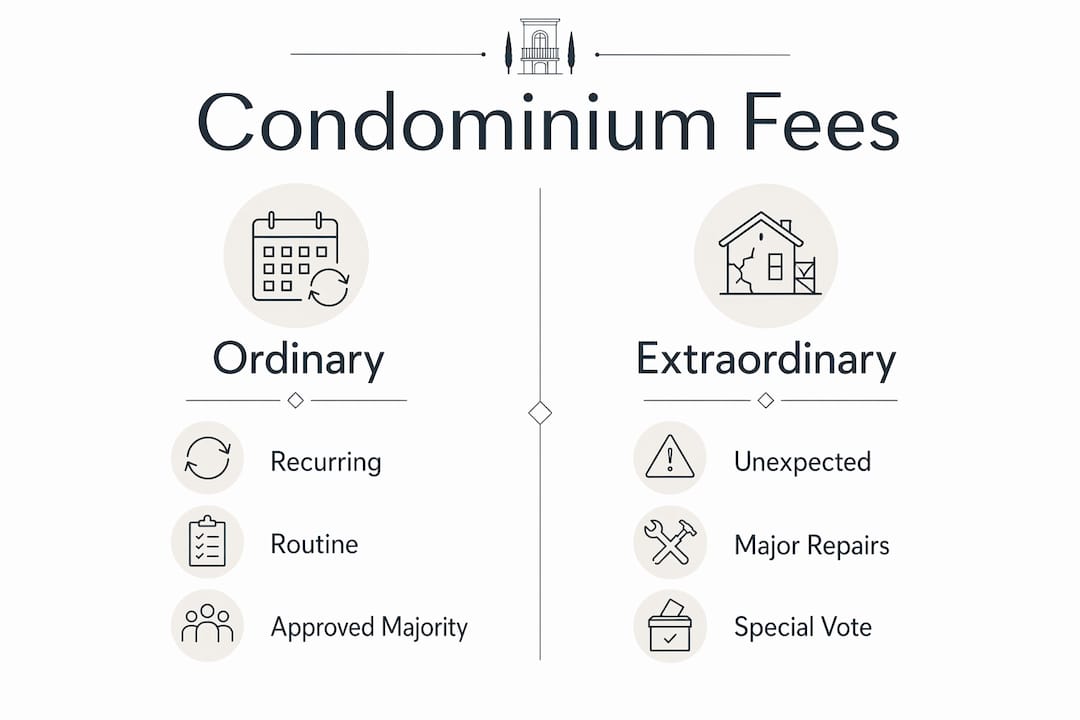
Ordinary vs. extraordinary expenses: what falls into each category
The distinction between ordinary and extraordinary costs matters enormously when you are buying, because extraordinary works can generate large, unexpected assessments that land on the new owner’s plate.
| Category | Definition | Typical Examples | Approval Required |
|---|---|---|---|
| Ordinary (spese ordinarie) | Recurring operational and maintenance costs | Cleaning, elevator servicing, lighting, insurance premiums, caretaker salary | Simple majority of assembly |
| Extraordinary (spese straordinarie) | Major repairs, structural works, upgrades | Facade renovation, roof replacement, elevator replacement, seismic retrofitting | Majority by millesimi (varies by scope) |
Ordinary expenses are predictable and budgeted annually. Extraordinary expenses arise when the building needs significant capital work, and the amounts per owner can run from a few hundred euros for a minor repair to several thousand for a full facade or roof project. These costs are approved at condominium assembly meetings, and some decisions, such as altering the millesimal tables themselves, require unanimous consent.
Renovation incentives like the Ecobonus or Sismabonus can offset some extraordinary costs, but eligibility rules change frequently. Verify current applicability with a tax advisor before factoring any relief into your purchase math.
Pro Tip: Ask the seller and the administrator directly: “Are there any extraordinary works approved or under discussion that have not yet been invoiced?” An approved project that hasn’t been billed yet is still a liability you may inherit.
How condominium fees are calculated: millesimi and a worked example
Article 1123 of the Italian Civil Code establishes the rule: costs are divided among owners in proportion to their ownership shares unless law or the condominium’s own regulations specify otherwise. Those shares are expressed as millesimi, thousandths of the building’s total value.
Here is how the millesimal system works, step by step:
- Millesimal tables are created at the time of construction or first subdivision. Each unit receives a value from 0 to 1,000 based on size, floor, orientation, amenities, and relative market value within the building.
- The total always sums to 1,000. If your unit carries 80 millesimi, you own 8% of the common areas and bear 8% of shared costs.
- The annual budget is set by the assembly. Suppose the building’s approved annual budget is €12,000.
- Your share is calculated as: (your millesimi ÷ 1,000) × annual budget. With 80 millesimi: (80 ÷ 1,000) × €12,000 = €960 per year, or €80 per month.
- Payments are typically monthly or quarterly, depending on the condominium’s regulations.
Millesimal tables can only be modified with a unanimous vote of all owners, which makes them stable but also means errors from the original construction can persist for decades.
Two common exceptions are worth knowing. Under Article 1124, elevator costs are split partly by floor level and partly by millesimi, since upper-floor owners use the elevator more. Centralized heating often uses individual consumption meters, with a year-end reconciliation (conguaglio) that adjusts each owner’s actual payment based on measured usage. That reconciliation can produce a meaningful additional charge or credit, so ask for the prior year’s conguaglio statement before closing.

What to expect in monthly fees and extraordinary cost ranges
Monthly ordinary fees vary widely depending on location, building age, and amenities. Reported ranges give a useful starting framework:
| Building Type | Typical Monthly Fee | Key Cost Drivers |
|---|---|---|
| Modest building, few amenities | €30–€100 | Basic cleaning, lighting, no elevator |
| Mid-range urban building | €100–€300 | Elevator, central heating, caretaker |
| High-end or full-service building | Over €300–€500 | Concierge, pool, gym, premium location |
Buildings in Rome or Milan tend to sit at the higher end of each band due to elevated service costs and more complex infrastructure. A building with a concierge, central heating, and an elevator in central Milan will cost meaningfully more than a four-unit walk-up in a smaller Umbrian town.
Extraordinary works are a separate line entirely. A facade renovation or roof replacement can run from a few hundred euros per owner in a small building to several thousand in a larger one. Payments are often staged over months or financed through a building loan, but the obligation attaches to the unit, not the person.
Red flags to watch for: Unusually low monthly fees can signal deferred maintenance or the complete absence of a reserve fund. A building with no reserve is one unexpected repair away from a large emergency assessment. Also watch for: no documented extraordinary projects in the last five years (unlikely in any older building), incomplete account books, or an administrator who is slow to provide records.
Who the administrator is and what documents you can demand
An administrator (amministratore di condominio) is legally mandatory for any building with nine or more units. For smaller buildings, owners can self-manage, though many still appoint one voluntarily. The administrator is not just a property manager; they are the legal representative of the condominium entity, responsible for executing assembly decisions, managing contracts, and maintaining the accounts.
Core legal duties include:
- Keeping formal financial records and preparing the annual budget and accounts
- Convening the annual assembly and any extraordinary meetings
- Executing assembly decisions and managing service providers
- Maintaining the condominium’s dedicated bank account
- Providing the list of delinquent owners (morosi) to creditors upon request, as required by law
- Collecting contributions and initiating recovery proceedings against non-payers
As a buyer, you have the right to request a specific set of documents from the administrator before signing anything. Push for all of the following:
- Last two years of approved financial statements (rendiconto)
- Last two years of assembly minutes (verbali)
- Current ledger of outstanding contributions and any delinquent owners
- Millesimal table (tabella millesimale)
- Building insurance policy and coverage summary
- Active service contracts (elevator, cleaning, heating)
- Any approved quotes (preventivi) for pending extraordinary works
If the administrator is slow to provide these or claims they are unavailable, treat that as a warning sign about how the building is managed.
Legal obligations and what happens when owners don’t pay
All owners are legally required to contribute to both ordinary and extraordinary expenses, even if they never use a particular common area. That obligation flows directly from Articles 1117–1139 of the Civil Code. You cannot opt out of elevator costs by living on the ground floor, and you cannot refuse to fund a roof repair because your unit is on the first floor.
When an owner stops paying, the administrator follows a structured recovery sequence: a formal payment demand by registered letter, then a decreto ingiuntivo (court payment order), and if that fails, forced collection (pignoramento) against the delinquent owner’s bank account, wages, or assets.
Under Article 63 of the Civil Code’s implementing provisions, creditors must first attempt recovery from delinquent owners before pursuing owners who are current on payments. This protection, known as the beneficio della preventiva escussione, means a supplier cannot simply go after the easiest target. Each owner’s liability is also proportional to their millesimi, never the full building debt. The Corte di Cassazione confirmed this in its landmark ruling No. 9148/2008, establishing that condominium obligations are parziarie (proportional), not joint and several.
For buyers, the critical point is this: you can inherit joint liability for unpaid contributions covering the year of the transfer and the immediately preceding year. That window can include significant sums if extraordinary works were approved and not paid. Creditors, including the condominium itself, may pursue the new owner directly rather than chasing the seller.
Extraordinary works: who approves them, who pays, and what happens at sale
Ordinary management decisions pass with a simple majority of the assembly. Extraordinary works generally require a majority representing at least 500 millesimi (half the building’s total value), though the exact threshold depends on the nature of the work and the condominium’s regulations. Altering the millesimal tables requires unanimous consent.
Costs for extraordinary works are split by millesimi unless the regulations specify otherwise. Payments may be staged over several installments or, in larger projects, financed through a building loan that individual owners repay over time. The obligation follows the unit.
At the time of sale, the exposure is concrete. Under Article 63 of the Civil Code’s implementing provisions, the condominium can claim unpaid contributions from the buyer for the year of purchase and the year before it. A buyer who purchases in 2026 may be liable for debts accrued in 2025 and 2026, even for assembly decisions made before they were involved. The practical risk is real: a facade renovation approved in September 2025 and unpaid by the seller becomes the buyer’s problem in 2026 unless it is identified and resolved before closing.
Request an explicit written statement from the administrator confirming the status of all approved works, any pending votes, and the seller’s payment record. If significant sums are involved, negotiate a price reduction or an escrow hold to cover the exposure.
Due-diligence checklist for U.S. buyers
Treat the condominium’s financial records with the same rigor you would apply to a structural inspection. The physical condition of a building is visible; the financial condition is not, and the liabilities are just as real.
- Request the last two years of assembly minutes. Look for votes on extraordinary works, disputes with suppliers, litigation, and any unresolved agenda items.
- Obtain the last two years of financial statements. Check whether the budget was met, whether there is a reserve fund, and whether the accounts balance.
- Get the detailed expense ledger for the current fiscal year. Confirm that the seller’s contributions are current through the date of your inquiry.
- Verify the millesimal table. Confirm your unit’s share and cross-check it against the worked calculation to validate what your monthly fee will be.
- Check for approved but unpaid extraordinary works. Ask specifically: “Has the assembly approved any works in the last 24 months that have not yet been fully invoiced or paid?”
- Request the building’s insurance certificate. Confirm coverage type, amount, and renewal date.
- Ask about pending litigation. Any lawsuit involving the condominium as plaintiff or defendant is a liability that can affect all owners.
- Request the reserve fund balance. A building with no reserve is a financial risk; ask how extraordinary works have been funded historically.
- Ask for the preventivo (quote) for any planned works. If a project is under discussion but not yet approved, get the estimate so you can model the potential cost.
- Require a formal written declaration from the administrator confirming the seller’s payment status and the absence of outstanding extraordinary assessments, where possible before signing the preliminary agreement (compromesso).
Sample questions to ask directly: “Is there a reserve fund, and what is its current balance?” “Are there any suppliers with outstanding invoices against the condominium?” “Has any owner filed a legal challenge to an assembly decision in the last two years?”
Pro Tip: Get certified Italian-to-English translations of the assembly minutes and the financial statements before your attorney reviews them. Key terms like decreto ingiuntivo or conguaglio carry specific legal meanings that a general translation may obscure. Route payments through escrow or a trusted advisor rather than direct wire transfer to the seller, and time the closing to coincide with a confirmed zero-balance certificate from the administrator.
For U.S. buyers navigating the Italian property purchase process, the condominium accounts are often the last documents reviewed and the first source of post-closing surprises. Reverse that order.
Key Takeaways
Condominium fees in Italy are legally mandated, millesimi-based charges that follow the unit, not the person, making pre-purchase financial due diligence as critical as any structural inspection.
| Point | Details |
|---|---|
| Millesimi determine your share | Your monthly fee equals your millesimi divided by 1,000, multiplied by the annual budget. |
| Buyer liability extends back one year | You can inherit unpaid fees from the transfer year and the immediately preceding year under Article 63. |
| Low fees are a warning, not a bargain | Fees below the typical €30–€100 range for a modest building may signal deferred maintenance or no reserve fund. |
| Four documents are non-negotiable | Request the last two years of minutes, financial statements, the millesimal table, and the outstanding contributions ledger before signing. |
| Livingitaly provides buyer-side support | Livingitaly’s advisory covers document collection, ledger review, and negotiation of seller guarantees to protect buyers from hidden liabilities. |
Why condominium accounts deserve the same attention as a structural survey
Most buyers I advise spend weeks on structural inspections and a single afternoon on the condominium accounts. That ratio is backwards. A cracked wall is visible and negotiable; an undisclosed extraordinary assessment approved six months before closing is invisible until the administrator sends the first invoice to the new owner.
The beneficio della preventiva escussione protects paying owners from bearing the full weight of a delinquent neighbor’s debt, but it does not protect a buyer who skips the ledger review. The law is clear that joint liability for the prior year’s contributions transfers automatically. No clause in the purchase agreement changes that relationship with the condominium, because the condominium is not a party to the sale.
What buyer-side representation actually changes is the information available before you commit. An advisor who requests the administrator’s formal declaration, reconciles the ledger against the assembly minutes, and flags a pending facade vote is doing work the notary is not required to do. The notary validates the transfer; the advisor protects the buyer’s financial exposure. Those are different jobs, and conflating them is one of the most common and costly mistakes U.S. buyers make in Italian transactions.
The other underestimated risk is the reserve fund. Italian condominiums are not legally required to maintain one, and many older buildings simply do not have one. A building with zero reserves and a 1960s roof is not a bargain at any price if you cannot model the extraordinary assessment that is coming.
Livingitaly handles the due diligence you cannot do from across the Atlantic
Buying investment property in Italy from the United States means reviewing Italian-language legal documents, interpreting assembly minutes written in bureaucratic Italian, and negotiating with administrators who have no obligation to make your life easier. That is exactly where Livingitaly’s buyer-side advisory earns its place.

Livingitaly’s team handles the full document collection and review process: requesting the administrator’s formal declarations, reconciling the expense ledger against the approved budget, identifying approved but unpaid extraordinary works, and coordinating with your notary and legal counsel to structure seller guarantees or escrow holds where the numbers warrant it. The firm also manages certified translations of key documents so your attorney in the U.S. can review them without ambiguity.
The difference from a traditional agency is straightforward: Livingitaly works for the buyer, not the seller. That means the incentive is to surface problems before closing, not after. If you are at the stage of evaluating a specific property, request a consultation to have Livingitaly’s team review the condominium accounts alongside the broader transaction.
Useful sources and further reading
The following sources were used to verify legal citations, cost ranges, and procedural details in this article. For any transaction, verify current rules with a licensed Italian notary or attorney, as legislation and case law evolve.
- Italian Civil Code, Articles 1117–1139 — the primary statutory framework governing condominiums, owners’ rights, and obligations. Available through the official Italian legal database at normattiva.it.
- Article 1123, Italian Civil Code — the specific provision governing proportional cost division by millesimi.
- Article 63, Civil Code Implementing Provisions — governs buyer liability for prior-year contributions and the beneficio della preventiva escussione.
- Condominium Expenses in Italy, Accounting Bolla — practitioner overview of fee structure, calculation methods, and administrator duties.
- Italy Handbook: Understanding the Condominio — practical guide to the condominium as a legal entity, voting rules, and document requests.
- Italy Handbook: How to Understand Condominio Fees — detailed breakdown of fee components including heating reconciliation.
- Legally Italy: Condominium Arrears and Buyer Liability — legal analysis of Article 63 liability and practical buyer risk scenarios.
- LaLeggePerTutti: Condominium Debts and Owner Liability — explanation of proportional liability and the beneficio della preventiva escussione with case law references.
- ADICU: Garnishment Against Condominiums and Owners — creditor remedies, pignoramento procedures, and owner protections.
- Estatefy: Common Charges for Apartments in Italy — cost range benchmarks and renovation incentive overview.
- RetirePlan: Italian Apartment Rules and Condominium Fees — buyer-focused overview including red-flag guidance on low fees.
For final verification of any legal or tax point, consult a licensed Italian notary (notaio) or an attorney registered with the Italian Bar (Ordine degli Avvocati). Rules around extraordinary works incentives, garnishment thresholds, and assembly voting requirements are subject to legislative change.