
Italy’s digital nomad visa is a national long-stay permit that lets non-EU remote workers live legally in Italy while continuing to work for foreign clients or employers. It is not a work authorization for the Italian labor market. The visa grants a one-year renewable residence permit, the Permesso di Soggiorno, and sits outside the annual immigration quota system, meaning your application does not compete with traditional labor migrants for a limited number of slots.
Two categories qualify: remote workers, who hold an employment contract with a foreign company, and digital nomads, who are self-employed and invoice foreign clients. Both must perform highly qualified work using technology, but the documentation each category submits differs in key ways. The visa is issued through the Italian consulate in your country of residence, and after you arrive in Italy, you have eight working days to apply for the Permesso di Soggiorno at the local Questura (police headquarters).
What are the eligibility requirements for the Italy digital nomad visa?
Qualifying for this visa comes down to four pillars: professional credentials, income, remote work history, and supporting documentation. Miss any one of them and the consulate will reject the application outright.

Professional credentials. The Italian government defines “highly qualified work” by reference to Legislative Decree 286/1998, Article 27-quater. You must hold a post-secondary degree, or demonstrate 3–5 years of relevant experience in a specialized field. The threshold drops to three years for ICT professionals.
Income. Your annual income from foreign sources must be at least three times the Italian threshold for health-cost exemption. That minimum currently works out to approximately €24,789 per year for a single applicant without dependents. Remote workers with an employment contract must also meet the ISTAT average gross annual salary benchmark.
Remote work history. You need at least six months of documented remote work experience. Freelancers can prove this with assignment letters, service contracts, or invoices. Employed remote workers submit prior contracts showing the sector and duration of remote activity.

Health insurance. Comprehensive travel medical insurance valid in Italy is mandatory, with minimum coverage of €30,000, covering hospitalization and repatriation. Generic travel policies and standard credit card coverage almost never satisfy this requirement. The policy must explicitly list those covered risks.
Required documentation at a glance
| Eligibility element | Required documentation |
|---|---|
| Identity and travel | Valid passport, completed visa application form |
| Professional qualification | University degree certificate or proof of at least three to five years specialized experience |
| Income | Bank statements, tax returns, or employment contract showing annual remuneration |
| Remote work history | Invoices, service contracts, or prior employment contracts |
| Health insurance | Policy explicitly covering €30,000 minimum, hospitalization, and repatriation |
| Accommodation | Registered lease or property deed covering the visa period |
| Employer declaration | Signed statement confirming no criminal convictions related to illegal immigration |
Pro Tip: Request an apostille on your US-issued documents (degree transcripts, tax returns) before your consulate appointment. Italian consulates routinely ask for apostilled copies, and sourcing them after the fact adds weeks to your timeline.
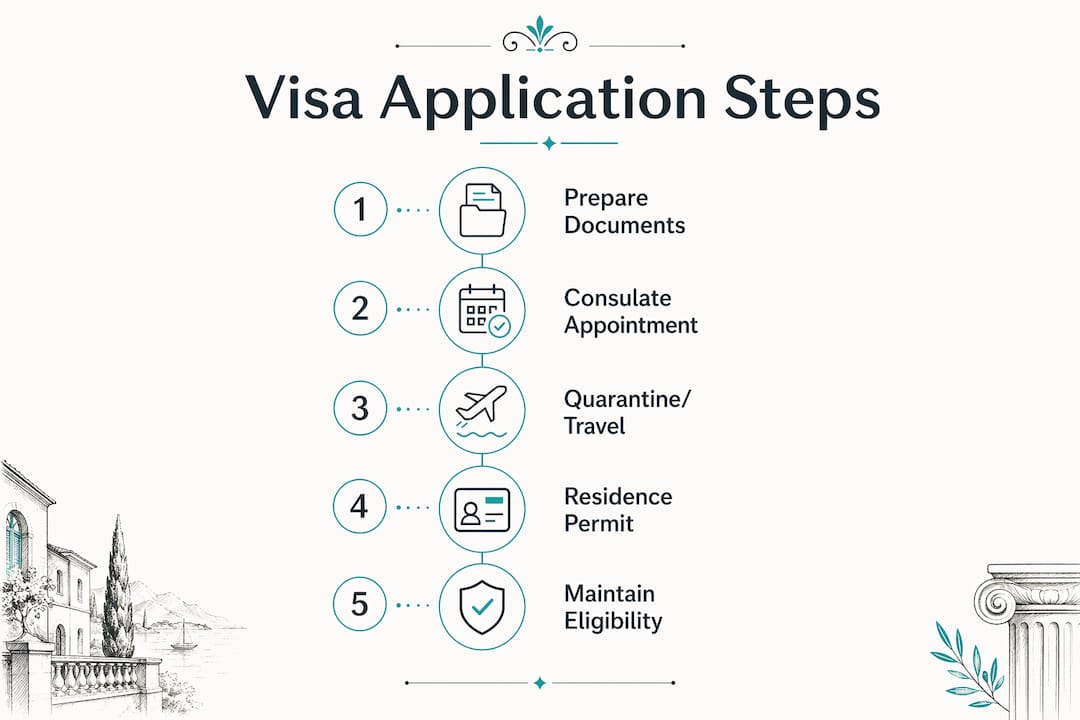
How do you apply for the Italy digital nomad visa from the US?
The process runs in two distinct phases: the consulate application in the US, and the residence permit application once you land in Italy.
Phase 1: Consulate application
- Identify your consulate. Apply at the Italian consulate with jurisdiction over your US state of residence. The Italian Consulate General in New York covers the Northeast; other major consulates serve Chicago, Los Angeles, Houston, and San Francisco.
- Book your appointment. Consulate appointment slots fill weeks or months in advance. Book as early as possible through the consulate’s online portal.
- Compile your full document package. Use the checklist in the eligibility section above. Incomplete packages are the single most common reason for delays.
- Attend the appointment and submit. Bring originals and copies of every document. The consular officer reviews your file and may request additional materials.
- Wait for visa issuance. Processing typically runs 1–3 months, depending on the consulate’s current workload and the completeness of your file.
Phase 2: Residence permit in Italy
Once you enter Italy on your visa, the clock starts immediately.
- Apply for the Permesso di Soggiorno within eight working days of arrival. Missing this window can create administrative complications that affect your legal residence status.
- Submit at the local Questura. Bring the same documentation you presented at the consulate, endorsed by the consular office.
- Complete biometric collection. The Questura schedules a biometric appointment for fingerprints and photographs.
- Receive your permit. The Questura issues the Permesso di Soggiorno, which bears the words “digital nomad” or “remote worker.” Your tax code (codice fiscale) is generated and communicated to you at this stage.
- Begin working legally. You can start working as soon as you submit the residence permit application, without waiting for the physical card.
Processing at the Questura adds another layer of time. Budget 2–4 months from your initial consulate appointment to holding a physical residence permit in hand.
What are your tax obligations as a digital nomad in Italy?
Spending more than 183 days per year in Italy makes you an Italian tax resident, and that triggers a set of obligations you need to plan for before you book your flight.
The most immediate requirement is a VAT number (Partita IVA). Digital nomad permit holders must obtain one to issue invoices, pay social security contributions, and file income taxes in Italy. The VAT number does not come automatically with the residence permit. You request it separately from the Agenzia delle Entrate (Italian Revenue Agency), either directly or through an Italian accountant (commercialista). Any violation found by the Revenue Agency can result in revocation of your residence permit.
Two tax regimes are particularly relevant for digital nomads:
- Regime forfettario (flat-rate regime). A simplified tax structure available to self-employed individuals below a certain annual revenue ceiling. It replaces standard income tax with a flat rate and reduces administrative burden considerably.
- Impatriati regime. A tax incentive for workers who transfer their tax residence to Italy after living abroad. It allows a significant portion of income to be excluded from Italian taxation for a set number of years, subject to eligibility conditions that have been revised in recent years.
Social security contributions follow Italian law by default. However, Italy has bilateral social security agreements with the United States, which may allow you to remain covered under the US Social Security system while working in Italy. Confirm your specific situation with a tax advisor before assuming coverage applies.
The residence permit itself depends on maintaining your income, accommodation, and health insurance throughout the year. A lapse in any of these can trigger non-renewal.
What are the real benefits and limitations of this visa?
The Italy digital nomad visa has genuine advantages over comparable European remote-work permits, but it also carries restrictions that catch applicants off guard.
Benefits:
- The income threshold (approximately €24,789 for a single applicant) is lower than many comparable European programs, making it accessible to a broader range of remote workers.
- The permit is exempt from annual immigration quotas, so you are not competing against a fixed number of slots.
- Family reunification is available, allowing qualifying dependents to join you in Italy.
- After five years of continuous legal residence, you can apply for an EU long-term residence permit, which opens broader mobility across the European Union.
- The permit is renewable annually for up to five years, provided you maintain the qualifying conditions.
Limitations:
- The visa strictly covers remote work for foreign entities. You cannot switch to local Italian employment or convert the permit into a self-employment visa for work within Italy.
- Your residence cannot be interrupted for a continuous period of more than six months, or the permit cannot be renewed.
- Short-term rentals and Airbnb arrangements do not satisfy the accommodation requirement. You need a registered lease or property deed.
- Health insurance must remain active and compliant throughout your stay, not just at the point of application.
The Italian Ministry of Interior has explicitly excluded this category from immigration quotas, reflecting a deliberate policy choice to attract skilled remote workers without affecting traditional labor market controls.
How does the digital nomad visa compare to the self-employment visa?
US applicants sometimes confuse the digital nomad visa with Italy’s traditional self-employment visa (lavoro autonomo). They serve different purposes and carry meaningfully different requirements.
| Dimension | Digital nomad visa | Self-employment (lavoro autonomo) visa |
|---|---|---|
| Eligibility requirements | Highly qualified work for foreign clients/employers; degree or 3–5 years experience | Must meet sector-specific authorization requirements; registration with relevant professional bodies |
| Work clearance (nulla osta) | Not required, simplifying and speeding up the process | Required before visa issuance; adds significant processing time |
| Allowed work scope | Remote work for foreign entities only; no local Italian employment | Independent work within Italy for Italian clients |
| Annual immigration quotas | Exempt | Subject to annual Decreto Flussi quota limits |
| Renewability | Annually renewable up to 5 years | Renewed based on continued authorization and quota availability |
| Tax treatment | VAT number required if tax resident; access to impatriati and forfettario regimes | Standard self-employment tax obligations from the start |
The absence of a nulla osta requirement for the digital nomad visa is the practical difference that matters most. For the self-employment visa, you must first secure work authorization from an Italian administrative authority before the consulate will even issue a visa. That step alone can add months. The digital nomad route skips it entirely, which is why the application process is faster for qualified remote workers.
One more distinction worth knowing: digital nomad status is not convertible to other permit types, including self-employment. If your plans shift and you want to work for Italian clients, you would need to exit and re-apply under a different visa category.
How Livingitaly helps you connect your visa to the right property
Securing the right accommodation is not just a practical matter. It is a legal requirement that directly affects whether your visa application succeeds and whether your permit gets renewed.
The consulate requires a registered lease or property deed covering the full duration of your visa. A short-term rental, a hotel booking, or an informal arrangement will not satisfy this requirement and commonly leads to application denial. That means you need to secure qualifying accommodation before you submit your visa application, not after.
For most US applicants, coordinating a property search from abroad while simultaneously managing a visa application is where things fall apart. Timing matters: you need the lease in place to apply, but you cannot sign a long-term lease until you know your visa timeline. Livingitaly works with international clients to align these two processes, identifying properties that meet consular requirements and structuring lease arrangements that hold up to scrutiny.
If you are considering purchasing rather than renting, the calculus shifts. A property deed satisfies the accommodation requirement and gives you a permanent base, but the purchase process in Italy involves its own legal and fiscal steps. Livingitaly’s advisory team handles property acquisition in Italy from search through closing, including due diligence, legal review, and tax planning for international buyers.
Pro Tip: If you plan to buy property in Italy, start the search at least three to four months before your intended visa application date. The Italian property purchase process, from offer to deed, typically takes 60–90 days, and you will need the deed or a preliminary contract to satisfy the accommodation requirement.
- Prioritize properties with a registered lease already in place if you are renting, since informal or tourist-category contracts do not qualify.
- Confirm with your landlord that the lease will be formally registered with the Agenzia delle Entrate, which is the only registration that counts for visa purposes.
- If you are buying, work with an advisor who understands both the Italian property buying process and the visa documentation requirements simultaneously.
- Keep your income, insurance, and accommodation stable throughout the permit year. Any gap in these conditions creates grounds for non-renewal.
For US applicants weighing the broader European context, the Spanish property market offers a useful comparison point, though Italy’s combination of cultural depth, lower income thresholds, and the quota exemption makes it a strong standalone choice for most remote workers.
Key Takeaways
Italy’s digital nomad visa offers non-EU remote workers a quota-exempt, annually renewable path to legal Italian residency, provided they meet income, insurance, accommodation, and professional qualification requirements before applying.
| Point | Details |
|---|---|
| Quota exemption | The visa sits outside annual immigration limits, so you are not competing for a fixed number of slots. |
| Income threshold | A single applicant needs approximately €24,789 per year from foreign sources to qualify. |
| Eight-day permit window | Apply for the Permesso di Soggiorno within eight working days of arriving in Italy or risk legal residency complications. |
| Accommodation requirement | A registered lease or property deed is mandatory; short-term rentals and informal arrangements lead to rejection. |
| Tax residency trigger | Spending more than 183 days per year in Italy requires VAT registration and Italian income tax compliance. |